Note News: A St. Louis Blues Podcast
Jun 3, 2026 · 1 hr 4 min · 12 segments
The Springfield Thunderbirds turned their season around once Steve Ott took over as head coach, and ended up surprising everyone to not only make the playoffs, but upset two teams to make it to the…
[clears throat] I think that, too, this, this really, um, we're, we're seeing a kind of mirroring of organizational structure as well as, I think, a, a reinforcement of the kind of foundation of, like, what it means to, to play Blues hockey.
'Cause all, all that you're talking about with the, the defensive structure and the, and the buy-in from the players intoUh, you know, how they like to play.
... you know, saw those, uh, impressive win streaks, uh, the season before and then last season as well.
Um, last season, I think they were a bit buoyed more by a, a, like, good defense and good offense.
They were scoring a lot of goals.
Um, but definitely, like, when Jim Montgomery hockey, when Blues hockey is working, I think it is that, that defensive buy-in, that, that team mentality.
Uh, and, and seeing them teach that in the AHL is, like, to me, really exciting and really, uh, enticing as kind of what I would hope a, a, an analytically driven team might, uh, seek to implement, you know, is, is, uh, if you, if you simplify the, the job of being an athlete, you know, is a lot of very quick reactive stuff that you hope you can master and practice so that it can work out, uh, in a, you know, in a fast-paced setting.
Um, the best way to do that, I would say, is to, or I would think, is to start that earlier.
Start that, you know-
... before you even see the NHL ice, uh, is to get used to that kind of style so that it's familiar, and so that when you're coming up, and, you know, that's just, that's development too.
So I don't know.
I think the, what I'm learning from this conversation is I think there's a really concerted effort in the, uh, organizational structure that they're trying to implement Blues hockey on all levels, uh, in all levels that they can control, that is.
And, um, and I think that's a, that to me would be a really good thing for the development of, of these young players, and perhaps why we're seeing the successes of young guys.
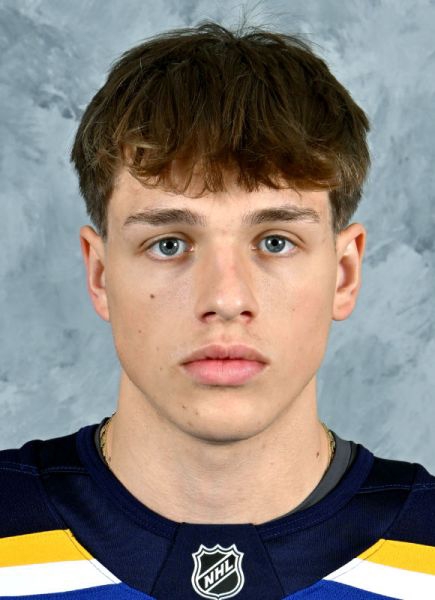
Like, you know, one of the more exciting, I would say, uh, rookie players from this year was, I think Otto Stenberg showed his, showed his salt in a way that I didn't-
... necessarily, uh, I don't know.
He surprised me.
And, and I think, you know, having that time in the AHL, I, I would hope at least helped with that is my, my assertion here.
So I, I don't know.
I think that, um, we're, we're peeking into a little bit the, the minds of, you know, Alex Steen and Doug Armstrong's whole, uh, organism of a, of an organization.
And I kind of see what they're doing, and I, and I, and I kinda like it.
[clears throat] I think that, too, this, this really, um, we're, we're seeing a kind of mirroring of organizational structure as well as, I think, a, a reinforcement of the kind of foundation of, like, what it means to, to play Blues hockey.
'Cause all, all that you're talking about with the, the defensive structure and the, and the buy-in from the players intoUh, you know, how they like to play.
... you know, saw those, uh, impressive win streaks, uh, the season before and then last season as well.
Um, last season, I think they were a bit buoyed more by a, a, like, good defense and good offense.
They were scoring a lot of goals.
Um, but definitely, like, when Jim Montgomery hockey, when Blues hockey is working, I think it is that, that defensive buy-in, that, that team mentality.
Uh, and, and seeing them teach that in the AHL is, like, to me, really exciting and really, uh, enticing as kind of what I would hope a, a, an analytically driven team might, uh, seek to implement, you know, is, is, uh, if you, if you simplify the, the job of being an athlete, you know, is a lot of very quick reactive stuff that you hope you can master and practice so that it can work out, uh, in a, you know, in a fast-paced setting.
Um, the best way to do that, I would say, is to, or I would think, is to start that earlier.
Start that, you know-
... before you even see the NHL ice, uh, is to get used to that kind of style so that it's familiar, and so that when you're coming up, and, you know, that's just, that's development too.
So I don't know.
I think the, what I'm learning from this conversation is I think there's a really concerted effort in the, uh, organizational structure that they're trying to implement Blues hockey on all levels, uh, in all levels that they can control, that is.
And, um, and I think that's a, that to me would be a really good thing for the development of, of these young players, and perhaps why we're seeing the successes of young guys.
Like, you know, one of the more exciting, I would say, uh, rookie players from this year was, I think Otto Stenberg showed his, showed his salt in a way that I didn't-
... necessarily, uh, I don't know.
He surprised me.
And, and I think, you know, having that time in the AHL, I, I would hope at least helped with that is my, my assertion here.
So I, I don't know.
I think that, um, we're, we're peeking into a little bit the, the minds of, you know, Alex Steen and Doug Armstrong's whole, uh, organism of a, of an organization.
And I kind of see what they're doing, and I, and I, and I kinda like it.
The rest of this transcript — segmented and speaker-labeled, so you land on the exact moment something was said
Search every transcript — by keyword, by phrase, or by meaning, across every show Radar indexes
Trends — what is surging across podcasts, measured against its own baseline
Alerts — when a name you follow appears in a newly indexed episode
No account is needed to search Radar.