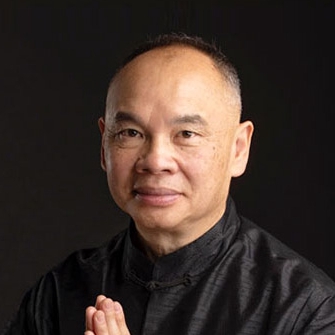
No Sacred, No Secular with Deng Ming-Dao
Jul 13, 2026 · 1 hr 9 min · 14 segments
### **QUICK SUMMARY** What if the world isn't divided into sacred and secular because everything is already sacred? In our first Daoism episode, bestselling author and martial artist Deng Ming-Dao…
### **QUICK SUMMARY** What if the world isn't divided into sacred and secular because everything is already sacred? In our first Daoism episode, bestselling author and martial artist Deng Ming-Dao (*365 Tao*) walks two Catholic hosts through the heart of Daoist practice: why self-cultivation means removing obstacles rather than becoming "better," how the breath bridges body and spirit, what a Daoist diet looks like, and why evil is a human problem, not a divine one. A calm, generous conversation full of unexpected overlaps with the Gospel and a masterclass in listening from a tradition whose word for "sage" literally contains the character for *ear*. ### **IN THIS EPISODE, WE EXPLORE** **\[00:03] From an unhappy kid to a lifelong path.** Ming-Dao found the Tao Te Ching on his mother's bookshelf before his teenage years and kept noticing the word *Tao* everywhere, from Zen texts to art history. What hooked him: a step-by-step system that begins with the physical and leads to the spiritual. **\[00:06] Self-cultivation isn't self-improvement.** The Daoist view: you are already naturally pure and good, but obscured by bad habits, bad ideas, and socialization. "The idea is not to make yourself better. The idea is to divest yourself of these obstacles." **\[00:07] The breath is the bridge.** Purification starts with the body; the breath, both voluntary and involuntary, is the link between body and mind. That's the simple thesis of Qigong. **\[00:12] What transformation actually looks like.** Better health, flexibility, stamina, and calm and a surprising pattern Ming-Dao has seen repeatedly: about a month into practice, students often get sick as the body "pulls the illness out." **\[00:14] A Daoist approach to eating.** Whole grains (in moderation), vegetables in three colors per meal, minimal meat, fermented foods, seasonal adjustment, home cooking over restaurants and skip the alcohol. **\[00:18] "Religious" vs. "philosophical" Daoism is a scholarly construct.** Who cares what your philosophy is if you're decrepit and unhealthy? Ming-Dao explains why he practices without ceremony, superstition, or fear of divine punishment. **\[00:24] "How will you be a person?"** His grandmother's kitchen held both Buddhist and Daoist figures. In Chinese communities, the question was never "How will you be religious?" traditions are shared like neighbors share a street. **\[00:28] What if everything is divine?** Air, water, food, life itself: given to us, unconditionally, by a world we did nothing to earn. "If we really open our eyes, this is a sacred world." **\[00:35] The problem of evil.** Daoism has no existential evil. Natural disasters aren't "evil"; only human behavior is. Which means behavior is a choice, and mercy extends to everyone: "you rescue everybody, both the good and the not good." **\[00:42] Festivals as embedded philosophy.** From Tomb Sweeping Day to the poet's festival in May, the lunar calendar carries Daoist lessons into the whole community, hear a story of honor every year of your life, and you can't help but absorb it. **\[00:48] Fame, "enough," and the useless tree.** Daoism warns against celebrity and status. The parable: useful trees get cut down for timber; the gnarled, "useless" tree survives. **\[00:51] Finding a true teacher.** Why lineage matters, what it was like being the demonstration partner for 13 years, and the master from Huashan who fled the Cultural Revolution to carry his tradition to America. "Even the masters need masters." **\[00:56] Mercy, compassion — can we just say kindness?** Don't hide behind semantics. Kindness to others is kindness to yourself, but kindness is not indulgence, and self-cultivation is not a tool to force yourself into someone else's ideal (the story of the biotech CEO who really wanted to play violin and walk on glaciers). **\[01:03] The art of listening.** What Ming-Dao listens for in every conversation: what the person really wants, a touchstone idea, or permission to be free. ### **ABOUT DENG MING-DAO** Deng Ming-Dao is an author, artist, and teacher whose books, including *365 Tao*, *Chronicles of Tao*, *Scholar Warrior*, *Everyday Tao*, *The Lunar Tao*, and *The Living I Ching*, have been translated into numerous European and Asian languages. Trained in Chinese martial arts since 1975 under teachers from Beijing, Hong Kong, Taiwan, and the Daoist mountains Huashan and Wudangshan, he specializes in the internal arts of Xingyiquan, Baguazhang, and Taijiquan. His forthcoming book, *The Complete Tao Te Ching*, publishes this November from Shambhala. **Connect with Deng Ming-Dao:** dengmingdao.com ### **MEMORABLE QUOTES** "Do you know the Chinese word for sage means somebody who listens well? It has the character for ear in it." — Deng Ming-Dao \[00:00] "The idea is not to make yourself better. The idea is to divest yourself of these obstacles." — Deng Ming-Dao \[00:07] "If we really open our eyes, this is a sacred world, because we are the humble recipients of everything that keeps us alive." — Deng Ming-Dao \[00:31] "Evil is not a divine problem. It is not a holy problem. It is a human problem." — Deng Ming-Dao \[00:36] "That's not kindness. That's indulgence." — Deng Ming-Dao \[01:01] ### **RESOURCES MENTIONED** - **Deng Ming-Dao's website & books:** com <!--THE END--> - **Start here:** *365 Tao: Daily Meditations* — his most popular book, outselling the others six to one after 30 years - **Forthcoming:** *The Complete Tao Te Ching* (Shambhala Publications, November) - **Tao Te Ching** by Lao Tzu — the classic text that started Dave's (and Ming-Dao's) journey - **Concepts to explore:** Qigong (breath training), Taijiquan (Tai Chi), Xingyiquan, Baguazhang, Qingming (Tomb Sweeping Day), the parable of the useless tree (Zhuangzi) - **Next episode:** Michael Rinaldi on holding Daoism and Christianity together as a Daoist priest and Camaldolese Oblate
### **QUICK SUMMARY** What if the world isn't divided into sacred and secular because everything is already sacred? In our first Daoism episode, bestselling author and martial artist Deng Ming-Dao…
- Show signals
- SuitabilityLimited