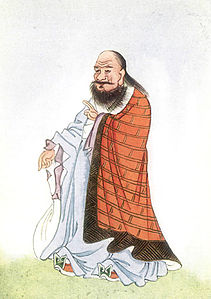
Laozi

Laozi

Chinese philosopherWikipedia

Search complete. 625 mentions across 262 episodes found for "Laozi".

Sep 11, 2026

Ed SpinaGUEST
61:13
I already had Jesus and Mary Magdalene, but I picked out in order-- Well, I put them in order to, to mix and match, uh, male, a male and female, as well as east and west.
Ed SpinaGUEST
61:24
So I picked, uh, Buddha, Mary Magdalene, Lao Tzu, uh, Archangel Michael, Kuan Yin, Saint Germain, Lakshmi, and Jesus.
Ed SpinaGUEST
61:36
And I put them in order as I was, you know, kinda had to number my MP3s, and I would-- so I would need to have an, an introductory, so that'd be module one.
Ed SpinaGUEST
61:44
And then I realized that they had led me to pick these eight, and they put them in, if for those of you who know numerology, they were all in the exact spot they were supposed to be.
Ed SpinaGUEST
61:59
Three, Mary Magdalene.
Ed SpinaGUEST
62:01
Uh, I, and I use her for empowerment.
Ed SpinaGUEST
62:04
Uh, four, Lao Tzu, the balance between work and play.
Ed SpinaGUEST
62:09
Five, Archangel Michael, freedom, cutting the cords that bind you.
Stuart BellNARRATOR
3:21
In the worship of Bacchus we have sacrificed too freely, and we have even transfigured the gory image of Mars.
Stuart BellNARRATOR
3:28
Why not consecrate ourselves to the queen of the camellias and revel in the warm stream of sympathy that flows from her altar? In the liquid amber within the ivory porcelain, the initiated may touch the sweet reticence of Confucius, the piquancy of Lao Tse, and the ethereal aroma of Sakyamuni himself.
Stuart BellNARRATOR
3:52
those who cannot feel the littleness of great things in themselves are apt to overlook the greatness of little things in others the average westerner in his sleek complacency will see in the tea ceremony but another instance of the thousand and one oddities which constitute the quaintness and the childishness of the east to him he was wont to regard japan as barbarous while she indulged in the gentle arts of peace He calls her civilized since she began to commit wholesale slaughter on the Manchurian battlefields.
Stuart BellNARRATOR
4:28
Much comment has been given lately to the code of the samurai, the art of death which makes our soldiers exult in self-sacrifice.

32 MINS LATER

Stuart BellNARRATOR
36:41
The Book of Tea by Okakura Kakuzo Part 2 Taoism and Zenism The connection of Zenism with tea is proverbial.
Stuart BellNARRATOR
37:09
We have already remarked that the tea ceremony was a development of the Zen ritual.
Stuart BellNARRATOR
37:14
The name of Lao Tse, the founder of Taoism, is also intimately associated with the history of tea.
Stuart BellNARRATOR
37:20
It is written in the Chinese school manual concerning the origin of habits and customs that the ceremony of offering tea to a guest began with Quan Yin, a well-known disciple of Lao Tse, who first at the gate of the Han Pass presented to the old philosopher a cup of the golden elixir.
Jay AbbasiHOST
6:59
They will say, we did it ourselves.
Jay AbbasiHOST
7:05
That's a modified quote of Lao Tzu, who is a Taoist philosopher.
Jay AbbasiHOST
7:13
I've adjusted it for our modern times.
Jay AbbasiHOST
7:15
And what he's pointing to is that the leader who doesn't spotlight themselves, who doesn't attempt to take credit, and instead their people say we did it, that's what true leadership looks like.
Ed SpinaGUEST
61:49
Well, I put them in order to, to mix and match, uh, male, a male and female, as well as East and West.
Ed SpinaGUEST
61:56
So I picked, uh, Buddha, Mary Magdalene, Lao Tzu, uh, Archangel Michael, Kuan Yin, Saint Germain, Lakshmi, and Jesus.
Ed SpinaGUEST
62:08
And I put them in order as I was...
Ed SpinaGUEST
62:09
You know, kinda had to number my MP3s, and I would, I would need to have an, an introductory, so that'd be module one.
Ed SpinaGUEST
62:31
Three, Mary Magdalene.
Ed SpinaGUEST
62:33
Uh, and I use her for empowerment.
Ed SpinaGUEST
62:36
Uh, four, Lao Tzu, the balance between work and play.
Ed SpinaGUEST
62:41
Five, Archangel Michael, freedom, cutting the cords that bind you.
Ed SpinaGUEST
58:45
I already had Jesus and Mary Magdalene, but I picked out in order-- Well, I put them in order to, to mix and match, uh, ma- a male and female, as well as East and West.
Ed SpinaGUEST
58:56
So I picked, uh, Buddha, Mary Magdalene, Lao Tzu, uh, Archangel Michael, Kuan Yin, Saint Germain, Lakshmi, and Jesus.
Ed SpinaGUEST
59:07
And I put them in order as I was, you know, kinda had to number my MP3s, and I would, I would need to have an, an introductory, so that would be module one.
Ed SpinaGUEST
59:15
And then I realized that they had led me to pick these eight, and they put them in, if for those of you who know numerology, they were all in the exact spot they were supposed to be.
Ed SpinaGUEST
59:31
Three, Mary Magdalene.
Ed SpinaGUEST
59:32
Uh, and I use her for empowerment.
Ed SpinaGUEST
59:36
Uh, four, Lao Tzu, the balance between work and play.
Ed SpinaGUEST
59:40
Five, Archangel Michael, freedom, cutting the cords that bind you.
San QingGUEST
2:39
That's kind of nuts.
San QingGUEST
2:40
That's like Lao Tzu just riffing right there, just bang, "Send this to him right now." I'm like, "Okay.
San QingGUEST
2:47
Done."
Guy LawrenceHOST
2:47
[laughs] W- well, to kick off the conversation, where we, we were speaking off air a little bit, we were talking about the, the, the difference within surrender or being submissive, even getting to the, this chase for, you know, experience, enlightenment.
Wayne DyerSOUNDBITE_SPEAKER
33:53
Every challenge you face, every obstacle you encounter, every moment when you feel like you can't go on, all of it is part of a plan far greater than our limited minds can comprehend.
Wayne DyerSOUNDBITE_SPEAKER
34:05
Lao Tzu, the great Chinese philosopher, once said, "When I let go of what I am, I become what I might be." And that's exactly what has happened to you.
Wayne DyerSOUNDBITE_SPEAKER
34:15
You've let go, perhaps not willingly, perhaps forced by life itself.
Wayne DyerSOUNDBITE_SPEAKER
34:20
But in that letting go, you've created space.
speaker_3NARRATOR
58:26
TAUISM.
speaker_3NARRATOR
58:46
meanwhile other influences had been helping to divert the attention of the chinese people from the simple worship of god and of the powers of nature the philosophy associated with the name of lao tzu who lived nobody knows when probably about b c six hundred which is popularly known as taoism from tao the omnipresent omnipotent and unthinkable principle on which it is based operated with confucianism though in an opposite direction in dislimining the old faith while putting nothing satisfactory in its place confucianism with its shadowy monotheistic background was at any rate a practical system for everyday use and it may be said to contain all the great ethical truths to be found in the teachings of christ Lao Tzu harped upon a doctrine of inaction by virtue of which all things were to be accomplished, a perpetual accommodation of self to one's surroundings with the minimum of effort, all progress being spontaneous and in the line of least resistance.
speaker_3NARRATOR
59:50
Such a system was naturally far better fitted for the study where the fact of it has always remained, than for use in ordinary life.
speaker_3NARRATOR
59:58
In one of the few genuine utterances of Liao Tzu, which have survived the wreck of time, we find an allusion to a spiritual world.
speaker_3NARRATOR
62:43
YES, THIS IS THE KEY TO MY THEME." This view naturally suggested the prolongation of earthly life by artificial means, hence the search for an elixir carried on through many centuries by degenerate disciples of Taoism.
speaker_3NARRATOR
63:00
But here we must pass on to consider some of the speculations on God, life, death, and immortality indulged in by Taoist philosophers and others who were not fettered, as the Confucianists were, by traditional reticence on the subject of spirits and an unseen universe.
speaker_3NARRATOR
63:17
mozu a philosopher of the fourth and fifth centuries b c was arguing one day for the existence of spirits with a disbelieving opponent all you have to do he said is to go into any village and make inquiries from of old until now the people have constantly seen and heard spiritual beings how then can you say they do not exist if they had never seen nor heard them could people say they existed of course replied the disbeliever many people have seen and heard spirits but is there any instance of a properly verified appearance mozu then told a long story of how king who swan b c eight twenty seven two seven eighty one unjustly put to death a minister and how the latter had said to the king if there is no consciousness after death this matter will be at an end but if there is then within three years you will hear from me three years later at a grand dubar the minister descended from heaven on a white horse and shot the king dead before the eyes of all chuang tzu the famous philosopher of the third and fourth centuries b c and exponent of the tao of lao tzu has the following allusions to god of course as seen through taoist glasses god is a principle which exists by virtue of its own intrinsicality and operates spontaneously without self-manifestation he who knows what god is and what man is has attained knowing what god is he knows that he himself proceeded therefrom knowing what man is he rests in the knowledge of the known waiting for the knowledge of the unknown the ultimate end is god he is manifested in the laws of nature he is the hidden spring at the beginning of all things he was taoism however does not seem to have succeeded altogether any more than confucianism in altogether estranging the chinese people from their traditions of a god more or less personal whose power was the real determining factor in human events the great general siang yu B.C. 233-202, said to his charioteer, at the battle which proved fatal to his fortunes, I have fought no fewer than seventy fights, and have gained dominion over the empire.
speaker_3NARRATOR
65:38
That I am now brought to this pass is because God has deserted me.
John VespasianHOST
0:10
It is almost the opposite.
John VespasianHOST
0:12
From reading Lao Tzu, I became fascinated by his metaphor of water.
John VespasianHOST
0:16
Lao Tzu observed that water doesn't struggle against the world.
John VespasianHOST
0:20
Instead of fighting, it finds the path of least resistance.
John VespasianHOST
0:23
Also in Chuang Tzu, I found stories about people who become more effective because they stop forcing things.
John VespasianHOST
3:41
I try to be like water.
John VespasianHOST
3:42
I've tried to imitate the flexibility of water in everything I do.
John VespasianHOST
3:46
Lao Tzu's thoughts about water had a huge impact on me.
John VespasianHOST
0:10
It is almost the opposite.
John VespasianHOST
0:12
From reading Lao Tzu, I became fascinated by his metaphor of water.
John VespasianHOST
0:16
Lao Tzu observed that water doesn't struggle against the world.
John VespasianHOST
0:20
Instead of fighting, it finds the path of least resistance.
John VespasianHOST
0:23
Also in Chuang Tzu, I found stories about people who become more effective because they stop forcing things.
John VespasianHOST
3:41
I try to be like water.
John VespasianHOST
3:42
I've tried to imitate the flexibility of water in everything I do.
John VespasianHOST
3:46
Lao Tzu's thoughts about water had a huge impact on me.

252 more episodes mention Laozi.

Create an account to see the whole feed, search across every transcript, and follow the entities you care about.

We value your privacy

We use cookies to understand how you use our platform and to improve your experience. Click “Accept All” to consent, or “Decline non-essential” to opt out of non-essential cookies. Read our Privacy Policy.