🎙️#18 Prof. Peter Tse: How Imagination Made Us Human
Oct 4, 2026 · 1 hr 31 min · 11 segments
Peter Ulric Tse is a Professor of Cognitive Neuroscience in the Department of Psychological and Brain Sciences at Dartmouth College, currently on sabbatical as a visiting professor at Cambridge and a…
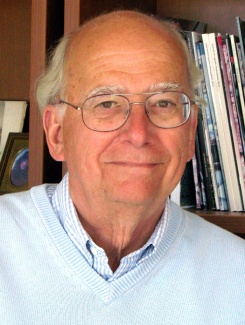
Peter Ulric Tse is a Professor of Cognitive Neuroscience in the Department of Psychological and Brain Sciences at Dartmouth College, currently on sabbatical as a visiting professor at Cambridge and a Visiting Fellow at Clare Hall. A Guggenheim and Humboldt Fellow, he studies attention, visual consciousness and volition, and has spent over fifteen years building a naturalistic case for libertarian free will, beginning with The Neural Basis of Free Will: Criterial Causation (MIT, 2013). He is now two volumes into a trilogy: A Neurophilosophy of Libertarian Free Will and Free Imagination (both OUP, 2024), with Re-enlightenment to follow. * * * In this conversation, I sit down with Peter to explore the idea at the heart of Free Imagination: that what makes humans free is not intelligence but imagination, our capacity to model what is not, has never been, and could not be. We start with bonobos sitting miserably in the rain and the Löwenmensch, a 40,000-year-old carving of a lion-headed man, and trace how tool-making may have forged an internal virtual avatar that lets us act in imagination long before we act in the world. Peter takes apart the Libet experiments and the case against free will made by Sapolsky and Gazzaniga, arguing that the real action lies not in split-second choices but in distal, deliberative imagining. We explore the brain's planning and willpower systems, efference copy and schizophrenia, Kundalini yoga, and why lobotomised patients simply stopped acting. Then the conversation turns to culture: whether our imaginations are sovereign, Edward Bernays and The Century of the Self, why some stories grip us from beneath, and Peter Singer's expanding circle. This is a conversation for anyone who suspects the imagination is both our greatest tool and our greatest weapon, and wants to know whether we can learn to wield it freely. * * * 🔗 Links \- Website: https://sites.dartmouth.edu/peter/ \- Free MOOC: https://www.youtube.com/playlist?list=PLBZk0Jl545845TCxtkEbJQ7bTJTqi\_HrF * * * ⏳ Timestamps: 00:00 Intro - Free will, imagination and the crack in the animal mind 00:47 What can we learn from bonobos sitting in the rain? 04:37 Defining imagination: our internal virtual reality 07:47 The Default Mode Network, daydreaming and the ego 11:08 From mental workspace to the Löwenmensch 14:27 Hand axes, Homo erectus and the slow birth of imagination 17:19 Our greatest tool and our greatest weapon: escaping the reptilian trap 22:14 Free Imagination: the internal avatar and the evolution of tool-making 24:54 Has neuroscience been barking up the wrong tree? 26:54 Libet, the readiness potential and the case against free will 32:31 Distal decisions: where free will really lives 34:34 Baseball, Sapolsky and learning Spanish: why past imagining still counts 38:27 Why volitional attention needs consciousness 39:59 Split brains, Gazzaniga and the interpreter 43:34 Efference copy and schizophrenia: did I do that? 47:14 Planning, priorities and the neuroscience of willpower 52:18 Lobotomies, akinetic mutism and the fire in the belly 55:57 Ritual, Jung and the gods and madness of the imagination 57:52 Breath, Kundalini yoga and training the will 1:00:30 Is your imagination sovereign? 1:01:56 Edward Bernays, The Century of the Self and propaganda 1:04:42 Why do some stories capture us? 1:07:49 Peter Singer's expanding circle 1:12:24 New religions for an expanding circle 1:16:12 The unconscious and the elves in the basement 1:18:59 Emotions, desires and cybernetic beings 1:21:31 Anagnorisis, storytelling and why Harari is wrong 1:24:19 Globalism and the merging of the world's religions 1:27:26 Peter's guest recommendations: Carolyn Dicey Jennings and Eddy Nahmias 1:28:23 Where to find Peter
Peter Ulric Tse is a Professor of Cognitive Neuroscience in the Department of Psychological and Brain Sciences at Dartmouth College, currently on sabbatical as a visiting professor at Cambridge and a…
- Show signals
- Audience≈209k followers