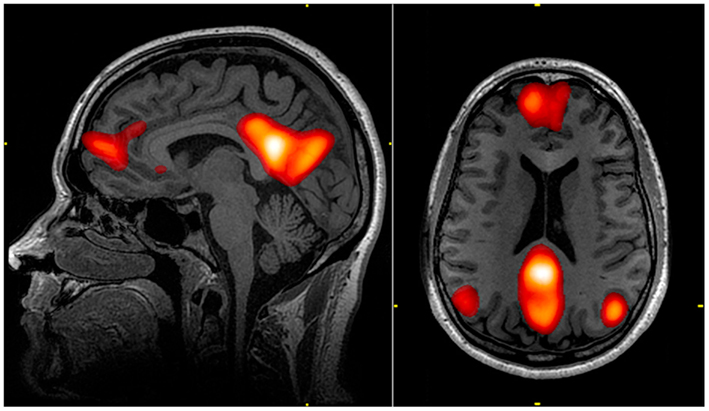
default network
236
MENTIONS
50
EPISODES
41
PODCASTS
Search complete. 236 mentions across 50 episodes found for "default network".
Sep 11, 2026

Gwen WildGUEST
Yes.
Gwen WildGUEST
Well, research shows us that when we are bored, you know, lacking stimulation, this engaging and meaningful, it turns on the default mode network of our brain.
Gwen WildGUEST
which isn't a specific structure, but it's just a connection of different structures.
Gwen WildGUEST
And it lights up and that turns on.
Gwen WildGUEST
And when that default mode network is active, that's when we're able to process our thoughts.
Gwen WildGUEST
It's what helps us figure out ourself, like who am I? What do I care about? It's the whole theory of mind happens within this default mode network.
Gwen WildGUEST
So there's a lot of really important things when we get to that place where the default mode network is active.
Gwen WildGUEST
The opposite of that is the task.

speaker_2HOST
We're seeing that this podcast is growing, so I thought we had another episode this week.
speaker_2HOST
Today, we're looking at the Brains Idle Engine, the default mode network.
speaker_2HOST
We'll see what this is all about.
speaker_2HOST
By the way, if you want to learn more about psychodynamic concepts in psychology, go to my sub stack, Psychodynamic Observations.
speaker_2HOST
But new functional neuroimaging revealed the opposite.
speaker_2HOST
Whenever a subject stops solving external puzzles or tracking environmental stimuli, a coordinated ensemble of brain regions surges into synchronized metabolic activity.
speaker_2HOST
Coined the default mode network, this system acts as the biological foundation for self-referential thought and autobiographical memory and perspective taking.
speaker_2HOST
The network revolves around three primary anatomical hubs, the medial prefrontal cortex, the evaluator of the self, so it processes social judgments, personal identity, moral decisions, the posterior cingulate cortex, and the precuneus, the central integration exchange.

MikeHOST
I mean, it is going to be pretty eye opening for some of you thirds.
MikeHOST
Now, the default mode network, the brain that won't shut up, that's what we'll call it.
MikeHOST
Because the DMN is the system that runs when you're not actively doing a task.
MikeHOST
It's basically your resting state.
MikeHOST
Research on insomnia rates in high IQ populations, they show significantly higher prevalence compared to average IQ controls.
MikeHOST
Now, not because of anxiety necessarily, right? But...
MikeHOST
It's because that DMN, the default mode network, is still running interesting threads when the rest of the nervous system is trying to shut down for the night.
MikeHOST
I mean, the brain will not stop being interesting to itself and highly, highly intelligent people.

Josh KordaHOST
The highest, most difficult model of all is the story of who we are and the idea that these are my thoughts and my actions.
Josh KordaHOST
Um, a network in our brain that's extremely important to know is called the default mode network, and it's strongly associated with autobiographical memory, imagining the future, reflecting on ourselves, thinking about other people's minds, and so forth.
Josh KordaHOST
When we aren't focused on the outside world, this region, the default mode, um, switches on.
Josh KordaHOST
It becomes active.
5 MINS LATER
Josh KordaHOST
But those messages are s- very similar to our thoughts.
Josh KordaHOST
There is no I creating those thoughts.
Josh KordaHOST
They're simply thoughts arising, and then some language is adding an I to it, just like the way our default mode network adds the sense of an I subsequently to our thoughts.
Josh KordaHOST
There are no, there's no thinker.

speaker_3HOST
You desperately need time to process, synthesize, and break down what you've actually consumed.
speaker_3HOST
When you walk in silence, your mind transitions into what neuroscientists call the default mode network, or the DMN.
speaker_2HOST
I've actually heard of the default mode network, but how does it actually function in this context? Like, why is it specifically triggered by walking in silence?
speaker_3HOST
So when you are focused on a task, like reading a tweet, answering an email, or watching a video, your brain activates the task positive network.
speaker_3HOST
It's great for immediate execution, but it's terrible for big picture thinking.
speaker_3HOST
When you remove external stimuli, when you just put one foot in front of the other with absolutely no goal, that spotlight turns off and the default mode network powers on.
speaker_3HOST
The DMN is more like a lantern.
speaker_2HOST
Ah, so it illuminates everything softly.

Tim DyerGUEST
And you, all of a sudden, you will start thinking naturally self-protective type thoughts in this moment, if that's the way that this is presented to you.
Tim DyerGUEST
Do some work on this, you know, pull out your own clod or copilot or whatever you want and dial in what's called the default mode network, the DMN.
Tim DyerGUEST
It's the new neuroscience on this.
Tim DyerGUEST
The DMN is the neural pathway that keeps us safe.
Tim DyerGUEST
that shapes the way in which we respond to any threat.
Tim DyerGUEST
And one of the interesting pieces of work that's been done on this in religious and also political contexts is when you get challenged about what is important to you in terms of your religious beliefs, your faith position, your sense of identity, you react very strongly to that threat, unlike a threat in other areas.

Manaan KarrayHOST
Yeah.
speaker_1UNKNOWN
But to do that effectively, the CEN has to shut down another major system, the default mode network, or DMN.
Manaan KarrayHOST
The library.
speaker_1UNKNOWN
The library, yes.
speaker_1UNKNOWN
The DMN has its hubs in the medial prefrontal cortex and the posterior cingulate.
speaker_1UNKNOWN
It is the network of resting wakefulness.
Manaan KarrayHOST
Right.
speaker_1UNKNOWN
When you stare out the window and let your mind wander or recall an embarrassing thing you said 10 years ago, that is the DMN humming away.

Jade TetaHOST
And is this also correlated to, I'm assuming, but I just want to just spell it out.
Jade TetaHOST
So you're watching the DMN, if you're watching something, and the more disorganized this gets, is that correlated with the chance also of ego dissolution, where someone would actually say and feedback to you as the scientist to say, hey, look, I was completely dissolved and felt connected to everything and did not know where Jade began and everything else.
Jade TetaHOST
So this Change in default mode network is correlated with ego dissolution.
Jade TetaHOST
And also, it sounds like you're saying that's also correlated with degree of efficacy on some of these things that we'll talk about here in a minute, like depression and trauma and anxiety and things like that.

speaker_0HOST
So my brain is just sampling those tracks and mashing them together.
speaker_1HOST
What's fascinating here is that this remixing ability, scientists call it prospection, is heavily driven by a network in your brain called the default mode network or the DMN.
speaker_1HOST
The
speaker_0HOST
DMN.
speaker_1HOST
Yeah.
speaker_1HOST
From an evolutionary standpoint, the human brain operates as relentless prediction machine.

speaker_1HOST
That feels deeper than copy and paste.
speaker_0GUEST
And that case file idea opens the door to the next network, the default mode network.
speaker_1HOST
The name makes it sound like screensaver mode.
speaker_0GUEST
Yeah, misleading, I know.
40 more episodes mention default network.
Create an account to see the whole feed, search across every transcript, and follow the entities you care about.