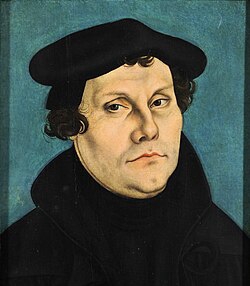
A little more than 500 years ago, an Augustinian friar in a little town that had a new university supposedly nailed, we don't know for sure how he circulated them, but I like the story and it's hopefully true, supposedly nailed the 95 theses which would become famous on the castle church door in Wittenberg.
He did that because that was like the bulletin board for the town and for the university and for the churches.
It's where you would advertise things.
It's where you would put theses, statements to be debated.
And this friar did that because at the time there were these things being sold called indulgences.
And we'll circle back to that.
But an indulgence was something that was meant to help you get out of purgatory or help a loved one get out of purgatory.
And in the medieval church, there was taught that there was hell.
If you went to hell, you were there forever.
That was bad news.
and there was purgatory, and the good news of purgatory was you were eventually going to heaven, but it could be quite a while, and your sins were going to be purged while you were there, and then there was heaven, and very few people, it was thought, made it right into heaven.
Only the real, the true saints made it right into heaven, and so indulgences were supposed to come from the what was called the treasury of the merits of Christ and the saints, the works that Jesus and the saints had done that went above and beyond what was necessary, and indulgences allowed these works to be applied to you or to a loved one.
Early on, these indulgences were associated with doing good works, going on a pilgrimage, giving to the poor, something like that, but with time, they became more and more transactional so that at Luther's time there was a man named Tetzel who was basically just selling these indulgences for money and using rather crude slogans as he did so and he wasn't allowed to sell these indulgences in Luther's territory because his prince had quite the collection of relics and you got indulgences for seeing those relics and so his prince didn't want to hurt that business but But people from Luther's parish were traveling into the next territory to purchase these indulgences.
And then they were coming back to Luther confident that they had done something good, that their time or the time of their loved ones in purgatory had been diminished to some degree.
And they placed their trust, their confidence in these indulgences.
And Luther was very troubled by this.
He was very troubled by the fact that their confidence was being placed into these sheets of paper rather than in Christ and that some thought, well, I don't need to repent now because I've already got this paper that will help spring me from purgatory.
But some would support him.
Some would even die for the confession of faith that Luther found in Scripture and preached.
They would be handed over.
They would be persecuted.
They would be killed.
The rest of this transcript — segmented and speaker-labeled, so you land on the exact moment something was said
Search every transcript — by keyword, by phrase, or by meaning, across every show Radar indexes
Trends — what is surging across podcasts, measured against its own baseline
Alerts — when a name you follow appears in a newly indexed episode
No account is needed to search Radar.