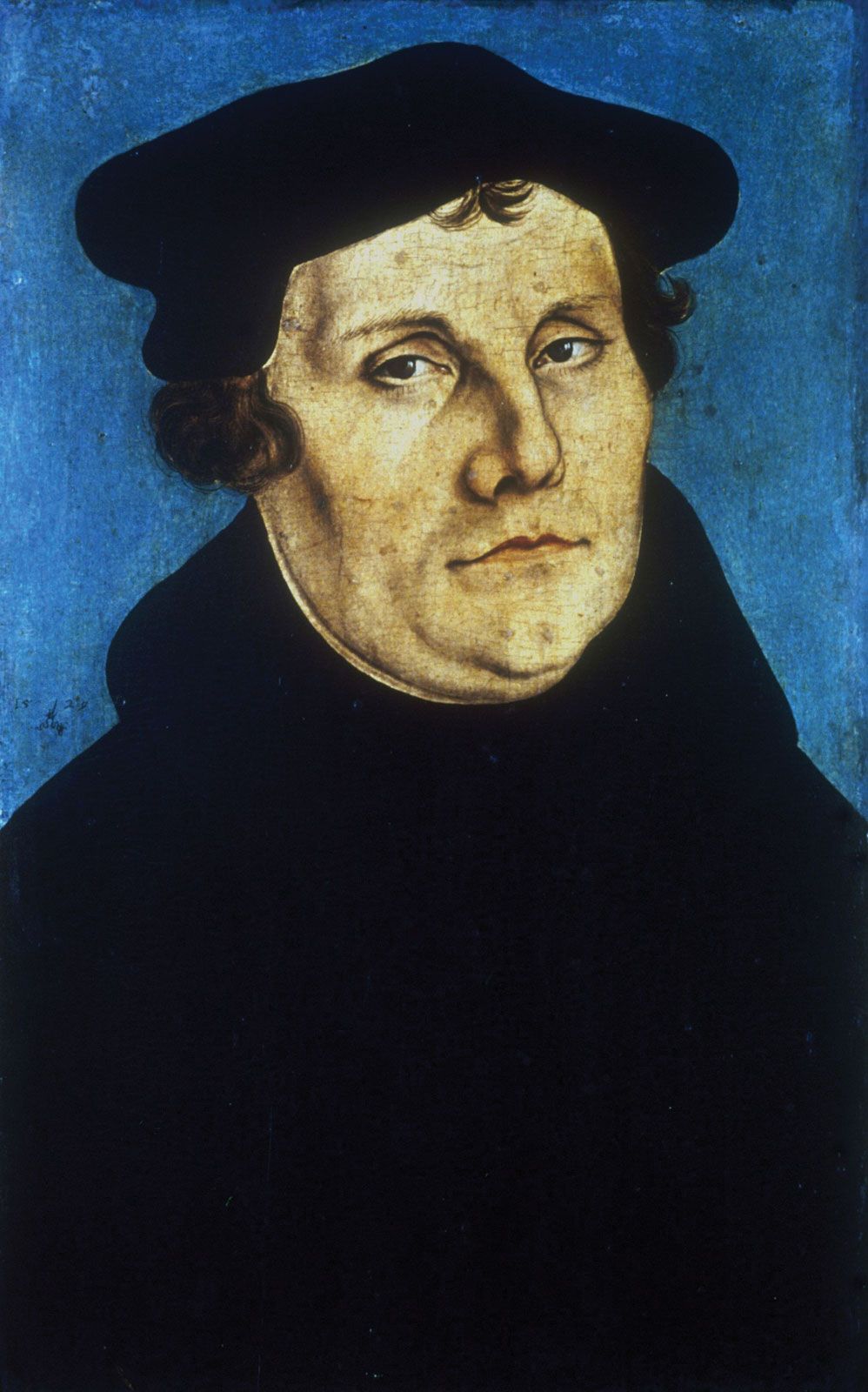
Martin Luther
German priest and theologianWikipedia
3.2k
MENTIONS
951
EPISODES
741
PODCASTS
Search complete. 3166 mentions across 951 episodes found for "Martin Luther".
Oct 27, 2026

Michael ReevesGUEST
In this session, we're going to look at the different views of Scripture held by the Roman Catholic Church and the Reformers.
Michael ReevesGUEST
Now, when Luther began his protest just over 500 years ago, he was addressing a church in Rome that affirmed Scripture's authority and inspiration.
Michael ReevesGUEST
So what was it about Luther's thought that was so different, so offensive to the Roman church? Well, Luther had the audacity to say that scripture alone is the supreme and inerrant authority.
Michael ReevesGUEST
While popes and councils err, scripture alone does not.
Michael ReevesGUEST
And so what distinguished the reformers from Rome was their claim that as important as tradition is, and they thought tradition was very important, tradition is not without error.
Michael ReevesGUEST
And because Scripture is the entirely trustworthy Word of God, Scripture alone is the church's ultimate authority, sufficient for faith and practice.
Michael ReevesGUEST
Now, the question of authority was critical in the Reformation.
Michael ReevesGUEST
So critical, it was the very heart of Luther's early key debates in the very first years of the Reformation.

Winston MarshallGUEST
Part one was the Enlightenment, and you have the likes of Edward Gibbon and Voltaire, who claim the...
Winston MarshallGUEST
Sorry, actually, part one was the Reformation, sorry, with Martin Luther, who... said anything to do with the Catholic Church was evil.
Winston MarshallGUEST
So he put the Crusades in that camp, although he did slightly change his tune on the Siege of Vienna, rather ironically.
Winston MarshallGUEST
Then part two is the Enlightenment with the likes of Edward Gibbon and Voltaire, who, because they become sort of more materialist, they find it harder and harder to understand how anyone could do anything for spiritual reasons, because they themselves, I think, could relate to that less.

Chuck MisslerHOST
He very appropriately did this deliberately on Halloween, on October 31st.
Chuck MisslerHOST
His name, of course, was Martin Luther.
Chuck MisslerHOST
Now the leadership at that time didn't like the implications of his views and ultimately the Diet of Worms, the Diet is a council and Worms is a location, don't get the wrong idea.
Chuck MisslerHOST
They excommunicated him as a heretic.
Chuck MisslerHOST
and they picked the four best plays and we haven't, I think we have them all somewhere, but the point is the four best are packaged for anyone that would like to promote that within their group somewhere.
Chuck MisslerHOST
It's available as an alternative diversion.
Chuck MisslerHOST
Another thing that's also worth doing, we haven't packaged a play for this, but it wouldn't be hard for an alert high school group to do their own research and write a play about Martin Luther and tie it to October 31st.
Chuck MisslerHOST
That's another possibility.

Scott RankHOST
Now, one thing that stops the proliferation of books isn't censorship as you explained, but they're still very expensive well into the 18th century.
Scott RankHOST
It's not as if Martin Luther invents the printing press and books are as cheap as anything we buy at Tesco or Walgreens today.
Scott RankHOST
Because paper is still expensive into the 18th century.
Scott RankHOST
You're relying on linen and cotton rags.

Karla AdcoxHOST
This has been a big topic, and we have had to break it up into multiple episodes in order to really do a deep dive.
Karla AdcoxHOST
And so up to this point, just to kind of give you guys a recap, we've hit Luther, we've hit Zwingli, we've hit Calvin, and we kind of ended the last episode talking about a little bit of a side conversation on baptism.
Karla AdcoxHOST
So Mike, why don't you just segue us in to a quick recap on the baptism? Because I know that's going to lead into our next topic, which is going to continue us down the path of the Reformation.
Mike ChuGUEST
So I wanted to just bring this up because it's been a little bit of a while since we talked about this, but I think the next conversation we're having, this is a related topic because baptism and the upcoming topic has always been a very divisive issue within the church broadly, at least in Western Christianity, which is ironic.
Karla AdcoxHOST
And that was the main point of kind of tension between these branches that you explained in previous episodes.
Karla AdcoxHOST
So my curiosity and my question to you is, if baptism was a point of contention, were some of the other key sacraments a point of contention, things like the Lord's Supper or other things like that, knowing that baptism was definitely an issue? Yeah.
Mike ChuGUEST
Yeah, so as a reminder as well for folks is that the three major Reformation fathers, Luther, Zwingli, and Calvin, they all agreed about the concept of baptism.
Mike ChuGUEST
They did not think that believers' baptism, for example, was necessarily something that people should do.

Gerald HiestandGUEST
Right.
Gerald HiestandGUEST
So, you know, Luther will say it's the doctrine upon which the church stands or falls.
Gerald HiestandGUEST
Calvin says it's the hinge upon which religion turns.
Gerald HiestandGUEST
And so it's, The reformers really zeroed in on the doctrine of justification, I think, because they saw that there was – I'm trying to think how to answer this without – getting too broad in the question, which I'm trying to answer in the book itself.
27 MINS LATER
Gerald HiestandGUEST
When you read through the New Testament, you have to be able to reckon with the fact that Paul uses the term a little bit differently than how James uses the term a little bit.
Gerald HiestandGUEST
And trying to just force every author to use it in exactly the same way is not going to get you good readings.
Gerald HiestandGUEST
I would take that same principle and I would apply it to Paul, because I think that Paul has a way of using the language of justification that fits very comfortably with the Protestant kind of reformed or Lutheran account of justification.
Gerald HiestandGUEST
But he also has a way of using justification that frankly doesn't fit very well, that does very much imply ontological renewal and regeneration.

Robby GallatyHOST
Outside of Israel, probably one of the best trips we've ever been on.
Robby GallatyHOST
Because you're at the epicenter of Protestantism with Martin Luther.
Robby GallatyHOST
We went to the church where Martin Luther nailed the 95 theses.
Robby GallatyHOST
I got to preach in the actual church Martin Luther preached in more than any other church in the world.
Robby GallatyHOST
Did you
Adam FrenchHOST
preach to our people or like everybody? No, our
13 MINS LATER
Robby GallatyHOST
Pause here for a second.
Robby GallatyHOST
This is what the Reformation was all about.

Tommy CreutzHOST
So I'm thinking back to the Protestant Reformation.
Tommy CreutzHOST
You get guys who are coming out of the Roman Catholic church and you get like Ulrich Zwingli, who's a Swiss reformer, and he has a disagreement with John Calvin, who has a disagreement with Martin Luther.
Tommy CreutzHOST
So Luther, Germany, Calvin, French.
Tommy CreutzHOST
And they have their unique kind of takes on certain things.
15 MINS LATER
Tommy CreutzHOST
Like Menno Simons.
Jeff BucknamHOST
Mm-hmm.
Tommy CreutzHOST
was why they call them Mennonites and Martin Luther's, why they call them Lutherans.
Tommy CreutzHOST
LNG White.

Skip HeitzigHOST
Only two did, and they lived to tell about it.
Skip HeitzigHOST
Martin Luther said, with God, one is always a majority.
Skip HeitzigHOST
And that's how David lived his life.
Skip HeitzigHOST
David saw a giant named Goliath.

Will WeedonHOST
And folks, the biggest part of our proclaiming his praises is joining together in the church's liturgy and hymns, Joining the generations that have come before us in singing the new song, even though it's been sounding for centuries, it remains new because it makes of us new men and women.
Will WeedonHOST
Martin Luther, the foremost reformer of Christ's church in the 16th century, wrote, This is the new song about the new kingdom, new creatures, new men, born not of law or of works, but of God and of the Spirit, who themselves are miracles and who work miracles in Jesus Christ our Lord.
Will WeedonHOST
And because the Holy Ghost commands us all to sing, it is certain that he also commands us to believe in the miracles.
Will WeedonHOST
Listen, says the Spirit, for you, for you, for you, it was done.
941 more episodes mention Martin Luther.
Create an account to see the whole feed, search across every transcript, and follow the entities you care about.