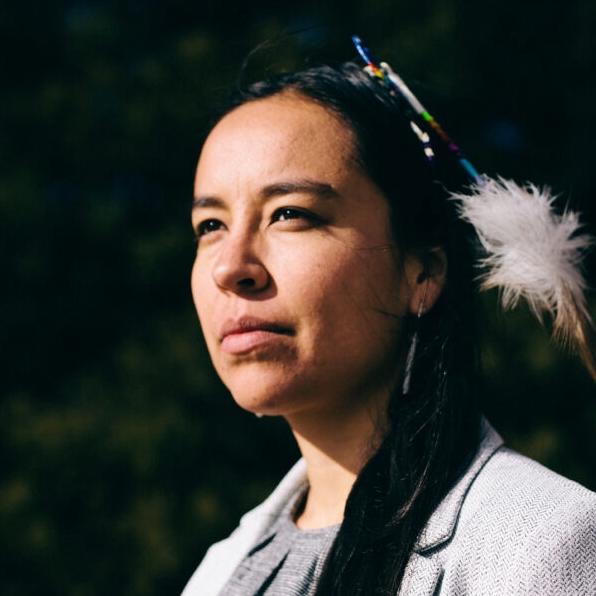
Lyla June JohnstonHost
Margo RobbinsGuestSo the first case study I'm gonna talk about is the American Tallgrass Prairie.
This is the f- a burn they're doing at the University of Kansas, and the American Tallgrass Prairie is verifiably fire dependent.
And the American Tallgrass Prairie is very beloved by ecologists and other people around the world, and it's a very endangered ecosystem.
Because when you put out the fires, you take away everything that goes along with it.
So different plants like big bluestem and, quote-unquote, "Indian grass" store about 80% of their biomass underground.
So when fires sweep through, they burn off the dead material above the surface, leaving the extensive root systems intact to re-sprout rapidly.
It also reduces what they call woody plants, such as invasive trees and shrubs that are not adapted to frequent burning.
And without these fires, encroaching trees shade out the native sun-loving grasses.
So when you burn off those shrubs and invasive trees, those sun-loving grasses are able to thrive again.
Again, if you don't burn, those grasslands collapse into shrublands or tiny forests.
It also supports thatch removal, so dead grasses and stems accumulate over the years, forming a thick mat on the prairie floor called thatch.
Fire consumes this layer, allowing vital sunlight and warmth to reach the soil and to reach emerging seedlings.
So I think we've all seen that in some really dense grasslands are just kind of a mat underneath, and sometimes that needs a little bit of cleansing and aeration to get a little bit of breathing room again.
If they don't have fire, they're not gonna function the way they're used to for thousands of years.
There's estimates that in Montana, Nebraska, South Dakota, Texas, Kansas, that the, based on the topsoils we find, black topsoils in the intact regions that haven't been plowed up for wheat, that these soil systems are up to 1,000 years old being regeneratively fed by indigenous fire for thousands of years, which is why they're more black, 'cause they have all that ash built up inside of them.
And so we estimate that native peoples have been burning the Tallgrass Prairie for centuries as a living heirloom, a living soil heirloom they pass on from generation to generation So when the colonizers came, they're like, "Oh, cool.
I'm gonna plant some wheat, and I'm gonna plow it all up." They didn't realize they're actually, or maybe they did, I don't, I don't think they did, destroying a living heirloom that is arguably hundreds of generations in the making, and something we passed on to our children, and we passed on to the bison, and we passed on to all the herbivores.
So when you plow it all up, it's not like you're just plowing naturally occurring soil.
So the first case study I'm gonna talk about is the American Tallgrass Prairie.
This is the f- a burn they're doing at the University of Kansas, and the American Tallgrass Prairie is verifiably fire dependent.
And the American Tallgrass Prairie is very beloved by ecologists and other people around the world, and it's a very endangered ecosystem.
Because when you put out the fires, you take away everything that goes along with it.
So different plants like big bluestem and, quote-unquote, "Indian grass" store about 80% of their biomass underground.
So when fires sweep through, they burn off the dead material above the surface, leaving the extensive root systems intact to re-sprout rapidly.
It also reduces what they call woody plants, such as invasive trees and shrubs that are not adapted to frequent burning.
And without these fires, encroaching trees shade out the native sun-loving grasses.
So when you burn off those shrubs and invasive trees, those sun-loving grasses are able to thrive again.
Again, if you don't burn, those grasslands collapse into shrublands or tiny forests.
It also supports thatch removal, so dead grasses and stems accumulate over the years, forming a thick mat on the prairie floor called thatch.
Fire consumes this layer, allowing vital sunlight and warmth to reach the soil and to reach emerging seedlings.
So I think we've all seen that in some really dense grasslands are just kind of a mat underneath, and sometimes that needs a little bit of cleansing and aeration to get a little bit of breathing room again.
If they don't have fire, they're not gonna function the way they're used to for thousands of years.
There's estimates that in Montana, Nebraska, South Dakota, Texas, Kansas, that the, based on the topsoils we find, black topsoils in the intact regions that haven't been plowed up for wheat, that these soil systems are up to 1,000 years old being regeneratively fed by indigenous fire for thousands of years, which is why they're more black, 'cause they have all that ash built up inside of them.
And so we estimate that native peoples have been burning the Tallgrass Prairie for centuries as a living heirloom, a living soil heirloom they pass on from generation to generation So when the colonizers came, they're like, "Oh, cool.
I'm gonna plant some wheat, and I'm gonna plow it all up." They didn't realize they're actually, or maybe they did, I don't, I don't think they did, destroying a living heirloom that is arguably hundreds of generations in the making, and something we passed on to our children, and we passed on to the bison, and we passed on to all the herbivores.
So when you plow it all up, it's not like you're just plowing naturally occurring soil.
The rest of this transcript — segmented and speaker-labeled, so you land on the exact moment something was said
Search every transcript — by keyword, by phrase, or by meaning, across every show Radar indexes
Trends — what is surging across podcasts, measured against its own baseline
Alerts — when a name you follow appears in a newly indexed episode
No account is needed to search Radar.