
Godmonster of Indian Flats
Oct 12, 2026 · 31 min · 10 segments
Please check out SWVHSARCHIVE.com If you'd like to hear the next episode, subscribe to my Patreon…
- Show signals
- Audience≈1k followers
Oct 12, 2026 · 31 min · 10 segments
Please check out SWVHSARCHIVE.com If you'd like to hear the next episode, subscribe to my Patreon…
Released briefly in 1973, Something Weird found themselves in possession of a 35mm print, initially dropping it on VHS in 1996 as part of the Frank Henenlotter's Sexy Shocker series.
Get the straitjackets ready.
We've dug up another
Gaseous vapors from an ancient mine cause a sheep to give birth to a huge, disgusting embryo, which is taken to the local mad doctor who helps it grow into an eight-foot mutant sheep.
Stuart Lancaster, the corrupt mayor of a historical Wild West tourist trap, wants to capture the damaged mongoloid beast as an attraction for the town.
But when Lancaster puts the creature on display, feast your eyes on the eighth wonder of the world, the townspeople freak and throw the monster in the town dump as a crazed Lancaster screams, Make them pay, make them all pay.
This received a limited theatrical release in 1973, which must have given brain seizures to those who saw it on the big screen.
As Michael Weldon has already asked, who is Hobbes and how could he have escaped
attention for so long?
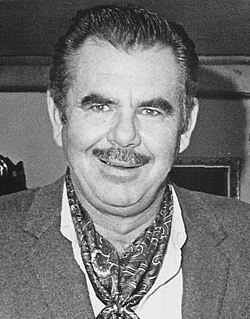
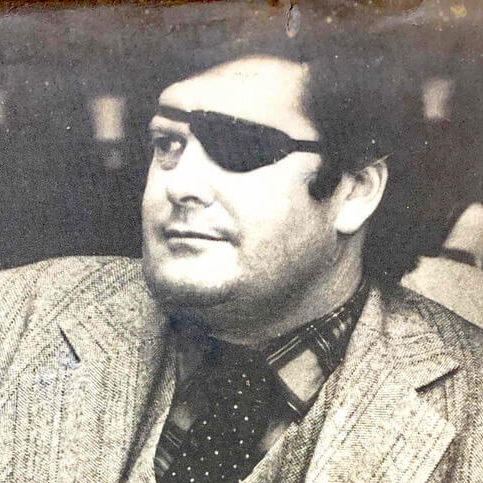
Godmonster of Indian Flats is the fourth and final feature film from writer-producer-director Frederick Hobbes.
Primarily known as a visual artist, directing was only one of the paths Hobbes took in his iconoclastic life.
He's sometimes called an outsider artist because of the rugged, homemade style of his output, but his institutional credentials are as elite as they come.
He attended Cornell University, and after two years in the Air Force during the Korean War, he studied in Spain at the Royal Academy of Fine Arts of San Fernando, the alma mater of both Picasso and Dali.
His illustration style brings to mind the ink splashing of Stephen Gemell or Ralph Steadman, and his canvases are often thick with paint-abstracted landscapes or contorted, non-realistic figures.
Most remarkable are his large sculptures that bring to mind the spiders of Louise Bourgeois or the assemblage work of Thornton Dial.
These sculptures were used in non-traditional art spaces such as parades or in his own films.
As a matter of fact, his films could be seen as excuses to have his sculpture work seen by a larger, more diverse audience, not unlike what another artist-turned-director, David Lynch, was doing with his short films like Six Men Getting Sick at around the same time.
Filmmaking for Hobbes was a brief distraction, and his movies might be best viewed as a part of his whole body of work.




Released briefly in 1973, Something Weird found themselves in possession of a 35mm print, initially dropping it on VHS in 1996 as part of the Frank Henenlotter's Sexy Shocker series.
Get the straitjackets ready.
We've dug up another
Gaseous vapors from an ancient mine cause a sheep to give birth to a huge, disgusting embryo, which is taken to the local mad doctor who helps it grow into an eight-foot mutant sheep.
Stuart Lancaster, the corrupt mayor of a historical Wild West tourist trap, wants to capture the damaged mongoloid beast as an attraction for the town.
But when Lancaster puts the creature on display, feast your eyes on the eighth wonder of the world, the townspeople freak and throw the monster in the town dump as a crazed Lancaster screams, Make them pay, make them all pay.
This received a limited theatrical release in 1973, which must have given brain seizures to those who saw it on the big screen.
As Michael Weldon has already asked, who is Hobbes and how could he have escaped
attention for so long?
Godmonster of Indian Flats is the fourth and final feature film from writer-producer-director Frederick Hobbes.
Primarily known as a visual artist, directing was only one of the paths Hobbes took in his iconoclastic life.
He's sometimes called an outsider artist because of the rugged, homemade style of his output, but his institutional credentials are as elite as they come.
He attended Cornell University, and after two years in the Air Force during the Korean War, he studied in Spain at the Royal Academy of Fine Arts of San Fernando, the alma mater of both Picasso and Dali.
His illustration style brings to mind the ink splashing of Stephen Gemell or Ralph Steadman, and his canvases are often thick with paint-abstracted landscapes or contorted, non-realistic figures.
Most remarkable are his large sculptures that bring to mind the spiders of Louise Bourgeois or the assemblage work of Thornton Dial.
These sculptures were used in non-traditional art spaces such as parades or in his own films.
As a matter of fact, his films could be seen as excuses to have his sculpture work seen by a larger, more diverse audience, not unlike what another artist-turned-director, David Lynch, was doing with his short films like Six Men Getting Sick at around the same time.
Filmmaking for Hobbes was a brief distraction, and his movies might be best viewed as a part of his whole body of work.
The rest of this transcript — segmented and speaker-labeled, so you land on the exact moment something was said
Search every transcript — by keyword, by phrase, or by meaning, across every show Radar indexes
Trends — what is surging across podcasts, measured against its own baseline
Alerts — when a name you follow appears in a newly indexed episode
No account is needed to search Radar.