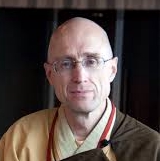
The Foundation We Skipped with Fedde de Vries
Jul 13, 2026 · 51 min · 10 segments
### **QUICK SUMMARY** Fedde de Vries, a professor of Chinese Buddhism, joins hosts Dave Plisky and Fr. John Gribowich to talk about merit-making, ritual, and why "playfulness" might be the secret to…
### **QUICK SUMMARY** Fedde de Vries, a professor of Chinese Buddhism, joins hosts Dave Plisky and Fr. John Gribowich to talk about merit-making, ritual, and why "playfulness" might be the secret to taking a tradition seriously. Fedde traces his path from an eight-year-old lighting a candle in a Protestant church to a PhD in Buddhist scholasticism, and opens up about why silent meditation didn't help during his darkest moments, and what did. Along the way: jazz as a metaphor for scriptural commentary, the surprising overlap between Catholic and Buddhist views on marriage, and what it really means to listen without an agenda. ### **IN THIS EPISODE WE EXPLORE** - *"If I beat myself up over being imperfect, then I'm misunderstanding something about the nature of the universe."* (00:00) - How a children's book on the Four Noble Truths, read at age 12, set Fedde on his spiritual path (03:00) - *"Tradition, properly understood... is intrinsically about or contains an element of play."* (30:00) - Why Western Buddhist converts often skip straight to meditation and miss the foundational practices of merit-making, offerings, and ritual (17:00–18:00) - *"In periods when I was struggling with depression or panic attacks, silent meditation was often not the answer."* (25:00) - The Sui and Tang dynasties: why this era of Chinese Buddhist history shaped Fedde's whole approach to the tradition (12:00–16:00) - Comparing Buddhist scriptural commentary to jazz improvisation; taking the tradition seriously while still playing within it (28:00–29:00) - The history of Buddhist-Catholic dialogue at the City of Ten Thousand Buddhas, including the friendship between Master Hsuan Hua and Cardinal Yu Bing (38:00–39:00) - What Fedde learned about marriage, sacredness, and the Trinity from preparing for his own interfaith wedding (40:00–43:00) - Fedde's practice for listening without an agenda and why it starts in the body, not the ears (47:00–49:00) ### **ABOUT FEDDE M. DE VRIES** **Fedde M. de Vries** is an assistant professor at Dharma Realm Buddhist University, located on the campus of the City of Ten Thousand Buddhas in Northern California. His spiritual journey began in his early teens and led him into a lifelong connection with that monastic community, alongside study with other Buddhist teachers in both the West and Asia. Fedde holds a BA in Religious Studies from Leiden University (2012), an MA in Asian Studies from UC Berkeley (2015), and a PhD in Buddhist Studies, also from UC Berkeley (2024). His research focuses on Chinese Buddhist scholasticism during the Sui and Tang dynasties. He joined the DRBU faculty in 2024, teaching courses that introduce students to Buddhist meditative practice. ### **RESOURCES MENTIONED** - **The Four Noble Truths** — the core Buddhist teaching that first captured Fedde's attention as a child - **City of Ten Thousand Buddhas** — the monastic community and campus in Ukiah, California, founded by Master Hsuan Hua - **Dharma Realm Buddhist University** — where Fedde teaches; offers a translation program, an MA in Buddhist Classics, and a BA in Liberal Arts - **The Sui and Tang dynasties** — the period of Chinese Buddhist history central to Fedde's academic research - **Master Hsuan Hua** — founder of the City of Ten Thousand Buddhas, who brought Chinese Buddhism to the West - **Cardinal Yu Bing** — the Catholic cardinal and friend of Master Hsuan Hua who founded Fu Jen Catholic University in Taiwan - ***The Divine Dance*** by Richard Rohr — recommended to Fedde by Fr. John ahead of his wedding, exploring the Trinity and relationality of the sacred ### Chapters - (00:00:00) - Religion to Reality: Zen Buddhism - (00:01:29) - Fedde de Vries on Dharma Realm Buddhist University - (00:02:46) - A Life Story of Buddhism - (00:05:07) - The Joy of Interreligious Wedding - (00:12:31) - The Chinese Buddhism of the Tang and Sui Dynasties - (00:19:32) - An offering of flowers to monks and nuns - (00:23:06) - Buddhism in the West - (00:31:43) - What are your students like? Are they all Buddhist? - (00:38:16) - Buddhist Catholic Dialogue - (00:43:20) - On Experience and the Catholic Problem - (00:47:00) - Religion to Reality: A Week in the Life
### **QUICK SUMMARY** Fedde de Vries, a professor of Chinese Buddhism, joins hosts Dave Plisky and Fr. John Gribowich to talk about merit-making, ritual, and why "playfulness" might be the secret to…