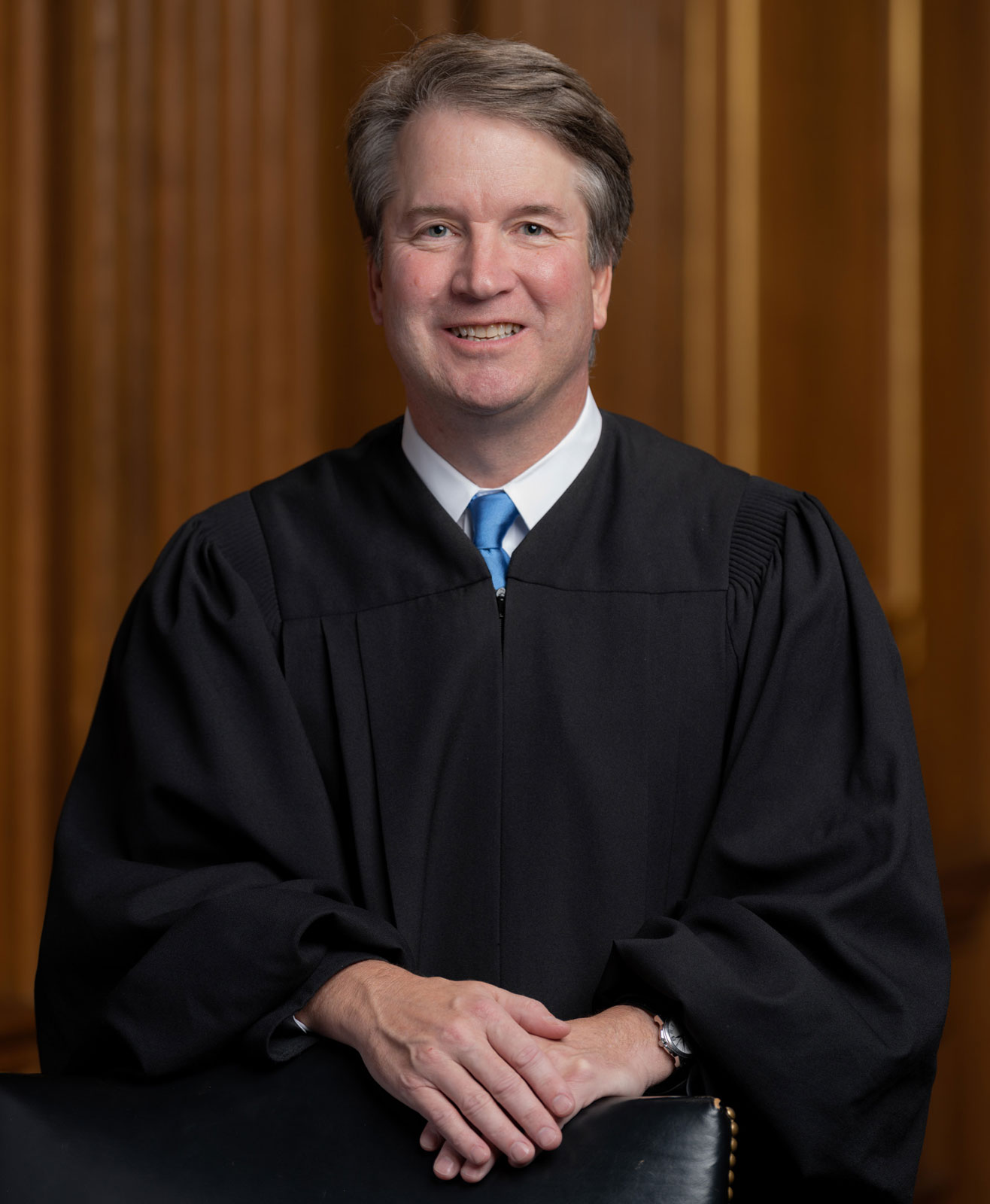
Brett Kavanaugh
Associate Justice of the Supreme Court of the United States
62
APPEARANCES
3
PODCASTS
Oct 13, 2026
PageGUEST
No, of course.

Brett KavanaughGUEST
Stinson looked at all that, uh, 30 years ago and came to the conclusion that the commentary was binding, controlling force of law, uh, and, uh, went through this whole exercise.
Brett KavanaughGUEST
And since then, as the Chief Justice said, the one major change in the sentencing realm is that those guidelines are no longer, uh, uh, as a whole binding.
Brett KavanaughGUEST
So I guess Stinson plus Booker together suggests that we've already been down this road.
Brett KavanaughGUEST
1B1.7 of the, of the guidelines itself says the commentary has the force of law.
1 HR 8 MINS LATER
FaganGUEST
The otherwise reached the correct result.

Brett KavanaughGUEST
But, but I'm, I guess I'm not, uh, seeing how it would make any sense to say that it's not final, but then, uh, that NEPA still applies, uh, which is a possible outcome here.
Brett KavanaughGUEST
Because then you go, as Justice Sotomayor correctly says, through the whole RCRA permitting process, and then you get done, and you go through the NEPA process.
Brett KavanaughGUEST
And that's just completely counterintuitive and extends everything and contrary to everything, um, about trying to get these things done expeditiously.
Brett KavanaughGUEST
So what sense would it make, uh- To resolve only the first question without the second question, or to resolve the first question to say not final, and the second question to say, yeah, NEPA applies.
46 MINS LATER
FlynnGUEST
Uh, and so I don't think that is a route, um, to avoid, uh, the text of NEPA, which is very clear that NEPA is not displaced in the absence of something like a clear and fundamental conflict or an express exclusion of the kind that Congress has repeatedly done over the years, but did not do for NE- for RCRA.
Brett KavanaughGUEST
Isn't the oddity of this case, uh, I think Justice Thomas alluded to this, the oddity of this case is that the permitting agency's not a federal agency.
Brett KavanaughGUEST
But Mr. Joshi responds to that by saying, well, even in that here territorial permitting process, you can still raise the argument that NEPA wasn't complied with.


Jeffrey WesslerGUEST
They show specifically that the performance of these funds underperformed other points of comparison in exactly the ways-
Brett KavanaughGUEST
Why do, why does performance matter, uh, in the sense that half of all the funds are gonna underperform or be lower than the median? Uh, it seems to me that what your complaint's really about is either the strategy of going low risk or the means to, uh, fulfill that strategy, namely hedge funds.
Brett KavanaughGUEST
What you just said suggests it's the latter, uh, the means to, uh, fulfill that strategy or achieve that strategy.
11 MINS LATER

Brett KavanaughGUEST
Uh, just to follow up on, uh, Judge Murphy's dissent in the Sixth Circuit, who raises the question about why performance, underperformance would ever be relevant.
RussellGUEST
But the principle, I think, protection, to the extent that seems unreasonable, is that Congress stands at the ready to to intervene and to enact federal law that preempts unreasonable state laws with undesirable national
Brett KavanaughGUEST
Does Congress have to act to allow them, or does Congress have to act to prescribe them? What's the baseline or the default? And I think in the abstract, that would be an interesting question, but we have the precedents.
Brett KavanaughGUEST
And just to, you know, go back to Ouellette, it does say regulation of interstate water pollution is a matter of federal, not state law.
16 MINS LATER
RussellGUEST
And I don't think that there can be any argument that there's any conflict between state and federal law when they both require the same thing.
ChenGUEST
But I think the more general principle is the BVA only has powers that Congress gives to it, and Section 511A I think is the primary, if not the only, statute
Brett KavanaughGUEST
Counsel, why do we need to go down that rabbit hole? Now, maybe we do, and I'll follow you down if I have to.
Brett KavanaughGUEST
But 511 is about district court review, right? So say the secretary or the board or whoever decides in their magnanimity to follow the Constitution of the United States and say the First Amendment is a thing.
Brett KavanaughGUEST
But I don't know why that — would affect the scope of district court review for purposes of a challenge to the Secretary's decision.
35 MINS LATER


Edward MalloyGUEST
And so making that come alive and making sure that we were doing everything we could to assure the people that lost someone that we cared about them, that we were praying for them.
Brett KavanaughGUEST
Well, I think at the White House on September 12th, President Bush made clear to everyone and to the country that this will never happen again in the United States, that that was his mission.
Brett KavanaughGUEST
From here on, my job is to make sure this never happens again in the United States.
Brett KavanaughGUEST
The next day, Thursday, and I encourage the students to watch the videos of some of the things I'm gonna mention here, because they're very powerful, and they bring it home to you, kind of how the country was adjusting and feeling.
Brett KavanaughGUEST
But Thursday, he had a call from the Oval Office, which was on TV with Mayor Giuliani and Governor Pataki.
Brett KavanaughGUEST
And at the end of the call in the Oval Office, after the call was over, the reporters were still there and asked him, how do you think about yourself at this moment? And he started tearing up, President Bush did, and said eventually, I don't think about myself, I think about the children, I think about the families.
21 MINS LATER

Philip MunozHOST
The question asks, how should the seemingly consensus that the Iraq war was largely mistaken impact our understanding now about 9-11? Any thoughts about that?

Brett KavanaughGUEST
I mean, that, the whole thing was the Assad regime after 53 years of complete oppression and brutal treatment-
Brett KavanaughGUEST
Well, that's an important marker then because that's, that's, uh, a big, uh, shift in both Syria but also the posture of other countries towards Syria, at least as I...
Brett KavanaughGUEST
I don't pretend to be an expert, but that's my understanding of what's the backdrop here.

Brett KavanaughGUEST
I mean, that, the whole thing was the Assad regime after 53 years of complete oppression and brutal treatment-
Brett KavanaughGUEST
Well, that's an important marker then because that's, that's a, um, a big, uh, shift in both Syria but also the posture of other countries towards Syria, at least as I...
Brett KavanaughGUEST
I don't pretend to be an expert, but that's my understanding of what's the backdrop here.
38:58
The, I don't think you can say the only fair inference from Hikma's statements is that they were directed solely at investors and were not gonna reach doctors.
Brett KavanaughGUEST
But I guess, uh, to your initial statement, when you started out saying this is not a Hatch-Waxman case at all, I think you said that, and to why this case is here, 'cause I'm glad it's here.

Brett KavanaughGUEST
Uh, the, uh, Federal's, uh, Congressman Waxman filed a, amicus brief, and I don't wanna put too much, uh, faith in a former congressman's brief about his own statute, but it says, "The Federal Circuit's decision threatens to decimate the compromise at the heart of the Hatch-Waxman Act, which in turn threatens to undermine the generic pharmaceutical i- industry if this kind of complaint's good enough," and points out, you know, generics have saved three point four trillion over the past 10 years, but the Federal Circuit's decision here leaves generic drug companies in the dark about what might expose them to liability.
Brett KavanaughGUEST
All of which is to say, I think the question is, you know, if this is good enough, then that's gonna have some serious implications market-wide.

Brett KavanaughGUEST
What if Hikma, Hikma had s- had not just said its drug is generic Vascepa, but went on to say that Vascepa is approved to treat cardiovascular risks?
18 MINS LATER
Brett KavanaughGUEST
Uh, the, uh, Federal, uh, Congressman Waxman filed a, amicus brief, and I don't wanna put too much, uh, faith in a former congressman's brief about his own statute, but it says the Federal Circuit's decision threatens to decimate the compromise at the heart of the Hatch-Waxman Act, which in turn threatens to undermine the generic pharmaceutical i- industry if this kind of complaint's good enough, and points out, you know, generics have saved three point four trillion over the past ten years, but the Federal Circuit's decision here leaves generic drug companies in the dark about what might expose them to liability.
Brett KavanaughGUEST
All of which is to say, I think the question is, you know, if this is good enough, then that's gonna have some serious implications market-wide.
Brett KavanaughGUEST
In footnote 21 of Sosa, uh, the court said there's a strong argument that federal courts should give serious weight to the executive branch's view of the case's impact on foreign policy.
Brett KavanaughGUEST
And when I was on the Court of Appeals, I took that seriously, um, in terms of executive branch statements.
Brett KavanaughGUEST
In your, from your perspective, are lower courts sufficiently paying attention to executive branch statements as dictated by footnote 21?
Jonathan GannonGUEST
Um, but we've continually said that we think that it shouldn't be expanded to aiders and abettors.
Brett KavanaughGUEST
On that last point about Congress, this is my last question, uh, and this is picking up on the Chief Justice's and Justice Gorsuch's question.
Brett KavanaughGUEST
By leaving the door somewhat ajar but never quite getting there, we've maybe misled Congress into thinking, oh, we don't need to do anything about these human rights things, the courts are taking care of it.
Brett KavanaughGUEST
And, and I'm concerned at a separation of powers level that, uh, we're not really allowing suits to go forward, but Congress thinks we are because of a lack of clarity in our case law.
Brett KavanaughGUEST
In footnote 21 of Sosa, uh, the court said there's a strong argument that federal courts should give serious weight to the executive branch's view of the case's impact on foreign policy.
Brett KavanaughGUEST
And when I was on the court of appeals, I took that seriously, um, in terms of executive branch statements.
Brett KavanaughGUEST
In your, from your perspective, are lower courts sufficiently paying attention to executive branch statements as dictated by footnote 21?
Michael DreebenGUEST
Um, but we've continually said that we think that it shouldn't be expanded to aiders and abettors.
Brett KavanaughGUEST
On that last point about Congress, this is my last question, uh, and this is picking up on the Chief Justice's and Justice Gorsuch's question.
Brett KavanaughGUEST
By leaving the door somewhat ajar but never quite getting there, we've maybe misled Congress into thinking, oh, we don't need to do anything about these human rights things, the courts are taking care of it.
Brett KavanaughGUEST
And, and I'm concerned at a separation of powers level that, uh, we're not really allowing suits to go forward, but Congress thinks we are because of a lack of clarity in our case law.

Paul ClementGUEST
And under the plain text of F1 and the relevant regulations, 40 C.F.R. 156, uh, point, uh, 70 sub-C and 152 point forty-four sub-A, those provisions say that the registrant cannot change the label with respect to state forms.
Brett KavanaughGUEST
It's not that there c- that, that, uh, you, you can in fact have misbranded but registered items, and EPA can, um, seek remedies against you.
Brett KavanaughGUEST
You're just saying nobody else can do the same even if it's the parallel, parallel proceeding, you know, uh, no, no additional, uh, requirements, because you have to go through processes to amend the label.
Brett KavanaughGUEST
So is, is it kind of at the impo- this really boils down to the impossibility argument then, doesn't it?
Paul ClementGUEST
But where the, where the arguments sort of come together is because EPA quite clearly takes the position that as to the safety warnings and the hazard warnings, those are things that the registrant can't change on their own.
Brett KavanaughGUEST
Well, a- with respect to that, if it all does boil down to the impossibility idea, um, that it's hard to add to these labels without EPA's permission, what do we do about the fact that at least as briefs before us suggest that, uh, registrants have added cancer w- warnings to their labels, uh, without EPA permission or objection?

Brett KavanaughGUEST
Just on that, um, there are ways, I think you're saying, that EPA can change requirements going forward, but if it tries to say you were misbranding when you did what they told you to do, that's a retroactivity problem of sorts, uh, in the sense that they're penalizing you retroactively for something they're saying is now required that they didn't say was required before, in fact, was prohibited before.
Paul ClementGUEST
And one of the anomalies of allowing a state tort remedy to be essentially a requirement is it does have this kind of retroactive effect to it, and I think that's what makes it particularly problematic here.
Brett KavanaughGUEST
And, and I think you just covered this in part, but to Justice Jackson's good point about new science, you're saying the way you account for new science is on a process that changes the requirements going forward, not on a process that retroactively tells you that what you did yesterday as ordered by EPA is somehow illegal.
Brett KavanaughGUEST
You admitted that correctly, and it's just then, is it sufficiently particular? And it seems like Detective Hilton here, you know, really went through, uh, a lot of the steps that sh- should be applauded, uh, and, and in terms of narrowing this down, going through multiple steps.
Brett KavanaughGUEST
I guess I'm trying to figure out why this was bad police work, uh, to get a warrant.
Brett KavanaughGUEST
A lot of Fourth Amendment cases, we say, "Get a warrant." Well, they got a warrant.
Brett KavanaughGUEST
And then you're sayingYou know, it's not sufficiently particular, but he went multiple steps.
1 HR 4 MINS LATER
YunokowskiGUEST
So if the court considers Google-
Brett KavanaughGUEST
And it's just then, is it sufficiently particular? And it seems like Detective Hilton here, you know, really went through, uh, a lot of the steps that sh-should be applauded, uh, and, and in terms of narrowing this down, going through multiple steps.
Brett KavanaughGUEST
I guess I'm trying to figure out why this was bad police work, uh, to get a warrant.
Brett KavanaughGUEST
A lot of Fourth Amendment cases, we say, "Get a warrant." Well, they got a warrant.
Brett KavanaughGUEST
And then you're saying You know, it's not sufficiently particular, but he went multiple steps.
1 HR 4 MINS LATER
FaganGUEST
I, I, I do think-
VeretskyGUEST
Um-
Brett KavanaughGUEST
Can you address his, uh, point, uh, 25% don't show up, just, and you heard him say that.

Jeffrey WallGUEST
Form matters and forum matters, and they can't say, "Well, we're just layering on additional procedures," where the additional procedure is a binding adjudication in front of the agency.
Brett KavanaughGUEST
It depends on the word binding, but, but let's move on from that, because I think I have your point on that.
Brett KavanaughGUEST
I mean, your reply brief begins, "The government's in retreat." That's absolutely correct.
Brett KavanaughGUEST
Um, but what you're complaining about, I think, and concerned about, and it's understandable, is you're, think you were misled into paying the money without getting the jury trial by what the government had in the orders, and I think that's a serious problem.
19 MINS LATER
Jeffrey WallGUEST
Form matters and forum matters, and they can't say, "Well, we're just layering on additional procedures," where the additional procedure is a binding adjudication in front of the agency.
Brett KavanaughGUEST
It depends on the word binding, but, but let's move on from that, 'cause I think I have your point on that.
Brett KavanaughGUEST
I mean, your reply brief begins, "The government's in retreat." That's absolutely correct.
Brett KavanaughGUEST
Um, but what you're complaining about, I think, and concerned about, and it's understandable, is you're, think you were misled into paying the money without getting the jury trial by what the government had in the orders, and I think that's a serious problem.
19 MINS LATER
Brett M. KavanaughGUEST
I, I mean, this kind of dovetails with Justice Jackson's question and goes back to Justice Thomas' question.
Brett M. KavanaughGUEST
Do you then say, "Well, I still win because just the word disgorgement, even though it's been taken out of D5, still has these traditional equitable limitations"? So is Liu kind of unnecessary? Obviously, it helps you if it squarely would require us to decide this case in your favor, but take Liu out of the equ- equation.
33 MINS LATER

Brett M. KavanaughGUEST
But, um, I, I guess one question that I have is how do we define disgorgement if not looking to the equitable piece of it? And actually, let me just back up and ask you, what is the government's practice with respect to distributing it to victims? Do you only try to restore them by calculating what they actually lost, or do you give them a windfall?
Daniel L. GeyserGUEST
So Congress made the determination that those investors are not entitled to recovery, the very recovery that the SEC says as a windfall they are entitled to here.
Brett KavanaughGUEST
Well, is it, is it your s- your claim that they didn't suffer an injury, or that it's just too hard to prove that they suffered an injury? Because the stock could have gone up and down for a million other reasons.
6 MINS LATER
Brett KavanaughGUEST
On your first principles argument, do you wanna res- respond to the amicus brief of the, um, professors Laycock and others, uh, on that succinctly? 'Cause they say you're, you're really quite wrong about the first principles.

Elizabeth PrelogarGUEST
But that runs counter to this court's repeated recognition, including in Exxon, that Section 1257 is the doctrinal foundation for where the Rooker Feldman rule comes from.
Brett KavanaughGUEST
You mentioned, um, Exxon and of course, Judge Hyten's put emphasis on the sentence in Exxon, the we hold sentence that did not articulate the rule in the way you do it today.
Brett KavanaughGUEST
So I guess my question to pick up on Justice Sotomayor's questions is, why not stick with what we said in the we hold sentence in Exxon, given that, um, it would be, uh, uh, problematic, uh, to have federal and state court parallel litigation to increase it? As you rightly said, there is federal and state court parallel litigation, but why add to it, uh, unnecessarily? Why not just stick to the we hold sentence and be, be done with it? Again, if we were starting anew, maybe your position would have more force, but given what we said in Exxon and given what Justice Sotomayor raised, it's just a question.
20 MINS LATER

Brett KavanaughGUEST
If we think 1257 and 1331 don't dictate an answer, and we look at Exxon and it doesn't dictate an answer, and we're just trying to figure out, okay, this is a judge-created doctrine, what makes the most sense here systemically, why does your position make more sense if it's going to create lots of duplicative litigation in federal and state court that, by your own admission, is usually gonna fail because these other doctrines are gonna toss it all out anyway? Your position seems to be, let's make sure the federal courts are open just so the federal courts can toss it out on other grounds.

Brett KavanaughGUEST
You've mentioned several times the practices of other countries, and that's obviously – as a policy matter, supports what you're arguing here, but obviously we try to interpret American law with American precedent based on American history.
Brett KavanaughGUEST
And so why should we be thinking about, even though as a policy matter I get the point, thinking about, gee, European countries don't have this, or most other countries, many other countries in the world don't have this, doesn't that, I guess I'm not seeing the relevance as a legal constitutional interpretive matter necessarily, although I understand it's a very good point as a policy matter.
1 HR 3 MINS LATER
speaker_10GUEST
So the Congress has, under the Naturalization Clause, the power to expand citizenship to other people not covered by the 14th Amendment, and obviously they have in many ways, but they can't go below that floor that the Constitution sets.
Brett KavanaughGUEST
I think Mr. Sauer acknowledged that, and you mentioned this in your opening, that if we agree with you on how to read Wong Kim Ark, then you win.
Brett KavanaughGUEST
So that could be a – if we did agree with you on Wong Kim Ark, that could be just a short opinion, right, that says the better reading is respondents' reading, government doesn't ask us to overrule, affirmed? Yes.
Brett KavanaughGUEST
You've mentioned several times the practices of other countries, and that's obviously – as a policy matter, supports what you're arguing here, but obviously we try to interpret American law with American precedent based on American history.
Brett KavanaughGUEST
And so why should we be thinking about, even though as a policy matter I get the point, thinking about, gee, European countries don't have this, or most other countries, many other countries in the world don't have this, doesn't that, I guess I'm not seeing the relevance as a legal constitutional interpretive matter necessarily, although I understand it's a very good point as a policy matter.
1 HR 3 MINS LATER

Cecillia D. WangGUEST
So the Congress has, under the Naturalization Clause, the power to expand citizenship to other people not covered by the 14th Amendment, and obviously they have in many ways, but they can't go below that floor that the Constitution sets.
Brett KavanaughGUEST
I think Mr. Sauer acknowledged that, and you mentioned this in your opening, that if we agree with you on how to read Wong Kim Ark, then you win.
Brett KavanaughGUEST
So that could be a – if we did agree with you on Wong Kim Ark, that could be just a short opinion, right, that says the better reading is respondents' reading, government doesn't ask us to overrule, affirmed? Yes.
Brett KavanaughGUEST
Just on Justice Thomas and Justice Gorsuch's questions, if the trial judge had said, do you have any response, and they'd said, we have no pretext argument, that's the essential equivalent of withdrawing the Batson objection.
Brett KavanaughGUEST
But what happened here, I gather, your position is And what Judge Mills, the district judge in the habeas case, found was, you know, Judge Mills said, perhaps Pitchford's counsel should have been more assertive, but the court will not fault them for failing to present specific arguments on pretext when the trial court appeared to have been resolute in its brusque determination that no violation had occurred.
Brett KavanaughGUEST
Now, the question is whether that – you know, whether what happened in the trial court was an unreasonable, whether it's unreasonable to find waiver, I guess, or how you analyze the trial record.
47 MINS LATER
Scroll for more appearances