Tahrir Podcast - بودكاست التحرير
May 29, 2026 · 1 hr 28 min · 16 segments
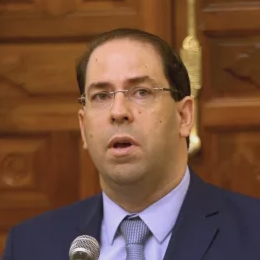
In episode 56 of Tahrir Podcast, Abdalla Nasef sits down in-person at Harvard University with former Tunisian Prime Minister Dr. Youssef Chahed for a conversation about Dr. Chahed's rise within…
Youssef ChahedGuest
Abdullah NasefHost
I mean, looking at Egypt, for example, you have poverty, poverty, uh, rates that are nearly 40%, perhaps even higher.

And so it comes off as even sometimes ridiculous if someone, uh, demands just democracy outright, considering that, you know, there are a lot of, uh, things that need to, to, to, uh, come first.

But then again, how you attain and, and sustain an economy, an economy that's sustainable, an economy in which there is high levels of, of trust.

I personally think that democracy is a requirement, considering that dictatorships are not, uh, they are stable until they're not.

Whereas when you have democracy, where you have participation, where you have, uh, real institutions, the rule of law and so forth, uh, I believe that's one of the only ways really that you could attain a sustainable economy.

But then democracy is not responsible about, uh, of the, including in Tunisia now I'm talking, uh, of a bad economic situation or social situation.

Of course, many anti-democratic political parties or politician may make the link saying, "Look, if your condition are bad, it is because of this democratic system that blah, blah, blah," et cetera.

Of course, there was huge difficulties in Tunisia in order to implement this new system after so many years of dictatorship.

But let me say the global idea is that countries living under democracy perform better than under auto- autocracy.

This you can compare historically, uh, GDP or GDP per capita, and it should be, you should find something clear in that.

But then, of course, the economic, uh, uh, I mean, the economic point is very important.

And Tunisia, when the Arab Spring started, if you go back to 2010 and 2011, and if you look to the, uh, modernization theory or democratization theories, et cetera, many of the scholars at that time expected that the experience will not succeed because the income was very low.

Tunisia income per capita was around four or $5,000, which is not meeting the pre-required condition for a successful democracy.

But then there was a lot of enthusiasm, and the 10 years, as you mentioned, that, where the democracy survived showed that it's not only about economy or, uh, a- and I, again, I believe that the Tunisian democracy collapsed not for economic reason, and I give you the best proof for that.

You can just compare the economic situation now compared to the situation during the democratic period.

So if democracy is responsible about that, what about now? You know, if you compare the, I mean, everything, uh, is deteriorating, you know, in term of economic indicators, et cetera, today compared to the, uh, including, you know, uh, we, w- w- I mean, if you compare the price of, I don't, you know, simple commodities like, uh, the, the kil- the kilogram of beef or...

It was multiplied by two or three, you know, compared to w- what is called in democratic, d- d- dark decade by, by some people.

So demo- so democracy is not responsible about, uh, of the econom- of the bad economic situation.

You know, I remember in 2019 election when I was candidate, I mean, all my, uh, uh, opponent were saying the economy is disaster, et cetera.

Today, the economy is in m- I mean, much, uh, difficult situation, but they are not saying anything, you know.
The rest of this transcript — segmented and speaker-labeled, so you land on the exact moment something was said
Search every transcript — by keyword, by phrase, or by meaning, across every show Radar indexes
Trends — what is surging across podcasts, measured against its own baseline
Alerts — when a name you follow appears in a newly indexed episode
No account is needed to search Radar.