Oct 17, 2026 Β· 1 hr 1 min Β· 19 segments
ποΈ Surround yourself with people who practice Stoicism. Build clarity, discipline, and self-control. ππ» https://estoicismoparaganadores.com/#en We putβ¦
It's spring.
There are citizens, farmers who've come down from the countryside, foreigners passing through.
It's called The Clouds, and the target of the joke is a real man who lives in Athens, who strolls through the marketplace every day, and whom half the audience knows by sight, Socrates.
The plot is simple.
A farmer ruined by the debts his son's passion for horses has run up wants to learn how to win lawsuits with verbal tricks so that he never has to pay anyone back.
So he turns to a sort of ridiculous school, the Thinkery, where pale-faced disciples study nonsense.
In charge is Socrates, who appears hanging in a basket in midair because, so he says, he thinks better about heavenly matters from up there.
He teaches how to make the weaker argument the stronger, mocks the old gods, and worships the clouds.
At the end of the play, the farmer, fed up, sets fire to the school.
It was a cruel caricature designed to make a fool of him in front of the whole city, and it was no innocent joke.
It lumped Socrates in with the charlatans who charged money to teach people how to deceive when he, of all people, charged nothing and spent his life unmasking exactly those charlatans.
Today, it would be like being put on the most watched program in the country as the village idiot and accused into the bargain of being the very opposite of what you are.
Consider, too, who this man was.
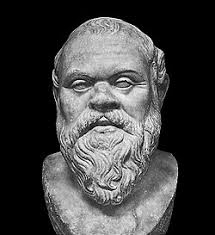
Ugly by the account of everyone who knew him.
A snub nose, bulging eyes, thick lips, always barefoot, wearing the same old cloak winter and summer.
He was about forty-five at the time.
He had served as an infantryman on several campaigns, and barely a year earlier, at the defeat of Delium, he had withdrawn from the battlefield so calmly that, as Alcibiades tells it in one of Plato's dialogues, the enemy preferred to keep well away from him.
He wasn't an easy man to frighten.
But now the attack came not with spears, but with laughter.
The writer Aelian records that as the actors repeated his name again and again, some foreigners in the audience began asking who on earth this Socrates was, and that he, to spare them the trouble, rose to his feet and stayed there standing for a good part of the performance so that everyone could compare the original with the caricature without losing his temper, without leaving, letting them laugh.
It's spring.
There are citizens, farmers who've come down from the countryside, foreigners passing through.
It's called The Clouds, and the target of the joke is a real man who lives in Athens, who strolls through the marketplace every day, and whom half the audience knows by sight, Socrates.
The plot is simple.
A farmer ruined by the debts his son's passion for horses has run up wants to learn how to win lawsuits with verbal tricks so that he never has to pay anyone back.
So he turns to a sort of ridiculous school, the Thinkery, where pale-faced disciples study nonsense.
In charge is Socrates, who appears hanging in a basket in midair because, so he says, he thinks better about heavenly matters from up there.
He teaches how to make the weaker argument the stronger, mocks the old gods, and worships the clouds.
At the end of the play, the farmer, fed up, sets fire to the school.
It was a cruel caricature designed to make a fool of him in front of the whole city, and it was no innocent joke.
It lumped Socrates in with the charlatans who charged money to teach people how to deceive when he, of all people, charged nothing and spent his life unmasking exactly those charlatans.
Today, it would be like being put on the most watched program in the country as the village idiot and accused into the bargain of being the very opposite of what you are.
Consider, too, who this man was.
Ugly by the account of everyone who knew him.
A snub nose, bulging eyes, thick lips, always barefoot, wearing the same old cloak winter and summer.
He was about forty-five at the time.
He had served as an infantryman on several campaigns, and barely a year earlier, at the defeat of Delium, he had withdrawn from the battlefield so calmly that, as Alcibiades tells it in one of Plato's dialogues, the enemy preferred to keep well away from him.
He wasn't an easy man to frighten.
But now the attack came not with spears, but with laughter.
The writer Aelian records that as the actors repeated his name again and again, some foreigners in the audience began asking who on earth this Socrates was, and that he, to spare them the trouble, rose to his feet and stayed there standing for a good part of the performance so that everyone could compare the original with the caricature without losing his temper, without leaving, letting them laugh.
The rest of this transcript β segmented and speaker-labeled, so you land on the exact moment something was said
Search every transcript β by keyword, by phrase, or by meaning, across every show Radar indexes
Trends β what is surging across podcasts, measured against its own baseline
Alerts β when a name you follow appears in a newly indexed episode
No account is needed to search Radar.