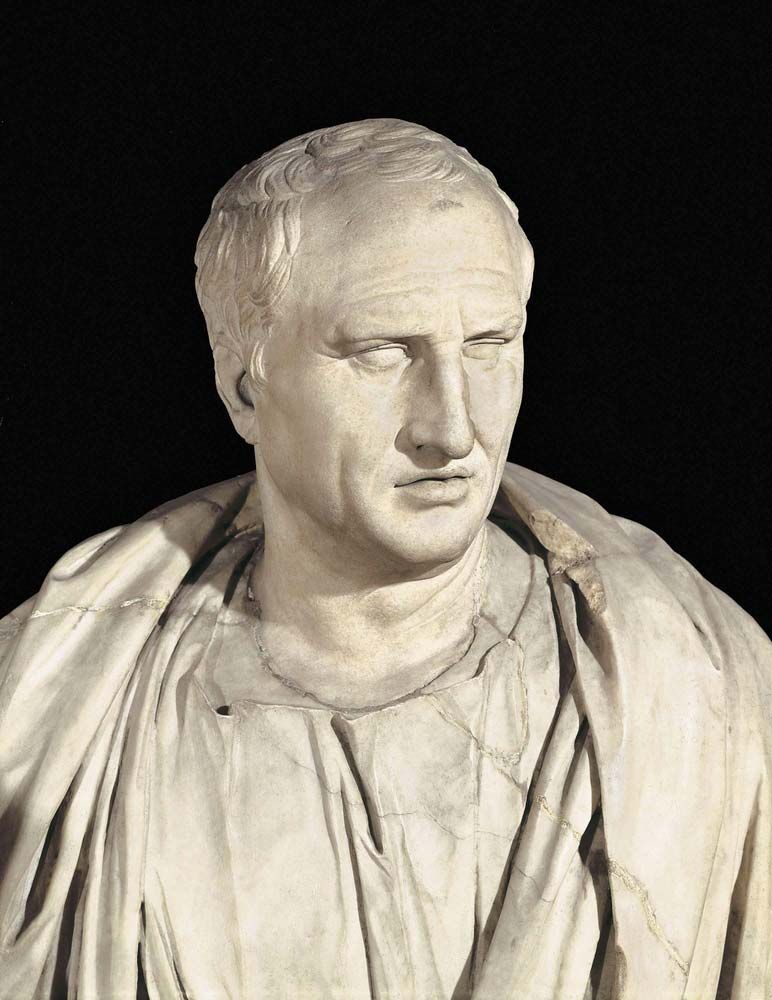
Cicero
Roman statesman and lawyerWikipedia
2.7k
MENTIONS
475
EPISODES
354
PODCASTS
Search complete. 2718 mentions across 475 episodes found for "Cicero".
Sep 17, 2026

Robert HarrisGUEST
Yeah, this is my fifth novel set in Rome.
Robert HarrisGUEST
I first did Pompeii more than 20 years ago, and then I did a trio of novels about Cicero.
Robert HarrisGUEST
And in both of those projects, I came across Agrippa.
Robert HarrisGUEST
And so I thought, well, why don't I give him a book of his own? What was it
Robert HarrisGUEST
yeah his downtime is building an aqueduct and so i thought well this is an interesting
Oliver CallanHOST
fellow
Robert HarrisGUEST
And then at the end of the Cicero books, he's the kind of he's the 19 year old consigliere of the 18 year old Octavius, who was the heir to Julius Caesar after his assassination.
Robert HarrisGUEST
And he is a sort of interesting brooding figure.

speaker_5NARRATOR
He could not write a note to ask for anything that would not be spiced with some scoff or other.
speaker_5NARRATOR
Once, for instance, he wrote to me thus, If those letters of Brutus thou hast in thy Cicero's letters, thou whom consolers of schools decked out in magnificent bindings sooth from their well-planned shells, yet more by the outside than inside, thou who from gods art descended, or goths, or from origin filthy, goethe, send them to me.
speaker_5NARRATOR
Footnote The German word is koth, and the whole object of the line is to introduce a play on the word goth, goter, gothen, and koth.
speaker_5NARRATOR
Translator End of footnote It was not polite, indeed, that he should allow himself this jest on my name, for a man's name is not like a mantle which merely hangs about him and which, perchance, may be safely twitched and pulled, but is a perfectly fitting garment which has grown over and over him like his very skin, at which one cannot rake and scrape without wounding the man himself.
6 HRS 3 MINS LATER
speaker_5NARRATOR
In this sphere, moral effects are required above all things, and here at once arises a dissension between the class that produces and that which uses, for the good work of art can and will indeed have moral consequences, but to require moral ends of the artist is to destroy his profession.
speaker_5NARRATOR
What the ancients had said on these important subjects I had read industriously for some years, by skips at least, if not in regular order.
speaker_5NARRATOR
Aristotle, Cicero, Quintilian, Longinus, none were unconsidered, but this did not help me in the least, for all these men presupposed an experience which I lacked.
speaker_5NARRATOR
They led me into a world infinitely rich in works of art.

Samraj MatharuGUEST
And I thought...
Samraj MatharuGUEST
when like i'll give you the first part of the story so i was invited to talk at the ivy great debate in 2024 and i represented the algorithm team in nexus in wpp it was called marketing science and i was basically the mere director of analytics and i basically presented about like what i thought about ai for the industry but i took a step back and i said well When I was in Athens, I met a guy and he told me his dad was a philosopher.
Samraj MatharuGUEST
He told me about this story about Plato's cave.
Samraj MatharuGUEST
So Plato is an ancient Greek philosopher who then taught Aristotle, hence Lyceum.
Samraj MatharuGUEST
And in that cave, you have people chained to a wall and behind them, there's a fire.
Samraj MatharuGUEST
And on the wall, there's shadows that depict society and people are holding up certain artifacts.
21 MINS LATER
Samraj MatharuGUEST
I'll start off with ethics and morals.
Samraj MatharuGUEST
So the word ethics comes from ethos in Greek, meaning character.

Mark HarringtonNARRATOR
A member of a plebeian family, Gaius Sallustius Crispus, was born in the year B.C. 86 in the town of Amiternum.
Mark HarringtonNARRATOR
Until B.C. 52, when he was one of the tribunes of the commons, we hear nothing of him, but he then took an active part against Cicero's client, Titus Annius Milo.
Mark HarringtonNARRATOR
Two years later he was removed from the Senate by the censors Appius Claudius and Lucius Calpurnius Piso, but his expulsion was probably only a party measure, as other Caesarians were similarly treated, and even if the story about his intrigue with the wife of Milo is true, adultery was at this time too common at Rome to exclude the offender from the Senate.
Mark HarringtonNARRATOR
It is said, without much authority, that immediately after his expulsion Sallust joined the army of Caesar.
Mark HarringtonNARRATOR
It is probable that these ten or twelve years comprised the whole period of his literary activity, and that during them he wrote not only the Catiline and Jugurtha, but the other essays which were joined together into a continuous account of about twenty years of Roman history.
Mark HarringtonNARRATOR
On Sallust's death his property all went to his grandnephew, who became a man of some note under Augustus and Tiberius.
Mark HarringtonNARRATOR
The story that the historian married Terentia, the wife whom Cicero divorced in B.C. 46, is worth mentioning, though the authority for it is not good, and it seems intrinsically impossible.
Mark HarringtonNARRATOR
The preceding brief sketch of Sallust's life enables us to gather that throughout his career he was a consistent democrat and supporter of Caesar.

Steven SeitelNARRATOR
Gargantua, in a letter to Pantagruel, studying at Paris, enlarges to his son on the vast improvements in learning and education which had recently, he says, been brought about.
Steven SeitelNARRATOR
Quote, All the world is full of savants, learned teachers, large libraries, and I am of opinion that neither in the time of Plato nor of Cicero nor of Papinian were there such facilities for study as one sees now.
Steven SeitelNARRATOR
Close quote.
Steven SeitelNARRATOR
It is indeed the study of the ancient languages and literatures that Gargantua considers in a liberal education, but the satisfaction at the present diffusion of learning, with the suggestion that here at least contemporaries have an advantage over the ancients, is the significant point.
1 HR 41 MINS LATER
Steven SeitelNARRATOR
Saint-Sorlin and Perrault had argued directly from the permanence of vigor in lions or trees to the permanence of vigor in man.
Steven SeitelNARRATOR
If trees are the same as ever, brains must also be the same.
Steven SeitelNARRATOR
But what about the minor premise? Who knows that trees are precisely the same? It is an indemonstrable assumption that oaks and beeches in the days of Socrates and Cicero were not slightly better trees than the oaks and beeches of today.
Steven SeitelNARRATOR
Fontenelle saw the weakness of this reasoning.

Anne VouleNARRATOR
It was to amuse.
Anne VouleNARRATOR
Cicero, in his persecution of Verres, had shown up this aristocracy in all its brutality and greed.
Anne VouleNARRATOR
It remained for the author of the Cena to hold its absurdity up to the light of day, to lash an extravagance which, though utterly unbridled, was yet unable to exhaust the looted accumulations of years of political double-dealing and malfeasance in office.
Anne VouleNARRATOR
Trimalchio's introduction is a masterstroke.
20 MINS LATER
speaker_6NARRATOR
For that reason, I will not deceive you as to the secrets of my profession.
speaker_6NARRATOR
The teachers who must gibber with lunatics are by no means to blame for these exercises, unless they spoke in accordance with the dictates of their young pupils.
speaker_6NARRATOR
They would, as Cicero remarks, be left alone in the schools.
speaker_6NARRATOR
And as designing parasites, when they seek invitations to the tables of the rich, have in mind nothing except what will, in their opinion, be most acceptable to their audience.

Jessica LouiseNARRATOR
The Duke's Children, 1880.
Jessica LouiseNARRATOR
Life of Cicero, 1880.
Jessica LouiseNARRATOR
Ayala's Angel, 1881.
Jessica LouiseNARRATOR
Dr. Wardle's School, 1881.
5 HRS 23 MINS LATER
Jessica LouiseNARRATOR
My own last personal concern with it was on a matter of fox hunting.
Jessica LouiseNARRATOR
Footnote.
Jessica LouiseNARRATOR
I have written various articles for it since, especially two on Cicero, to which I devoted great labor.
Jessica LouiseNARRATOR
There came out in it an article from the pen of Mr. Freeman, the historian, condemning the amusement, which I love, on the grounds of cruelty and general brutality.

Amelia ChesleyNARRATOR
several leaves have been lost hence the fragmentary character of the essay the paris manuscript has an index first mentioning the problems and then dionysu allongenu peri ipsus that is the work of dionysus or of longinus about the sublime on this showing the transcriber of the manuscript considered its authorship dubious Supposing that the author was Dionysus, which of the many writers of that name was he? Again, if he was Longinus, how far does his work tally with the characteristics ascribed to that late critic and peculiar to his age? About this Longinus, while much is written, little is certainly known.
Amelia ChesleyNARRATOR
Was he a descendant of a freedom of one of the Cassi Longini, or of an Eastern family with a mixture of Greek and Roman blood? The author of the treatise avows himself a Greek and apologizes as a Greek for attempting an estimate of Cicero.
Amelia ChesleyNARRATOR
Longinus himself was the nephew and heir of Fronto, a Syrian rhetorician of Amisa.
Amelia ChesleyNARRATOR
Whether Longinus was born there or not, and when he was born, are things uncertain.
3 HRS 17 MINS LATER
Amelia ChesleyNARRATOR
He has made the subject of a very bitter allusion by Pindar.
Amelia ChesleyNARRATOR
We may suppose that the stern and lofty spirit of Pindar had little sympathy with the tearful strains of Simonides or his imitators.
Amelia ChesleyNARRATOR
CECILIUS a native of caelacte in sicily and hence known as sicilius calictinus lived in rome at the time of augustus he is mentioned with distinction as a learned greek rhetorician and grammarian and was the author of numerous works frequently referred to by plutarch and other later writers He may be regarded as one of the most distinguished Greek rhetoricians of his time, his works all of which have perished, comprised, among many others, commentaries on Antipho and Lysias, several treaties on Demosthenes, among which is a dissertation on the genuine and spurious speeches, and another comparing that orator with Cicero, on the distinction between Athenian and Asiatic eloquence, and the work on the sublime referred to by Longinus.
Amelia ChesleyNARRATOR
The criticism of Longinus on the above work may be thus summed up.

Scott CrawfordGUEST
I guess it's just something I can't resist.
Scott CrawfordGUEST
But my position would be what the Roman orator Cicero declared, while there is life, there is hope.
Scott CrawfordGUEST
What would your choice be in this awful situation?
John RossHOST
Well, it's hard to say.

David WalesNARRATOR
To pursue the story of the modern world in the pages of Hume, Macaulay, Thiers, and Sismonde, and our own Prescott, Motley, and Bancroft.
David WalesNARRATOR
To enjoy afresh the eloquence of Demosthenes and the polished and splendid diction of Cicero.
David WalesNARRATOR
To drink in the wisdom of philosophers and to walk with Socrates, Plato, and the Stoics through the groves of academia.
David WalesNARRATOR
To be kindled by the saintly utterances of prophets and apostles, St. Paul's high reasoning of immortality, or the seraphic visions of St. John.
465 more episodes mention Cicero.
Create an account to see the whole feed, search across every transcript, and follow the entities you care about.