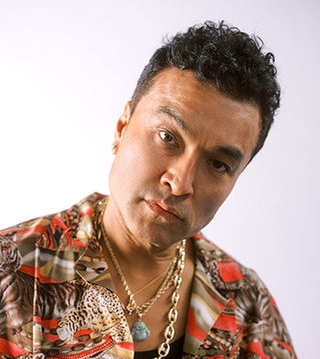
Jeff ChangGuest
Dennis BernsteinHostJennifer HasegawaHost
[laughs] I, I feel like Bruce was always in my life, you know? I mean, technically I was really, really young, probably just out of diapers or whatever when he first started appearing in the movies.

So I never got to see him in the theaters like my older cousins did or, you know, my uncles or that kind of thing, my aunties.

And so I kinda grew up in that generation where Bruce was just always there, you know? Like, I don't remember a first time I saw Bruce.


But I remember growing up, literally every time a Bruce Lee movie would come on, everything would stop.

Whatever we were doing, everything would stop, and we would all just sit there and watch.
Y'all, you know, your subtitle, Bruce Lee and the Making of Asian America, how did you make that connection? It sounds like it must have been quite natural, or was that a lightning flash moment for you when you put those two together?

Um, I studied here at Cal under Ron Takaki, you know? Um, and, uh, Ling-Chi Wang and all of the, all of the, you know, sort of stellar lights of Asian American studies.

Um, and of course during the '90s, you know, with magazines like Giant Robot and sort of folks like Jeff Yang doing A Magazine, there was sort of, uh, an upswelling, right? This is when the T-shirt comes out with Bruce behind two turntables, right? Um, so we were proud.

But I didn't really think of this as an Asian American thing until, until the pandemic.

Um, you know, I, I had been signed, uh, to do just a straight biography of Bruce, and I thought, "Okay, I'll be able to bring all these things to, to the table that other biographers have not." Um, but what happened was, you know, during the pandemic, of course, folks who look like you and I were in the streets.
The rest of this transcript — segmented and speaker-labeled, so you land on the exact moment something was said
Search every transcript — by keyword, by phrase, or by meaning, across every show Radar indexes
Trends — what is surging across podcasts, measured against its own baseline
Alerts — when a name you follow appears in a newly indexed episode
No account is needed to search Radar.