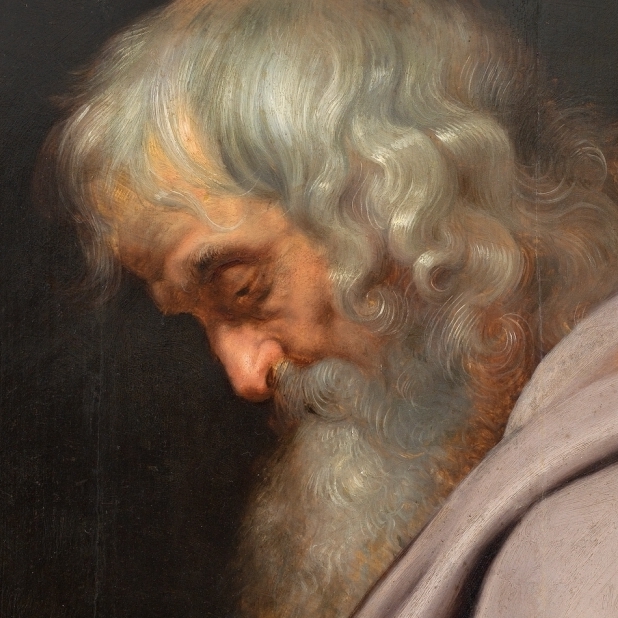
But unlike those earlier gospels, the author of Luke uses first-person language and clearly states that he is setting out to compose a historical document, such as in the opening line when he mentions earlier gospels, and that he is using information which has been delivered to him to compose his own, which is meant for someone named Theophilus.
though this usage of first-person language and mention of an approach similar to that of a historian as he wades through eyewitness accounts is limited to the opening chapters of the Gospel.
that of Jesus arising at the Jordan River to be baptized as an adult.
though this author was also familiar with Matthew's Gospel and borrowed material from that source as well.
Our oldest fragments of Luke, called p75 and p45, date to the late 2nd century, and our earliest fragment, which includes the first two chapters, called p4, doesn't appear until the 3rd century.
Marcion of Sinope, who assembled the first Christian canon around 145, included the Gospel of Luke as it existed in that time, and it lacked the opening chapters, as we know from Against Heresies by Irenaeus.
As for the name, it wasn't originally called Luke in 140, but was referred to as Evangelion, meaning good news or gospel.
The name later attached may have come from Colossians 4.14, a Pauline letter once thought to be authentic, but now widely regarded as a forgery.
There, the letter mentions a friend of Paul who is a physician.
How this one character in a forged letter was chosen to be the author of the anonymous gospel is lost to time, assuming that's who the author is supposed to be.
Whoever first began adding Luke's name to the top of this gospel may have been referencing someone else entirely, and the connection with the fabled physician is just a guess.
Luke frequently prefers Mark's Gospel over Matthew's, having a more Gentile-friendly stance than the pro-Jewish Gospel of Matthew.
The Sermon on the Mount, which Matthew constructed, is broken down by Luke into several smaller collections of sayings.
such as the statement from John the Baptist concerning the arrival of Jesus.
In Mark 1.8, John the Baptist states that he baptizes with water, but there is one who is coming who will baptize with the Holy Spirit.
But unlike those earlier gospels, the author of Luke uses first-person language and clearly states that he is setting out to compose a historical document, such as in the opening line when he mentions earlier gospels, and that he is using information which has been delivered to him to compose his own, which is meant for someone named Theophilus.
though this usage of first-person language and mention of an approach similar to that of a historian as he wades through eyewitness accounts is limited to the opening chapters of the Gospel.
that of Jesus arising at the Jordan River to be baptized as an adult.
though this author was also familiar with Matthew's Gospel and borrowed material from that source as well.
Our oldest fragments of Luke, called p75 and p45, date to the late 2nd century, and our earliest fragment, which includes the first two chapters, called p4, doesn't appear until the 3rd century.
Marcion of Sinope, who assembled the first Christian canon around 145, included the Gospel of Luke as it existed in that time, and it lacked the opening chapters, as we know from Against Heresies by Irenaeus.
As for the name, it wasn't originally called Luke in 140, but was referred to as Evangelion, meaning good news or gospel.
The name later attached may have come from Colossians 4.14, a Pauline letter once thought to be authentic, but now widely regarded as a forgery.
There, the letter mentions a friend of Paul who is a physician.
How this one character in a forged letter was chosen to be the author of the anonymous gospel is lost to time, assuming that's who the author is supposed to be.
Whoever first began adding Luke's name to the top of this gospel may have been referencing someone else entirely, and the connection with the fabled physician is just a guess.
Luke frequently prefers Mark's Gospel over Matthew's, having a more Gentile-friendly stance than the pro-Jewish Gospel of Matthew.
The Sermon on the Mount, which Matthew constructed, is broken down by Luke into several smaller collections of sayings.
such as the statement from John the Baptist concerning the arrival of Jesus.
In Mark 1.8, John the Baptist states that he baptizes with water, but there is one who is coming who will baptize with the Holy Spirit.
The rest of this transcript — segmented and speaker-labeled, so you land on the exact moment something was said
Search every transcript — by keyword, by phrase, or by meaning, across every show Radar indexes
Trends — what is surging across podcasts, measured against its own baseline
Alerts — when a name you follow appears in a newly indexed episode
No account is needed to search Radar.