
AHA MOMENT1:08
Consciousness Creates Space And Time
Space and time may be consciousness's creations

Vedanta Talks - Swami Sarvapriyananda
Feb 22, 2026 · 1 hr 2 min · 10 segments
Inside the Dream of Vasistha: The Fusion of Trika and Advaita Vedanta in the Yogavasistha by Prof. Sthaneshwar Timalsina Dr. Sthaneshwar Timalsina received academic and philological training from…
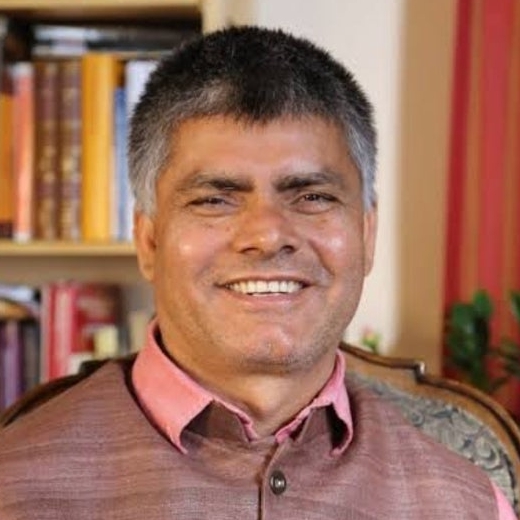
 Sthaneshwar TimalsinaGuest
 Diane CrawfordHost
No matter how radical, ideological the idea seems, in the first round when we hear Yoga Vasistha, actually, if we do a second round of reading or a third round of reading, we start connecting the dots and some deeper insights start coming.
My first introduction to the Yoga Vasishta was without knowing the book, but just some grandmother's stories and some added, not like textually correct, some whatever my grandmother felt like adding to make it more interesting.
And I was a little surprised that my grandmother, who could not read or write, was actually telling stories from an existing book.
Later, I decided to do my PhD on the central thesis of the Yoga Vasishta because I had two teachers who were like brothers, gurubai.
One teaching me Advaita Vedanta, another training me into Tantra Shastra with a focus on the Trika system.
And I found the Yoga Vasishta as a merging point, overlapping philosophy.
So I was not trying to read the narratives in the Yoga Vasishta as yet other stories, but wanted to find the connections, philosophical connections.
And so this second or third or whatever rounds of reading I have done since then I have only felt the need to read the Yogavashishta one more time and again one more time.
For those who have not read the Yogavashishta, this is a very simple book.
almost like fairy tale style stories, some like half stories, some just like a premise for a story, and some are really lengthy, voluminous stories.
And then the author starts giving philosophy in the middle of the narrative or sometimes in the beginning and at the end, of course, certainly.
In almost in a random way, you never know when he's going to start philosophizing the narrative.
But in every account, these narratives are illustrations, to make the case.
And what is the case? Number one, Consciousness is the only singular reality.
Many words in Sanskrit refer to this, chiti, chaitanya, and there are others like prajnaana.
Chit, Chiti, Chaitanya, Brahman, and goes beyond these words and also uses Manas or Chitta, the mind, for the same.
In technical philosophies, the mind and the consciousness are not used synonymously.
Mind is a product, citta is a product of that higher foundational consciousness, the Brahman.
But Yoga Vasishta sometimes makes that distinction, oftentimes doesn't care.


No matter how radical, ideological the idea seems, in the first round when we hear Yoga Vasistha, actually, if we do a second round of reading or a third round of reading, we start connecting the dots and some deeper insights start coming.
My first introduction to the Yoga Vasishta was without knowing the book, but just some grandmother's stories and some added, not like textually correct, some whatever my grandmother felt like adding to make it more interesting.
And I was a little surprised that my grandmother, who could not read or write, was actually telling stories from an existing book.
Later, I decided to do my PhD on the central thesis of the Yoga Vasishta because I had two teachers who were like brothers, gurubai.
One teaching me Advaita Vedanta, another training me into Tantra Shastra with a focus on the Trika system.
And I found the Yoga Vasishta as a merging point, overlapping philosophy.
So I was not trying to read the narratives in the Yoga Vasishta as yet other stories, but wanted to find the connections, philosophical connections.
And so this second or third or whatever rounds of reading I have done since then I have only felt the need to read the Yogavashishta one more time and again one more time.
For those who have not read the Yogavashishta, this is a very simple book.
almost like fairy tale style stories, some like half stories, some just like a premise for a story, and some are really lengthy, voluminous stories.
And then the author starts giving philosophy in the middle of the narrative or sometimes in the beginning and at the end, of course, certainly.
In almost in a random way, you never know when he's going to start philosophizing the narrative.
But in every account, these narratives are illustrations, to make the case.
And what is the case? Number one, Consciousness is the only singular reality.
Many words in Sanskrit refer to this, chiti, chaitanya, and there are others like prajnaana.
Chit, Chiti, Chaitanya, Brahman, and goes beyond these words and also uses Manas or Chitta, the mind, for the same.
In technical philosophies, the mind and the consciousness are not used synonymously.
Mind is a product, citta is a product of that higher foundational consciousness, the Brahman.
But Yoga Vasishta sometimes makes that distinction, oftentimes doesn't care.
Every episode on Radar is fully transcribed, speaker-labeled, and rich with metadata. Here is a taste of this one. Try Radar for free to see the rest.
3 of 10
Consciousness Creates Space And Time
Space and time may be consciousness's creations
Rebirth As A Reward System
Desire may shape more than personal outcomes
Dreams Have Real Consequences
Dreams can change us despite lacking permanence
+7 more clips · 15 min 9 sec of audio in all
7 of 16
The rest of this transcript — segmented and speaker-labeled, so you land on the exact moment something was said
All 10 clips — the highlight moments, each cut as its own audio, with a title and a speaker
All 10 segments — the transcript broken into labeled sections, every ad read marked
All 16 topics — jump to every other episode discussing the same subject
Every related episode — other shows Radar links to this one
No account is needed to search Radar.

