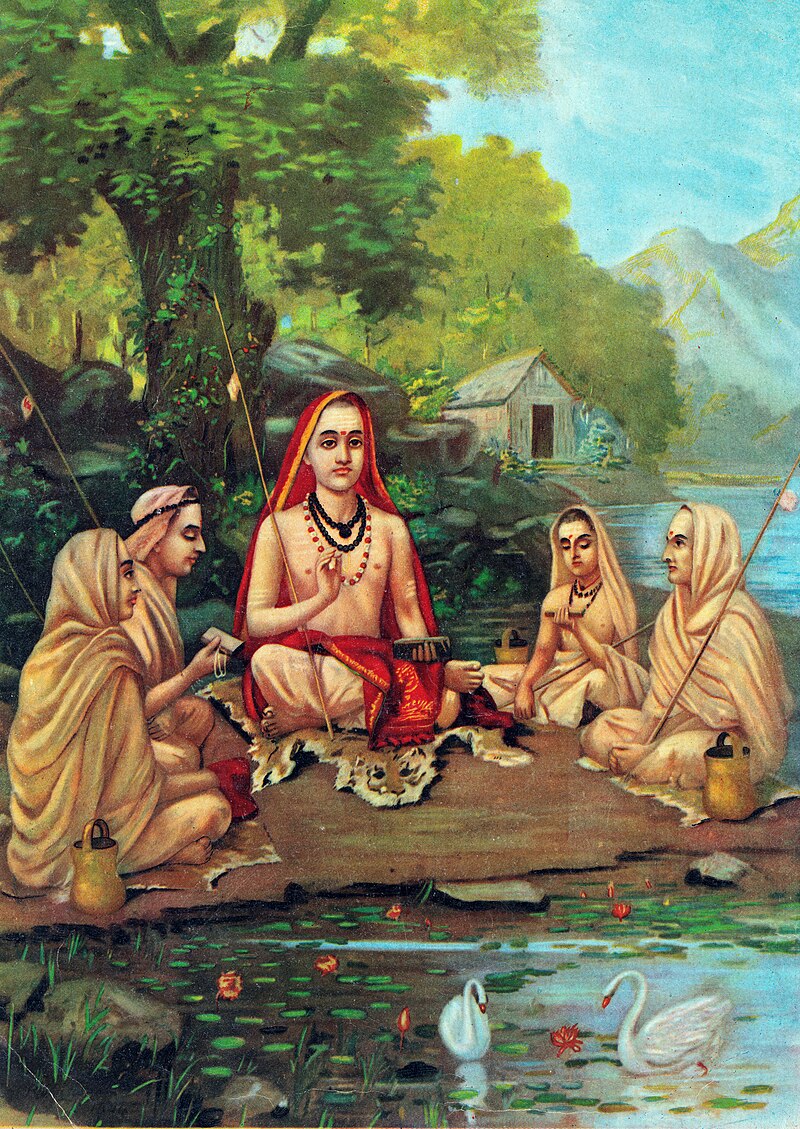
Adi Shankara
Indian philosopherWikipedia
326
MENTIONS
54
EPISODES
26
PODCASTS
Search complete. 326 mentions across 54 episodes found for "Adi Shankara".
Sep 11, 2026

Satyanarayana DasaHOST
But about Hinduism before that, there was no such mention that preaching was done.
Satyanarayana DasaHOST
But in the recent times, I think, when we see probably, of course, Sankaracharya priests and Vaishnavacharyas, they also preached.
Satyanarayana DasaHOST
But they were still limited to their places.
Satyanarayana DasaHOST
I think Sankaracharya was more prevalent.
Satyanarayana DasaHOST
But Madhavacharya, Ramanuja Sampradaya, they remained more to South India.
Satyanarayana DasaHOST
Then North India we had Nimbarka Sampradaya, then Vallabha came, so Chaitanya Mahaprabhu.

Alok PandeyHOST
So he's not just going to just take the mantras and The usual thing, because already by then, Yaska's commentary is there, among the famous ones.
Alok PandeyHOST
Sayana's commentary is there, Shankaracharya's commentary, some of them are there.
Alok PandeyHOST
And of course, later on, Max Muller and plenty of European, Tilak's commentary is there.
Alok PandeyHOST
So, there are already commentaries on the Vedas, but he is saying from a new standpoint.

Alka PandeGUEST
In fact, if you read Kalidas, sometimes you get really embarrassed reading in the Kumarasambha when you are reading the explicit scenes between, you know, even God's making love.
Alka PandeGUEST
And when you start reading about the beauty of Tripura Sundari done by Adi Shankaracharya, and you talk of her luminous breasts, which are like the thing of moons, you really wonder, here is a man writing about a woman's a Devi's body in that term so what does it show that Indians really did not they were not about commodification also there were no taboos and they were very open about their expressions and emotions and sensuality played a very very important role as I say even our gods made love So these are very important things.
Alka PandeGUEST
And you'll see, particularly in the medieval period, when the miniature tradition starts, there's a lot of erotic imagery there.
Alka PandeGUEST
Unfortunately, we have not yet made the parameters clear.

BinduHOST
So therefore the Krishna Arjuna Samvada or the dialogue between the Krishna and Arjuna has now become more intimate when Krishna addresses Arjuna with the very word Tata.
BinduHOST
In Shankara's
BinduHOST
view the core positions By directly answering Arjuna's fear point by point, you know, Arjuna's question had four elements.
BinduHOST
Ubhayavibrashta, fallen from both sides.
BinduHOST
As the Kalyanakrita is guided towards it again because Krishna's own declaration implies the Sadgati or good destination instead of the Vimodha, Vimodattva of Brahmanapati.
BinduHOST
The word Navidyate has an ontological impossibility of destruction.
BinduHOST
Shankaracharya says that
BinduHOST
vinasa na vidyate, destruction does not exist.

Saman ShrutpragyajiGUEST
Great knowledge.
Saman ShrutpragyajiGUEST
Sankaracharya in Hinduism, in eight years old, Sankaracharya, eight years, very small child, he have a lot of understanding.
Saman ShrutpragyajiGUEST
And in their life is very short life, only 33 years.
Saman ShrutpragyajiGUEST
Yeah.
Saman ShrutpragyajiGUEST
Age of the 33 passed away.
Saman ShrutpragyajiGUEST
And in 33 age, Sankaracharya established the Hindu culture throughout the India.
Saman ShrutpragyajiGUEST
So because of the past life experience, he enlightened in very young age.
KavitaHOST
Yeah.

Abigail AjaniHOST
It is a festival that has a much deeper meaning.
Abigail AjaniHOST
So the essence of Ganesh, if we were to extract it, was brought out beautifully by Adi Shankaracharya, who's a revered, um, spiritual saint here in India.
Abigail AjaniHOST
Though Ganesh is worshiped as the elephant-headed god, the, he has a different way of being described, which is Ajam Nil Vikalpam Nirahkaram Ekam.
Abigail AjaniHOST
So this means that Ganesh was never born.
BinduHOST
The samshaya is rooted in avidya which only a brahmachnyana can eradicate.
BinduHOST
At a deeper level, Sankaracharya reads samshaya as rooted in the fundamental avidya of non-recognition of Atman.
BinduHOST
Arjuna's doubts exist because he does not fully recognize Atman's nature.
BinduHOST
As his own nature, and as also indestructible, ever pure and ever present.
BinduHOST
Namo Brahmadibhyo Brahmavidya Sampradaya
speaker_3UNKNOWN
Kartrubhyo Vamsha Rishibhyo Mahabhyo Namo Gurubhyah Shruti Sprati Purananam Alayam Karunalayam Namami Bhagavad Padam Shankaram Lopa Shankaram Shankaram Shankaracharyam Keshavam Badarayanam Sutra Baashakrita Vande Bhagavantau Punapunah Ishwaro Guru Ratmeti Murti Veda Vibhagine Yoma Vat Vyapta Dehaya Dakshinamurthaye Namah The Gita Dhyana Shlokam.
speaker_3UNKNOWN
We saw that Arjuna was having
MendoHOST
doubt on the capacity for the Yoga Aruda or the one who is striving for achieving the Yoga Nishta or Yoga Yukta, Avastha.

Nishanth SelvalingamHOST
And that unchanging thing we call the transcendent.
Nishanth SelvalingamHOST
This is where the Shakta non-dual school agrees with the Kevala Advaita of Sri Shankara.
Nishanth SelvalingamHOST
Here we say, there must be some substratum for change.
Nishanth SelvalingamHOST
Like if a river is flowing, you need a riverbed for there to be any flow at all.
Nishanth SelvalingamHOST
Then we point to the riverbed and we say, that's Brahman, that's Atman.
Nishanth SelvalingamHOST
So the word that they use in the Upanishads Par excellence for this reality is the Atman.
Nishanth SelvalingamHOST
But that word Atman, self, is understood to be synonymous, at least along Shankara's interpretation, with Brahman, whose root is Bri, like Birhad Aranyakupanishad, vast.
Nishanth SelvalingamHOST
So Brahman is the all, the substratum of the river upon which everything flows.

Keith KempisHOST
Mm
Sandy KingHOST
... it's, it's a section selected by Sri Adi Shankaracharya, and it's in our Jivamukti chant book-
Keith KempisHOST
Mm
Sandy KingHOST
... very near the beginning, but it's one that is not chanted super often in my understanding.
44 more episodes mention Adi Shankara.
Create an account to see the whole feed, search across every transcript, and follow the entities you care about.