The EU Law Live Conversation Series
Jun 22, 2026 · 31 min · 11 segments
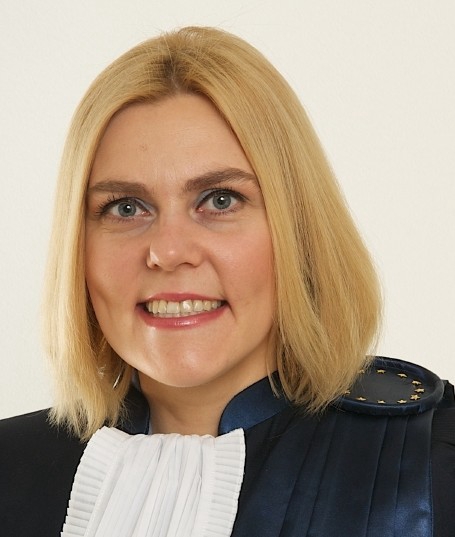
Daniel Sarmiento talks with Julia Laffranque, judge of the Estonian Supreme Court and former judge of the European Court of Human Rights, and former member of the 255 Committee, on the challenges and…
Julia LaffranqueGuest
Daniel SarmientoHost
Uh, to go through your very impressive career as a European lawyer, I'm delighted that we're doing this podcast.

Let me start from the earliest stages of your career, and we'll do a, a linear evolution of the many positions you've held and your experiences as a, as a judge.

But let me start in 2004, because that's the year in which you joined the Supreme Court of Estonia.

What did that transition to the bench mean for you personally? Where did you come from professionally before then, and how did this new position shape your understanding and the role and responsibility of, of a judge, and particularly in a constitutional, in a young constitutional democracy?

Uh, but I had already defended my doctoral thesis and had obtained a PhD in law from my alma mater, which is called University of Tartu.

Uh, I had also already worked for more than eight years at the Ministry of Justice of Estonia, first as an EU law expert, then as a head of EU law and foreign relations division, and finally as a deputy secretary general of the whole ministry.

I was responsible for the legislative drafting, so this was a top non-political highest position of civil service.

So I have very early on my career already gained experience in writing laws and leading teams.

But I must say that one of the highlights of my professional life prior joining the Supreme Court was the honor to be one of four authors who drafted the modifications of Estonian Constitution prior EU accession.

And this Estonian Constitution Amendment Act that I contributed to write with was adopted by referendum on 14th of September, 2003, and this was actually the, the way which enabled Estonia to accede to the EU, uh, in conformity with the rule of law.

The turnout was impressively high, sixty-four percent, and almost sixty-seven percent voted in favor of constitutional amendments and EU accession.

Thus, for me, the transition to the bench meant a logical step from law making to applying and to interpreting law, and this was very appealing to me.

I wanted to have experience how the abstract written laws perform in practice and how I can help people concretely.

And this happened interestingly just about the same time when Estonia became member of the EU.

I took the oath before the Estonian Parliament as a judge at the Supreme Court in International Women's Day in 2004, and Estonia joined EU officially less than two months later on 1st of May the same year.

Some of them were previously judges, other prosecutors, private lawyers, professors.

Uh, to go through your very impressive career as a European lawyer, I'm delighted that we're doing this podcast.

Let me start from the earliest stages of your career, and we'll do a, a linear evolution of the many positions you've held and your experiences as a, as a judge.

But let me start in 2004, because that's the year in which you joined the Supreme Court of Estonia.

What did that transition to the bench mean for you personally? Where did you come from professionally before then, and how did this new position shape your understanding and the role and responsibility of, of a judge, and particularly in a constitutional, in a young constitutional democracy?

Uh, but I had already defended my doctoral thesis and had obtained a PhD in law from my alma mater, which is called University of Tartu.

Uh, I had also already worked for more than eight years at the Ministry of Justice of Estonia, first as an EU law expert, then as a head of EU law and foreign relations division, and finally as a deputy secretary general of the whole ministry.

I was responsible for the legislative drafting, so this was a top non-political highest position of civil service.

So I have very early on my career already gained experience in writing laws and leading teams.

But I must say that one of the highlights of my professional life prior joining the Supreme Court was the honor to be one of four authors who drafted the modifications of Estonian Constitution prior EU accession.

And this Estonian Constitution Amendment Act that I contributed to write with was adopted by referendum on 14th of September, 2003, and this was actually the, the way which enabled Estonia to accede to the EU, uh, in conformity with the rule of law.

The turnout was impressively high, sixty-four percent, and almost sixty-seven percent voted in favor of constitutional amendments and EU accession.

Thus, for me, the transition to the bench meant a logical step from law making to applying and to interpreting law, and this was very appealing to me.

I wanted to have experience how the abstract written laws perform in practice and how I can help people concretely.

And this happened interestingly just about the same time when Estonia became member of the EU.

I took the oath before the Estonian Parliament as a judge at the Supreme Court in International Women's Day in 2004, and Estonia joined EU officially less than two months later on 1st of May the same year.

Some of them were previously judges, other prosecutors, private lawyers, professors.
The rest of this transcript — segmented and speaker-labeled, so you land on the exact moment something was said
Search every transcript — by keyword, by phrase, or by meaning, across every show Radar indexes
Trends — what is surging across podcasts, measured against its own baseline
Alerts — when a name you follow appears in a newly indexed episode
No account is needed to search Radar.