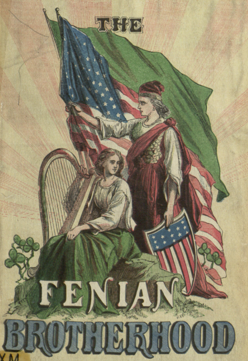
117 The Fenians (Part Two)
Aug 27, 2026 · 1 hr 16 min · 15 segments
 On this episode of the Irish History Show we returned to…
- Speakers
 John DorneyHost
 Cathal BrennanHost
Aug 27, 2026 · 1 hr 16 min · 15 segments
 On this episode of the Irish History Show we returned to…
John DorneyHostCathal BrennanHost
First of all, not that many people are killed as a result of the 1867 rebellion, but lots of people are imprisoned, like thousands, and several hundred of them are transported to Australia to penal servitude, et cetera.
Now, the Fenians have a big thing about rescuing prisoners, so as we saw, the Manchester Martyrs emerged from an attempt to rescue two leaders, Kelly and Deasy, who were on their way to trial in Manchester.
They also tried to rescue prisoners in Ireland, and as we'll see, we'll talk about later, even as far afield as Australia.
But in Clerkenwell, there's a load of Fenian prisoners imprisoned there, and the Fenians attempt to blow them out.
So they use dynamite, and they attempt to blow in the wall of Clerkenwell prison in East London.
And it not only blows down the wall, although it doesn't free the prisoners, it damages many of the tenements in the area.
It's one of the things that the incoming Prime Minister Gladstone said made him focus on the Irish question, the loss of life in the Clerkenwell explosion.
Now, a couple of things to say about this because it prefigures some of what Fenianism is going to do over the next 20 or 30 years.
The Fenians envisioned themselves not as terrorists as we would use the phrase, and by terrorism, it's a very loaded phrase, we mean individual acts of violence or very small group acts of violence at symbolic targets designed to instill fear or terror in the enemy.
On the other hand, this is what the Fenian organization turns out to be best at because the Fenian organization is small individual circles, which are basically cells, which are not connected with each other except by one center.
And this is the whole idea of Fenianism, to maintain secrecy, but that is a very poor structure for a large paramilitary organization, which the Fenians would have liked to have been to fight open battles and so on.

There is that debate, isn't there, all the way through the latter half of the 19th century, that some of the Fenian leaders, and particularly the leadership like the Supreme Council, view the IRB as an organization that would almost take to the field in uniforms, in pitched battles against the British, and that this was dishonorable, these individual acts of terrorism.
But you have the more realist members of the Fenians saying that, "Look, just we cannot compete with the British Army.
They're better funded, they're better organized, they've more weapons, and it's just going to be a bloodbath.
First of all, not that many people are killed as a result of the 1867 rebellion, but lots of people are imprisoned, like thousands, and several hundred of them are transported to Australia to penal servitude, et cetera.
Now, the Fenians have a big thing about rescuing prisoners, so as we saw, the Manchester Martyrs emerged from an attempt to rescue two leaders, Kelly and Deasy, who were on their way to trial in Manchester.
They also tried to rescue prisoners in Ireland, and as we'll see, we'll talk about later, even as far afield as Australia.
But in Clerkenwell, there's a load of Fenian prisoners imprisoned there, and the Fenians attempt to blow them out.
So they use dynamite, and they attempt to blow in the wall of Clerkenwell prison in East London.
And it not only blows down the wall, although it doesn't free the prisoners, it damages many of the tenements in the area.
It's one of the things that the incoming Prime Minister Gladstone said made him focus on the Irish question, the loss of life in the Clerkenwell explosion.
Now, a couple of things to say about this because it prefigures some of what Fenianism is going to do over the next 20 or 30 years.
The Fenians envisioned themselves not as terrorists as we would use the phrase, and by terrorism, it's a very loaded phrase, we mean individual acts of violence or very small group acts of violence at symbolic targets designed to instill fear or terror in the enemy.
On the other hand, this is what the Fenian organization turns out to be best at because the Fenian organization is small individual circles, which are basically cells, which are not connected with each other except by one center.
And this is the whole idea of Fenianism, to maintain secrecy, but that is a very poor structure for a large paramilitary organization, which the Fenians would have liked to have been to fight open battles and so on.
There is that debate, isn't there, all the way through the latter half of the 19th century, that some of the Fenian leaders, and particularly the leadership like the Supreme Council, view the IRB as an organization that would almost take to the field in uniforms, in pitched battles against the British, and that this was dishonorable, these individual acts of terrorism.
But you have the more realist members of the Fenians saying that, "Look, just we cannot compete with the British Army.
They're better funded, they're better organized, they've more weapons, and it's just going to be a bloodbath.
The rest of this transcript — segmented and speaker-labeled, so you land on the exact moment something was said
Search every transcript — by keyword, by phrase, or by meaning, across every show Radar indexes
Trends — what is surging across podcasts, measured against its own baseline
Alerts — when a name you follow appears in a newly indexed episode
No account is needed to search Radar.