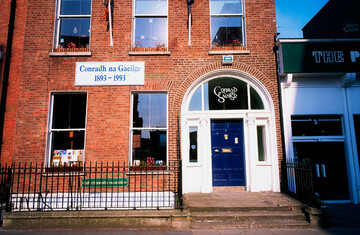
Conradh na Gaeilge
Adult education school in Dublin, IrelandWikipedia
4
MENTIONS
4
EPISODES
4
PODCASTS
Search complete. 4 mentions across 4 episodes found for "Conradh na Gaeilge".
Sep 24, 2026

Donal FallonHOST
In England, you'll find a few thousand of perfectly cultivated people, but you'll find the mass of the people singing songs of the music hall.
Donal FallonHOST
And even harsher were the words of Douglas Hyde, Douglas de Gieda, our first president, founder of the Gaelic League, who wrote in 1907 of his view that music halls were kind of part of a broader rot that had set in.
Donal FallonHOST
Of Ireland, he said, her delightful music, once the joy of the Western world.
Donal FallonHOST
was being replaced with the most worthless of foreign trash, her native instruments were being superseded by the concertina and the melodion, and her traditional native songs were being universally replaced by the paltriest and lowest ditties from the music halls of London or of Liverpool.

Diarmaid FerriterHOST
It's being revitalised especially in urban centres in the early 20th century.
Diarmaid FerriterHOST
He joins the Gaelic League, which had been established in 1893 to revive the Irish language.
Diarmaid FerriterHOST
He's actually...
Diarmaid FerriterHOST
And

BrianGUEST
[coughs] I mean, when it was started in 1904 by Brían Óg Éad, a Cork woman by the way, I mean, she was very interested in reviving the Gaelic culture.
BrianGUEST
She was a member of Conradh na Gaeilge, the Gaelic League, and she wanted women to participate in all parts of society, including sports, and she started the Camogie Association.
BrianGUEST
And at the start, only women were allowed to take positions within the Camogie organization and within clubs so that the women would have the confidence to be able to run these organizations.
BrianGUEST
And it also meant that they were, didn't have to be depending on, uh, men to do things for them.

Dan MulhallGUEST
Look, it seems to me that the great achievement of Devil Era And many others who made that journey across to the United States from the late 19th century onwards when it became very easy to travel across the Atlantic.
Dan MulhallGUEST
And like, for example, Douglas Hyde, when he was president of the Gaelic League, went over and spent seven months traveling around America raising money for the Gaelic League.
Dan MulhallGUEST
John Redmond raised huge amounts of money for the Home Rule Party.
Dan MulhallGUEST
The Irish-American, who were the Fenian movement in America, they sent vast amounts of money back to Ireland to prepare for the Easter Rising.