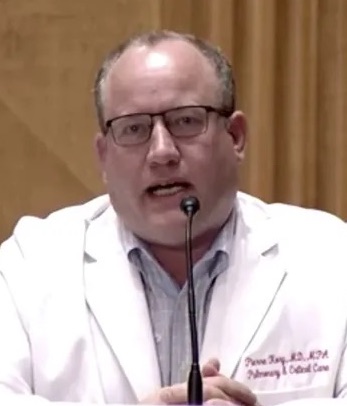
Pierre Kory
American physician
21
APPEARANCES
10
PODCASTS
Oct 16, 2026


Steve KirschGUEST
They said, "You know what? We need studies on veterans," 30 years later, okay?

Pierre KoryGUEST
okay?They were investigated by a congressional committee and found that they manipulated and misled the public.
Pierre KoryGUEST
They've gone on over the next few decades to address a number of toxins for which the government would be having to pay out massive compensation claims, including Gulf War syndrome, the anthrax vaccine, where veterans, chronically ill, lives destroyed from Gulf War syndrome, they tested for squalene, an ingredient in the anthrax vaccine.
51 MINS LATER
Dave FarinaHOST
Since the debate was dragging on, Travis decided to skip straight to the last topic, and that's the ivermectin shit, Pierre's bread and butter.
Pierre KoryGUEST
I put it up on a preprint server, and within one week I treated my first patient with ivermectin.

Pierre KoryGUEST
They wouldn't be breathing at 40 or 50 or, you know, tripoding or nasal flaring.
Pierre KoryGUEST
And I remember, this is like my f- second week in the ICU, uh, in New York, and I remember I was literally taking a shower one morning and I said, "Wait a second.
Pierre KoryGUEST
They're behaving like patients with organizing pneumonia." 'Cause I remember some of these cancer patients that I would see on the medical wards in consultation who would be on these high-flow nasal cannulas, but they would be comfortable.
Pierre KoryGUEST
They would be in a regular floor on lots of oxygen, which is pretty unique, you know, historically.
24 MINS LATER
Kimberly OvertonHOST
What I really want to ask you though, is when you, when you first kind of discovered that ivermectin had some real potential to be a game changer with this virus, did you go into that Senate testimony, like, expecting th- that, like, maybe they just don't know, and you, you were really excited to tell them and share this information? Did you feel like they were going to embrace it, and we were gonna kick this virus in its ass? Or were you surprised at the, at the, the call?

Ron JohnsonMODERATOR
Just speak to that a little bit.
Pierre KoryGUEST
In fact, the last time I checked, and I stopped checking a while ago, but there was 106 different studies and trials on ivermectin.
Pierre KoryGUEST
The vast majority, or the overall signal around it, shows immense impact on mortality.
Pierre KoryGUEST
If you look at just the WHO's review of ivermectin done in the spring of 2021, if you look very carefully in there, they found an statistically significant 81% reduction in mortality, yet their recommendation to the world was to only continue to use it within the context of a clinical trial.
1 HR 25 MINS LATER
Ron JohnsonMODERATOR
But, uh, Dr. Corey.

Natali MorrisHOST
But also, I don't think that people understood they were going all the way through that, right? And so you need to tell them before you do that.
Pierre KoryGUEST
Well, going on a ventilator, you know, the real challenge that I think around ventilators is that You know, the challenge of an ICU doctor, which was my specialty, is you never want to put someone on a ventilator too late and you don't want to put them on too early.
Pierre KoryGUEST
I taught specialists how to become an ICU specialist or doctors how to become ICU specialists.
Pierre KoryGUEST
And, you know, the right time to put someone on ventilators generally in the eyes of the beholder.
22 MINS LATER


Pierre KoryGUEST
But it was just, there was a seriousness to the book that kind of had me, you know, like, this is interesting.
Pierre KoryGUEST
But I still had a lot to learn about chlorine oxide because I made my first fatal error.
24 MINS LATER
47:37

So where are we right now, in your opinion, being a truth-teller that's been in the battle now for six years at the front lines? Informed consent and medical freedom, where are we in the United States of America now?
Pierre KoryGUEST
One is a description of the same reality we've been living through, which is when you say informed consent, that means that you are able to gather as a physician and deliver to a patient the accurate information you need around any sort of therapy.
Pierre KoryGUEST
The pharmaceutical industry distorts, manipulates, and hides, uh, data that's inconvenient to it.

Pierre KoryGUEST
Yeah, so, I mean, I didn't sign up for this, uh, job, but I got thrust into it.
Pierre KoryGUEST
But basically, you know, I'm a pulmonary and critical care specialist, and when this disease was coming at us, you know, it was a pulmonary and critical care disease.
Pierre KoryGUEST
Everybody was landing on ventilators, and me and a few colleagues, we started a nonprofit and we just started reading everything we could.
Pierre KoryGUEST
We learned everything we could about the disease and how to treat it, and the government was not putting out any treatment guidance besides, like, supportive care only nonsense.
Pierre KoryGUEST
And we started publishing protocols, and we were highly published, very well recognized in our specialty.

Pierre KoryGUEST
Yeah, so, I mean, I didn't sign up for this, uh, job, but I got thrust into it.
Pierre KoryGUEST
But basically, you know, I'm a pulmonary and critical care specialist, and when this disease was coming at us, you know, it was a pulmonary and critical care disease.
Pierre KoryGUEST
And me and a few colleagues, we started a nonprofit and we just started reading everything we could.
Pierre KoryGUEST
We learned everything we could about the disease and how to treat it, and the government was not putting out any treatment guidance besides, like, supportive care only nonsense, and we started publishing protocols.

Pierre KoryGUEST
Let me, let me play devil's advocate 'cause I think this is a really important point that the public needs to understand.
Pierre KoryGUEST
Not only is there delays that are, uh, you know, automatic when you do a trial, right? Because of all of those steps you have to go to to put someone in a trial.
Pierre KoryGUEST
But the thing is is the opposite thing is true, is Paul's hospital and the system and the way his ICU ran is not completely unique, but it's extremely rare in the organization of hospitals, and that is...
Pierre KoryGUEST
And I, I, when I learned this, that's why I finally figured out why Paul's results are completely different than everyone else's, even mine.
Pierre KoryGUEST
Because I worked in a hospital that didn't have the same system as his, and that's...
30 MINS LATER


Pierre KoryGUEST
You know, everything they did, every action they took was to service their own interest and increase profits.
Pierre KoryGUEST
Anyone who talks sideways about their products, whether it be the vaccines or molnupiravir or Paxlovid, they needed to silence them.

Adryana CortezHOST
According to Dr. Kory, there was no consensus on treatment in the guidelines derived by big national and international societies, so his leadership reverted to a treatment process he'd never seen before.
Pierre KoryGUEST
before.I was being told by people above me that we should do nothing, meaning supportive care only.
Pierre KoryGUEST
And supportive care only for a viral syndrome just means like fluids if you're dehydrated, oxygen if you n- need oxygen, Tylenol for fever.
Pierre KoryGUEST
Normally, the true advances and discoveries happen organically on the ground by those on the front lines.
Pierre KoryGUEST
You discover that you, you do trial and error u- using risk and benefit, and you find stuff that works.
12 MINS LATER


Clayton MorrisHOST
Have you been able to figure out, like, where the money flows in all of this?
Pierre KoryGUEST
I'll give you the textbook answer [laughs] and then the new, this brave new world we're in.
Pierre KoryGUEST
Um, the textbook answer is that it's really poorly transmissible human-to-human.
Pierre KoryGUEST
Um, in fact, there's really only one strain that you even concern yourself with, and unfortunately, that's the strain that was apparently on that ship.
Pierre KoryGUEST
The, the American strains, the European strains, really rare to have human-to-human transmission.

Pierre KoryGUEST
So the re- actually I'll tell you why you're asking that question because you are in a world where ivermectin is unproven, so you might get this wrong, Dr. Kory, and so what would it take for you to admit that you're wrong? And I'm sorry, I don't have an answer for that.

Wendy ZukermanHOST
But what if it's not?What if it's not? Like, what if, what if you remove, what if you remove the conspiracy?

Pierre KoryGUEST
... um, I think that's kinda the way to go and, you know, I was, I'll give you a personal example.
Pierre KoryGUEST
I have a, a telehealth practice, I have 30 employees and we pay for their health care insurance or we subsidize it, uh, uh, significantly.
Pierre KoryGUEST
But I will tell you the kind of people that I work with in my community, my, you know, network, they're not interested in getting care from a system that is so controlled, so curated-
Pierre KoryGUEST
And so I'd, I'd, I'd love, uh, uh, yes, a f- freeing up of the health care system and g- you know... and the thing is, the re- what I think my employees and nurses really want is, is... and, and to be honest, it's, it's really what I am so happy about is that I'm a fee based practice.
Natali MorrisHOST
What do you make of the spin on this and, and what we can take from it, this study?
Pierre KoryGUEST
So it's, it's a study that's called a retrospective single center observational study.
Pierre KoryGUEST
Now, any time you have a study that, like that and you have any findings with which result for that, in typical science fashion, they do not allow you to make conclusions from such a study.
Pierre KoryGUEST
You can say that we found an association, a correlation, but they don't allow you to say that this does that.
Pierre KoryGUEST
So they take this very limited retrospective single center study, and how does the media portray that to the society? As if the vaccines are this, you know, amazing addition to cancer therapy, that if you're on a specific cancer therapy and you get the vaccine, it's like a, a two for one.
9 MINS LATER
Pierre KoryGUEST
I think it's fitting that that doctor is a pediatrician because they're acting like a child who's trying to do what daddy or mommy told them to.
Pierre KoryGUEST
You know, they're literally just robotically following what the CDC used to say.
Pierre KoryGUEST
The new CDC, they don't trust, right? So, you see how they behave when they don't trust the new DC- CDC and when they trusted the old one, they did everything it could, and they're- they're scram-...
Pierre KoryGUEST
They don't know what to do, right? And so, um, i- it's just- it's just bizarre that- that- that they're still relying on old guidance from a clearly a corrupt exercise.
Pierre KoryGUEST
And when you juxtapose Trump's, um, admission that, "Hey, uh, I might have gotten something wrong here.
speaker_15UNKNOWN
Yeah.
Pierre KoryGUEST
You know, I dug into the data behind that, uh, article, and, you know, I- I'll, I'll just be open and honest with you.
Pierre KoryGUEST
I mean, my first thought when I saw that headline is, duh, you know, this is probably related to the COVID mRNA vaccine campaign.
Pierre KoryGUEST
But to be honest, the data that I found, um, doesn't really support a direct association with that, because strokes have been rising in this age bracket of 18 to 44 consistently over the last 15 years, from year to year.
Pierre KoryGUEST
There was maybe a slight uptick in 2021, but it wasn't like anything that you would, uh, find is remarkable.
Pierre KoryGUEST
And so I think really the issue is, um, why do they keep rising? And we're seeing more and more young people have strokes than ever before.
Pierre KoryGUEST
So, first and foremost, I would say the one that has the evidence base already that you wouldn't...
Pierre KoryGUEST
Is, is sort of nasopharyngeal sterilization or dis- disinfection, so things like iodine sprays, uh, Xylitol sprays.
Pierre KoryGUEST
The, the nasal carriage and pharyngeal, um, apparatus, uh, has the highest burden of those viruses.
Pierre KoryGUEST
And we know if you reduce viral loads simply by topical applications, mouthwash, and sprays, you actually...
6 MINS LATER
Clayton MorrisHOST
Uh, what are your, what is your recommendation for people now to get this outta their body? Can they?
23:12
... there's a 200-page report the parents had, and the parents gave that to you?
Pierre KoryGUEST
I'm a lung specialist and an ICU specialist, and probably one of the most common diseases I've treated in my career is pneumonia.
Pierre KoryGUEST
Uh, but to keep that 200 pages in context, Steve, I've done medical malpractice reviews throughout my career.
Pierre KoryGUEST
But 'cause she, because the reason why it's not that a lot i- she was not in the hospital very long until she died, and that's the tragic, um, uh, that's one of the tragic, uh, facets of this.
11 MINS LATER
23:11
How do you... There's a 200-page report the parents had and the parents gave that to you?
Pierre KoryGUEST
Yeah, so they released the records, uh, and (clears throat) I was sent the records. I'm a lung specialist and an ICU specialist, and probably one of the most common diseases I've treated in my career is pneumonia. Uh, but to keep that 200 pages in context, Steve, I've done medical malpractice reviews throughout my career. Uh, 200 pages is not a lot. I've had a 1,000 and 1,500-page (laughs) records. But 'cause she, 'cause the reason why it's not that a lot i- she was not in the hospital very long until she died, and that's the tragic, um, uh, that's one of the tragic, uh, facets of this. But, you know, per what Mary and Brian were saying, um, I'm gonna be as clear as I can be.She came in with a community-acquired pneumonia, and I'm going to give the hospital credit. They made the correct diagnosis. In, in the chart, it clearly says it, that it's a secondary bacterial pneumonia, which can happen after viral infections. I have three daughters. One of mine, when she was 13, had influenza, and a couple of... like, a week later, she also developed a secondary bacterial pneumonia, which we treated at home with an antibiotic, and she did fine. So it's not just about measles. Any virus can do this. They temporarily suppress the immune system. But let's go back to this case. This case, the child came in with a pneumonia. It was correctly diagnosed. The standard of care... And, and when you talk about malpractice, in order to prove malpractice and the definition of malpractice, is when a physician's treatment violates the standards of care. The standard of care for the treatment of community-acquired pneumonia is the administration of two separate antibiotics. One, which is what's called a beta-lactam, which is like penicillin or a cephalosporin, and the other one is a macrolide which is like a azithromycin. That combination is standard. It's what I've given to patients all throughout my career. Anyone who comes in with a pneumonia, because you don't know what the organism is. So the, the guidelines are set up so that the antibiotics that you choose cover all of the most common organisms from the community. Mycoplasma, which is what she died of, is so common, it- it's like Medicine 101, Steve, to put someone on a Z-Pak, uh, because penicillins and cephalosporins do not cover mycoplasma. (music) And the... What's worse about this case is... Okay, so you don't know what the pneumonia is on admission. That's why we have those... We, we've checked... We've studied data for decades. We know what antibiotics to use, and they didn't do it. They chose two antibiotics, none of which cover mycoplasma. What's worse about that, is she continued to decline over the next few days, and they still didn't change the antibiotic regimen. They only changed it after a test came back telling them it was mycoplasma.
9 MINS LATER
Pierre KoryGUEST
I am not saying that, you know, it was the trainee that made the mistake. It was... I don't know what was in their head when they chose the regimen, but what happened next is the doctor above them, right, who is called the attending physician, uh, for whatever reason, did not change or correct that regimen. And the regimen that was chosen was they got one of the two, uh, uh, antibiotics right. The second one was actually a very powerful antibiotic, which is used to treat multi-drug resistant organisms. However, it doesn't cover the very common community-acquired, uh, uh, pneumonia organism. So, it's not clear to me... Uh, they must... Whoever chose that must have felt, "Oh, we're doing very aggressive antibiotic care," but it, it showed, it belied a lack of knowledge into how to treat a community-acquired pneumonia.