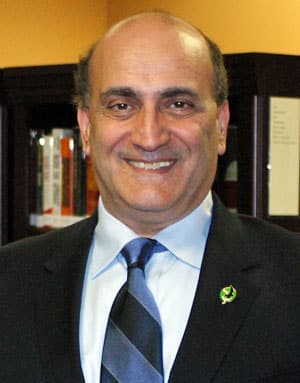
Walid Phares
Lebanese-American scholar
18
APPEARANCES
6
PODCASTS
Oct 2, 2026


Walid PharesGUEST
I wish I was in the Oval Office to give him at least [laughs] some of my suggestions.
Walid PharesGUEST
Number one, it is late if you want to avoid the backlash of midterm elections.
Walid PharesGUEST
Actually, those who are gonna vote with the other side have decided, same for the President's sides, which is the Republicans.
Walid PharesGUEST
But what the President can do, and his basic instincts already told him, you can read it on his, on his face, he doesn't trust the Islamic regime anymore.

Raymond ArroyoHOST
Why does this continue, and why does the Nigerian government still insist it isn't religious or religiously motivated?


Walid PharesGUEST
If you allow me, I'll segue a little bit and then we address more details if you want.
Walid PharesGUEST
First, who is this super coalition representing? It's not really an organization.
46 MINS LATER


Dan BallHOST
Who are we talking about that's still doing business with Iran that we've told months ago, "Stop doing business"?
Walid PharesGUEST
The, the, the, the sheer power of the Treasury Department in America is global, global reach.
Walid PharesGUEST
There is one for the Treasury Department, and all other intelligence services and our allies, should they be in Europe, in Israel and in Arab-friend, friendly, uh, forces.
Walid PharesGUEST
But let me make one comment in the beginning to understand the map we are dealing with.
speaker_1UNKNOWN
Okay
Walid PharesGUEST
The president now is going a little bit more in the right direction on all fronts, confronting the Islamic regime in Iran, we'll talk about it, bringing in the Saudis, good Lord, from, from years of absence from the battlefield, uh, sending missiles with us against the, the regime in Iran.
Walid PharesGUEST
But the more important matter is that now President Trump realized that without his own intervention between Ukraine and Russia, it's not gonna be resolved.
Walid PharesGUEST
And the problem has been that the Kremlin should have taken advantage of having a president like President Trump in the White House to help them.
speaker_1UNKNOWN
Mm-hmm
Dan BallHOST
doc let's start this time because it's always about iran iran with russia ukraine because man has ukraine been stepping it up i thought they were decimated if you listen to russia and they didn't have much to fight back with but they have been striking near moscow inside moscow inside russia they're hitting energy oil all this stuff i got to imagine that putin at some point is going to have to want to come to the bargaining table am i wrong
Walid PharesGUEST
You know, the North Koreans and the Chinese have pushed all the way down to the peninsula.
Walid PharesGUEST
And we pushed them down, up with the Southern Koreans, all the way to a certain limit, which became the border.
Walid PharesGUEST
So now at this point in time, the Kremlin, that's President Putin's advisors, they initially wanted to take all of Ukraine and the capital.


Eric LevinePANELIST
Do you share the same view that some of the people that are giving the president advice just don't know or understand who the Iranians are?
Walid PharesGUEST
And we need to be absolutely loyal to facts that we are presenting to the president.
7 MINS LATER
Walid PharesGUEST
These are two different things that they have the control of the process, that they are going to be forcing the United States to send them the money they want.
speaker_6ADVERTISER
Start your show today at Spreaker.com. Spreaker, because if you're going to talk to yourself for an hour, you might as well publish it.
Walid PharesGUEST
The American side, President Trump, his vice president, and their team find this deal as good, sustainable, and they will have a lot of eyes to observe it.
Walid PharesGUEST
But the Iranian or the Islamic regime side interpretation of the deal It's still untrusted by me.
Walid PharesGUEST
You know what? The answer to this deal from the Islamic regime side is, are they still at war with the United States? They have to bring down those slogans of you know, death to America, death to Israel.
Walid PharesGUEST
So there's a lot of work to be done on their side for that to happen, for me to be able to trust it.
Walid PharesGUEST
that a similar conversation took place at the end of the 12-day war last year, and we tend to forget it.
Dan BallHOST
But where are we in the actual peace negotiations? This ceasefire was only for, what, 60 days? And it barely lasted a few days.
Walid PharesGUEST
You and I have been discussing this for a while now, and that is the right statement.
Walid PharesGUEST
He has to unlink the campaign against that regime from the campaign to maintain a majority and maybe increase it in Congress.
Walid PharesGUEST
The regime has as leadership commanders of the IRGC, but they have the bankers now.

Walid PharesGUEST
There are certainly differences between, uh, Israeli explanation and US explanation, and even within the US, uh, between various poles of the, uh, administration.
Walid PharesGUEST
But the general strategy is that all negotiations, serious negotiations with the Islamic regime in Iran have failed, and that the story did not, uh, start a few weeks ago when the military operation, uh, started.
Walid PharesGUEST
It, it really started at the end of the twelve-day war, uh, back in, uh, in the summer last year.
Walid PharesGUEST
And the issue was that the Israelis were ready at the end of the twelve-day war to continue and strike exactly as the coalition now is striking, meaning targeting mostly the IRGC and of course the larger popular militia, uh, which is the Basij.
Walid PharesGUEST
But somehow, probably Qatar intervened and others intervened and promised that the regime at the time, Khamenei was in charge, uh, will make considerable, uh, concessions.

Ben WhedonHOST
Um, so do you see a credible on-the-ground, uh, alternative to the current Islamic Republic?

Walid PharesGUEST
It all depends on what would our partners, Arab partners, uh, what would Turkey do? What would many countries do? And also, what would China and Russia do? We know that Russia is now very busy in Ukraine.
Walid PharesGUEST
China could be busy sending equipment to the regime, the Islamic regime of Iran.
Walid PharesGUEST
The problem is, would, after two or three days, they still have airports and airfields to land this equipment? So it's going very, uh, fast.
Walid PharesGUEST
Secretary of War Pete Hegseth described this morning in a, in a stunning way what we are actually doing on the ground, and it could be summarized very quickly.
Walid PharesGUEST
They have no more navy, or let's say 90% of the navy is already gone, which means something very important.

Terrance BatesHOST
How do we determine when we're finished, when this mission is complete? Uh, do you have any idea? Or, or from your perspective, what would a metric of completion of this war be?

Eric BollingHOST
What is your assessment of where things stand at, what is this, 4 o'clock on Monday, about 48 hours after this thing started, maybe a little longer?
Walid PharesGUEST
yeah eric we this is great we are at the third day we have done only 10 to 15 but the most important of the whole conflict is to start with doing the the ultimate objective now is to make sure that the iranian navy or the regime's navy is destroyed or disabled why because that way we can protect the hormones passage which is so important economically for the rest of the world and for us And second is to attack the ICBMs as the secretary of war, Pete Hexett has said, making sure that they won't have delivery systems.
Walid PharesGUEST
Thirdly, of course, destroying the Iranian air force or the regime's air force.
Walid PharesGUEST
As we can see now on the screen, these wonderful, you know, air force planes and fighters can defeat the other side.
Walid PharesGUEST
You and I have discussed before the war that the two goals are to bring down or to dismantle the IRGC.
Eric BollingHOST
Are those countries not going to step up and say, enough Iran, we're going to get involved in this? I mean, it would seem like that would be the thing it would take to bring the regime down fully and completely.
Walid PharesGUEST
Eric, this is the usual narrative by Islamist regimes, in this case, humanists in Iran regime.
Walid PharesGUEST
They are the ones who have been shooting, machine gunning, mowing down people.
Eric BollingHOST
Doctor, is it a regime change or is removing Ali Khomeini, the Ayatollah, simply akin to removing Maduro in Venezuela and the infrastructure that's already there just replaces him? How does this work?
Walid PharesGUEST
I mean, if we take the Venezuelan model and try to apply it to Iran, they are about, they say, at least 12,000 people killed by the regime.
Walid PharesGUEST
Either they're going to continue to kill and get them to 100,000 or they're going to go.
Walid PharesGUEST
I don't imagine that there's going to be a national cabinet of unity between the Islamic regime and these masses.
Eric BollingHOST
So the religious fanaticism, will there ever be a case where they've been removed from power? They can still exist, but at least from the day-to-day running of the country? Let me

David BrodyHOST
But what about Delcy Rodriguez and the rest of the Maduro regime? I mean, they can't be trusted, can they? How does this all proceed from here? Good morning to you.
Walid PharesGUEST
President Trump made something unclear a little bit clearer when he said, we're going to run.
Walid PharesGUEST
It's a mandate for the United States to rearrange the relationship with Venezuela, making sure that the threat that was previously against the United States is over.
David BrodyHOST
Where is this heading exactly? Do you think this regime ultimately falls or is this a false alarm?
Eric BollingHOST
Tell us how this headline may change the outlook for foreign policy here in the U.S.
Walid PharesGUEST
Well, Eric, for many, many decades now, since 1979, the Islamic regime in Iran is in a state of war with the United States.
Walid PharesGUEST
They said, well, if you give us $150 billion, we can calm down and then we'll see what we do.
Walid PharesGUEST
to lobby here in the United States and in Europe, but a lot of that money to support the militias, Hezbollah, Hashd, Houthis, Assad regime at the time.
Walid PharesGUEST
So really, they have the comfortable position of willing to do deals anytime they want, but their position, their legitimate position is that they are in confrontation.