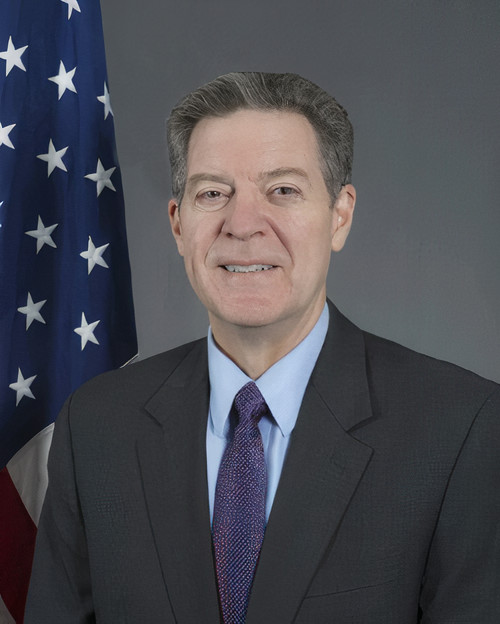
Sam Brownback
Attorney and former United States Senator
25
APPEARANCES
20
PODCASTS
Sep 25, 2026


Jesse WeberHOST
Where do you see this potential arms deal, freeing it up for Taiwan? Because the other way looking at it, isn't this a major bargaining chip for the United States as we go into these negotiations with China on so many different issues?

Sam BrownbackGUEST
I think the way Secretary Rubio is positioning this is exactly probably how it's being seen.
Jesse WeberHOST
But do you see an agreement in place? And is it a smart move to get on the same page with China? On top of the fact, can you even believe anything, any kind of agreement you get in with China? Yeah.


John SolomonHOST
But did we have a miscalculation over a 20-year period of policy about China's true intentions?
Sam BrownbackGUEST
I wanted to see them economically grow and closer to us in the thought that this would open up their political liberalization, which we had seen in some other countries.
Sam BrownbackGUEST
And what they did is they took it, pocketed the money, and we were doing fine.
Sam BrownbackGUEST
And there was... religious freedom liberalization, human rights liberalization happening under the Deng Xiaoping philosophy and several of the communist dictators that they had during that era.

Sam BrownbackGUEST
I'm reading this as this is the long arm of the CCP trying to reach out again overseas, but also to take away any sort of ethnic diversity in the country, whether it's Tibetan Buddhists or Muslim Uyghurs or Mongolian.
Sam BrownbackGUEST
Any sort of difference there, they're just saying, no, basically they're going to mold you all into Han Chinese and take away particularly religion.
Sam BrownbackGUEST
Religion is the key piece that they're really after, that they go after religious heads the first and the hardest.
Sam BrownbackGUEST
It's an organization that's outside of the direct control of the CCP, and that's what they don't tolerate.
Sam BrownbackGUEST
I really think we as the United States need to step up much more aggressively and cite to these problems of what is happening to religious groups and these diverse ethnic religious groups like Tibetan Buddhists or Muslims in Xinjiang and stand up for them, stand up for their religious freedom rights, but also their rights to be different from Han Chinese.

Tiffany MeierHOST
What lessons could you share that could help us bring the country back together?


Newt GingrichHOST
Could you describe a little bit? It's so compelling and it so clearly had a huge impact on you.
Sam BrownbackGUEST
You know, Newt, I used to get to interview people, and I'd talk to them for 30 minutes in my office and advocate for them.
Sam BrownbackGUEST
What I got to do in this book was spend time with individuals and really get into their cases, and hers is just an incredible.
Sam BrownbackGUEST
They take her babies away from her when she gets back to Xinjiang, where she was from, or Urumqi.
Newt GingrichHOST
What specifically would you recommend that America and the free world do differently if they want to help ensure that Chinese totalitarianism does not win?
Jan JekielekSOUNDBITE_SPEAKER
I happen to agree with you on exactly, uh, exactly on this, actually, but why don't you lay out the argument for me?
Sam BrownbackGUEST
Uh, it's the only country in the world I've been able to find you cannot name a child Muhammad.
Jan JekielekSOUNDBITE_SPEAKER
I mean, usually to describe significant amounts of death, but what you're talking about is something different.


Sam BrownbackGUEST
The main takeaway is that both leaders are basically after just trying to get the temperature down a little bit.
Sam BrownbackGUEST
I mean, the takeaway that I think each of them needs to have and that the world is looking for is let's just get the temperature down here for a little bit.
Sam BrownbackGUEST
President Trump, I think, has got some really good cards to play, but he's also got a near-term problem with oil and gas prices.
Sam BrownbackGUEST
And he's asking President Xi to help him out in dealing with that, which is also a big problem for Xi that he has.
Sam BrownbackGUEST
We'll see if they get some of that solved, but I think really this is just trying to show the world, okay, all right, we're going to try to calm things down here for a little bit.
Sam BrownbackGUEST
So what are the cards that you believe President Trump has at his disposal right now? I think he's got major cards on oil.

Sam BrownbackGUEST
It seemed to Xi giving, gave him more room on Pastor Ezra Jin than he did Jimmy Lai.
13 MINS LATER

Kelly SadlerHOST
I- ironically, he has talked about Iran, uh, but what is, what is the pope's role in this, and what should he be doing?


Ben DomenechHOST
Uh, why do you believe that that didn't happen? Or did it happen, but it simply didn't carry with it any of the types of values, uh, that we as Americans or as just as economies in the West had hoped would be injected into the Chinese communist experience in ways that would prove, um, unpalatable or really unendurable for the communist regime to hold the kind of power and authority that they have in the long term?
Sam BrownbackGUEST
I mean, you asked the question I've chewed on just so much, uh, 'cause I, I believe that.
8 MINS LATER

Sam BrownbackGUEST
[clears throat] My plan is, is that the most effective tool we have against the Chinese Communist Party taking over the world, and they seek to do that, the most effective tool we have is religious freedom.
Sam BrownbackGUEST
They fear religious freedom more than our aircraft carriers or even our nuclear weapons.
Sam BrownbackGUEST
'Cause you give religious freedom to the people of China or other authoritarian regimes around the world, they ultimately undermine the legi- the regime itself because their allegiance is to a higher power than it is to the government.
Sam BrownbackGUEST
And this is critical for the Sov- well, it was critical for the Soviet Union, it is critical for the Chinese Communist Party, and the CCP studied the fall of the Soviet Union and saw religion playing such a key role in its demise with the Jewish refuseniks, evangelicals.
Sam BrownbackGUEST
And then the, the, uh, Catholics in Poland who hadn't been to mass in decades, but once John Paul shows up and says, "Be not afraid," communism was dead in Poland.
4:11
J- just give me a minute and make the case, uh, that the Chinese Communist Party is, uh, un- is right now pursuing unrestricted warfare against the United States of America.
Sam BrownbackGUEST
We feature in chapter one in the book Peter Xu, uh, who was a guy who was arrested five times.
Sam BrownbackGUEST
They hung him in a cross formation in his jail cell till he nearly killed him and took him down to sign his confession that Jesus was a hoax, God wasn't real, and he just looks at the warden and says, "Thanks for allowing me to participate in the sufferings of Christ." That, that's the character and the nature of these committed Christians that are in China who believe that their calling is actually to carry the gospel on through China and finish the circumnavigation back to Jerusalem.
Sam BrownbackGUEST
They're a phenomenal group, and that threatens the CCP, and that's why they're arresting them, and that's why we really ought to stand with them, bring them into the White House, recognize them, give them a platform to talk about what's taking place in China, and to push back against this CCP and the surveillance state that they are, uh, putting in place in China and in a whole lot of other countries around the world.
Sam BrownbackGUEST
Uh, w- uh, first off, we gotta start confronting them, and we've gotta realize that whether we think we're at war with them or not, they are at war with us, and they wanna take us out.
Sam BrownbackGUEST
And the Chinese Communist Party has killed more of its own people than any regime in the history of mankind.


Steve BannonHOST
Talk to us about the specifics of the Chinese Communist Party's persecution of Christians, their war on people of faith.
Sam BrownbackGUEST
What they're doing to Christians right now is they're locking up more of the pastors now than they have arguably since any time since Mao.
Sam BrownbackGUEST
My plan is, is that the most effective tool we have against the Chinese Communist Party taking over the world and they seek to do that, the most effective tool we have is religious freedom.
Sam BrownbackGUEST
They fear religious freedom more than our aircraft carriers or even our nuclear weapons.
Sam BrownbackGUEST
Because you give religious freedom to the people of China or other authoritarian regimes around the world, they ultimately undermine the regime itself because their allegiance is to a higher power than it is to the government.
Sam BrownbackGUEST
And this is critical for the Soviet Union, is critical for the Chinese Communist Party.
Sam BrownbackGUEST
And the CCP studied the fall of the Soviet Union and saw religion playing such a key role in its demise with the Jewish refuseniks, evangelicals, and then the Catholics in Poland who hadn't been to mass in decades.
Sam BrownbackGUEST
But once John Paul shows up and says, be not afraid, communism was dead in Poland.
Steve BannonHOST
Give me a minute and make the case that the Chinese Communist Party is... is right now pursuing unrestricted warfare against the United States of America?


Sam BrownbackGUEST
And so anybody that, that seeks a, a higher moral authority, uh, they go after them, and they go after the leaders first of the faith community.
Sam BrownbackGUEST
And then under Deng Xiaoping, that era, they kinda opened up, and they loosened up, and they let people kind of operate and look around.
7 MINS LATER


Sam BrownbackGUEST
And, uh, uh, it was, let's see, now it would be seven years ago that I first utter- uttered the words in Hong Kong that China is at war with faith.
7 MINS LATER

32 MINS LATER

Tudor DixonHOST
And that, I also think y- American CEOs should be held accountable if they have a factory in China where people are forced to live there.
John SolomonHOST
I thought, uh, there was a moment or two where President Xi seemed to be incredibly disrespectful to the United States, to our face, particularly when saying, "Hey, don't mess with China or don't mess with Taiwan, you'll regret it." Um, did we miss a moment, or what do you think of the outcome of that summit in terms of being able to address these very important issues that you brought up in your book?
Sam BrownbackGUEST
I, I think this summit, the, the objective had to be for each side, honestly, to just try to get the boil down, to just get the temperature down, to send some signals around the world of, uh, that we can talk, that we need to talk, uh, even though we've got these just real diametrically opposed, uh, systems.
Sam BrownbackGUEST
And President Trump really needs to get the oil situation out of the Strait of Hormuz dealt with to lower the price of oil and gasoline.
Sam BrownbackGUEST
I mean, he's got a very near-term issue, uh, to, that he has to wrestle with.
Sam BrownbackGUEST
So I, I think that's really what this was about, was just trying to get that temperature down more than anything, show the world we can talk.
John SolomonHOST
But how do we recalibrate this so that, uh, Christians no longer have to fear for their lives in Nigeria or Syria or wherever they practice in the world?

Sam BrownbackGUEST
That, that would be my focus, but I think what was accomplished this week was just trying to lower the temperature and show the world these two leaders can talk.
Sam BrownbackGUEST
Uh, I, I think both sides really didn't have a, a major agenda that they thought they could accomplish.
Sam BrownbackGUEST
They got a big agenda, but it's just these are two really opposed systems, and Xi Jinping is stepping up and standing together a, um, an axis of evil, a modern axis of evil, uh, that he's behind the Iranians, he's behind the Russians, he's behind the North Koreans.
Sam BrownbackGUEST
None of that's possible without him and without the Chinese Communist Party, and we stand for Western, uh, civilization and democracy.
Sam BrownbackGUEST
Uh, but right now both sides wanna, "Okay, let's just kinda lower the temperature here a little bit.
Sam BrownbackGUEST
Let's show we can talk." Uh, there'd be a few minor things, but I, I think that was the desire, and I, I think that's basically what was accomplished.

Josh HammerHOST
C- can you just talk a little bit about perhaps not just Uyghur Muslims, but also Christianity, essentially all other faiths in China there? This, this is not a particularly, a robustly pro-religious freedom regime, is it?

Sam BrownbackGUEST
Uh, the people we feature in the book, a number of them have sought exile in the United States from China.
Sam BrownbackGUEST
And they're Buddhist and they're Falun Gong and they're Muslims and they're Christians, uh, and they're normal other, other people as well.Uh, I mean, I, I think really the actions speak for themselves.
Sam BrownbackGUEST
It's just really, I think, a way to try to obfuscate and to, um, and, and to, uh, try to push back against somehow this narrative that is so clearly in the facts and in the witnesses.
Sam BrownbackGUEST
What we have in the book is, um, a series of 10, uh, people that are eyewitnesses to persecution that they have experienced.
25 MINS LATER

Sam BrownbackGUEST
Uh, the people we feature in the book, a number of them have sought exile in the United States from China, and they're Buddhist and they're Falun Gong and they're Muslims and they're Christians, uh, and they're normal other, other people as well.
Sam BrownbackGUEST
It's just really, I think, a way to try to obfuscate and to, um, and, and to, uh, try to push back against somehow this narrative that is so clearly in the facts and in the witnesses.
Sam BrownbackGUEST
What we have in the book is, um, a series of 10, uh, people that are eyewitnesses to persecution that they have experienced.
25 MINS LATER

Sam BrownbackGUEST
Well, thanks for asking that and, and thank you for having this conversation at this point in time when this doesn't appear to be the agenda item that Xi Jinping and Donald Trump are gonna be talking about.
Sam BrownbackGUEST
Uh, but it certainly sits there in and between and is a major issue between the United States and China and our visions of the world.
Sam BrownbackGUEST
Uh, I contend, um, really right now what you're looking at is this confrontation of civilizations, this, uh, clash of civilizations between an authoritarian, uh, communistic system and Western democracy, Western civilization that's built on a Judeo-Christian ethic of the individual, has inherent dignity and has rights from God.
Sam BrownbackGUEST
Of course, the CCP is, "There's no God, uh, and all rights come from the government, and the government is all-powerful." So you've got really, in my estimation, this clash of civilizations, and these are the two big powers in the world, and they're gathering a sphere of influence around them, and I think we're really in the process of breaking these two economies apart that have grown together so intertwined but now are being brought, broken apart.
Sam BrownbackGUEST
Historically, the, the Christian community globally has looked at China as a place to proselytize, uh, as the, the, I mean, the, the biggest population planet, uh, population on the planet until recently, uh, and just saying we, we should send missionaries here, that they could share the Gospel of Jesus Christ.
Sam BrownbackGUEST
And some of the most, uh, storied missionaries, Hudson Taylor and, um, and then missionaries coming out of China, um, uh, Watchman Nee, uh, are just legendary figures in Christendom, in modern Christendom within the past, you know, 150 years.
24 MINS LATER

Aaron MacLeanHOST
If you were there, which obviously you're not, um, you, you're not allowed, uh, into the, to, to China, which to, to me is a, um, a badge of honor, um, what would you be advising the President? Like, how do you balance these economic considerations with the kinds of, uh, questions of, of political freedom, religious freedom, uh, that you're pointing to?


Jan JekielekHOST
So tell me more about these pastors, 'cause you have quite a number of, of chapters dedicated to, you know, various, uh, Christian pastors.
Sam BrownbackGUEST
And we did, and we, I did that because it's one of the largest groups still operating in China that's dominantly Han Chinese.
Sam BrownbackGUEST
The Falun Gong had huge growth when the government allowed them, uh, to grow, and then just really, uh, smashed them as much as they possibly could.
Sam BrownbackGUEST
But there's still the underground church, uh, going on in China, both Catholic and Protestant.
Sam BrownbackGUEST
Uh, what has changed recently is now you're seeing the hammer come down on these Christian leaders, even some in the, in theState-sponsored church if they're not towing the line right, and the expansion of the arrests has taken place.
Sam BrownbackGUEST
So Pastor Wang Yi was one that was arrested in 2019 that we feature in the book, who I- I kinda laughed at it when I heard he said it.
Sam BrownbackGUEST
Um, I'm sure it didn't get a laugh in Beijing, but he said, "We're all sinners, uh, including Xi Jinping." And he says that from the pulpit in China.
12 MINS LATER
Jan JekielekHOST
You said, "Turn the tables," or, "Flip it around." Can you explain that a little more to me as we finish?


Ben ShapiroHOST
What, what are the kinds of things that you saw as ambassador to China that made you say, "Wow, China really does not have some sort of cooperative interest at heart"?
Sam BrownbackGUEST
What, what I saw that really turned me on this were the concentration camps in Xinjiang or East Turkestan, whatever you wanna really refer to it as.
Sam BrownbackGUEST
It's never been a part of China until the Chinese Communist Party took it over.
Sam BrownbackGUEST
But when they put in place concentration camps, and this is in 2018 that I first started to notice this, you're going, "What? In, in 2018 we have concentration camps in the world?" And then if you get out of the concentration camps, you have this digital police state that's around you with cameras everywhere and tracking devices on your phone and, and keyword searches.
Sam BrownbackGUEST
They were pr- putting in a beta test of how you mollify a religious population, and they were doing that.
Sam BrownbackGUEST
And then they export that technology to other authoritarians and dictators around the world to make them better dictators, to build up their side of the aisle, if you will, their side of the camp of the communists, the authoritarians, and the totalitarians.
Ben ShapiroHOST
What are the best strategies the United States should be using in order to curb Chinese influence operations?


Larry O'ConnorHOST
But of course, Sam Brownback, if the conversation has to do with the economy and manufacturing and big tech being able to make their smartphones over in China for pennies on the dollar so that Americans here back at home can enjoy these incredible wonders of technology without paying too much money for them, you can't separate that from religious freedom, can you? Because it's, well, the Uyghurs, as we know, are part of the slave labor that's being utilized or at least it was have there been any reforms there have apple and these big manufacturers actually mandated back to china that they can no longer exploit the labor and persecute those religious minorities as slave labor
Sam BrownbackGUEST
One of the Falun Gong people, the lady we feature in the book, brought two jackets to one of the dinners that we've had that she made that were targeted for the European and the American market.
Sam BrownbackGUEST
They move now the Uyghurs throughout the country and don't just keep them in East Turkestan.
Sam BrownbackGUEST
They move them throughout the country, so it's not as easily targeted geographically.
Larry O'ConnorHOST
What is the status right now of American churches or Western Christian organizations being able to send missionaries to Asia, to China in particular? That's got to be a very dangerous endeavor if it happens at all.


Jack PosobiecHOST
What do you think President Trump's plan is for when he gets them all in that room together?
Sam BrownbackGUEST
The country understands we're at war with Communist China, but our elite leaders don't get it.
Sam BrownbackGUEST
Uh, and many of the times they're just looking at this and saying, "Well, how do we keep making money?" But now they're disinvesting from China.
Sam BrownbackGUEST
You're seeing now the financial inflows to China reduce substantially and quickly as we start breaking these supply chains because clearly these two systems cannot stand next to each other and tolerate each other, right? Uh, officially atheistic, control-oriented, authoritarian communist regime and free society, the Western civiliz- civilization model of each individual is unique and created in the image of God and is, has an inherent dignity and unalienable rights.
Jack PosobiecHOST
One of the things I like in your book is that you've called for trade that conditionally links market access in the United States to progress on these things like religious freedom, human rights, and of course, the forced organ harvesting
Jack PosobiecHOST
What do you think President Trump's plan is for when he gets them all in that room together?
Sam BrownbackGUEST
The country understands we're at war with communist China, but our elite leaders don't get it.
Sam BrownbackGUEST
uh and many of the times they're just looking at this and saying well how do we keep making money but now they're disinvesting from china you're seeing now the financial inflows to china reduce substantially and quickly as we start breaking these supply chains because clearly these two systems cannot stand next to each other and tolerate each other.
Sam BrownbackGUEST
Officially atheistic, control-oriented, authoritarian communist regime and free society, the Western civilization model of each individual is unique and created in the image of God and has an inherent dignity and unalienable rights.
Jack PosobiecHOST
One of the things I like in your book is that you've called for trade that conditionally links market access in the United States to progress on these things like religious freedom, human rights, and of course, the forced organ harvesting.