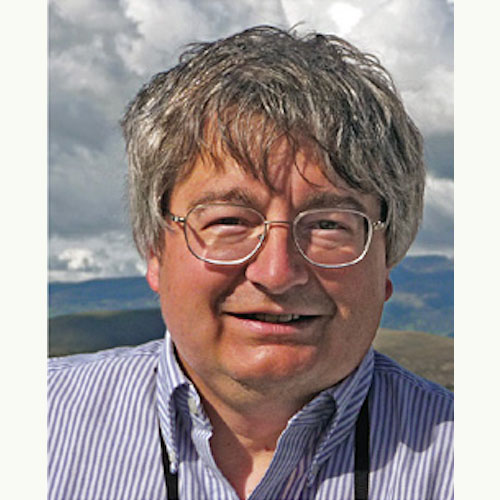
Richard H. Ebright
American molecular biologist
4
APPEARANCES
3
PODCASTS
Oct 11, 2026

speaker_21NARRATOR
Not necessarily a nefarious lab leak, not a bioweapon, but just a lab accident of people, virologists, working on these viruses.

Richard EbrightGUEST
They've come up with shortcuts and easy pictures that you can actually print in the press to shape the opinion.
Richard EbrightGUEST
And because there was such a repression of any dissenting voices, it was most likely that the dissidents would be coming from the margins.
37 MINS LATER
speaker_21NARRATOR
Basically, we're pretty


Richard H. EbrightGUEST
So the two individuals in lower right, the first of them is Robert Gary, who is a virologist at Tulane.
Richard H. EbrightGUEST
The second is Christian Anderson, who is a computational virologist from Scripps.
Richard H. EbrightGUEST
Those two individuals and two of their colleagues, one, Andrew Rambeau, who is from Edinburgh, and the other, Eddie Holmes, who is from Australia, they began to look at the sequence of SARS-CoV-2 after it was first published on January 20th of 2020. and they immediately became concerned that there were aspects of the sequence that strongly suggested it had been genetically engineered and thus that the virus had a lab origin, and not only a lab origin, but a lab origin involving deliberate genetic enhancement using recombinant DNA techniques.
Richard H. EbrightGUEST
They, in the third week of January 2020, they contacted their funding agency heads.
Richard H. EbrightGUEST
They contacted Anthony Fauci, funding agency head of the two in the United States, and they contacted Jeremy Farrar, who, as head of Wellcome Trust, was the funding agency head for the investigator in the United Kingdom and the investigator in Australia.
Richard H. EbrightGUEST
So the four of them reached out to their funding agency heads in the U.S. and in the United Kingdom to state that they were very strongly suspicious that the virus had a lab origin with genetic engineering.
ChrisUNKNOWN
One, is there a paper trail supporting the big ask? And two, could you go into a little bit of the details of what the actual fingerprints on the DNA sequence that really actually suggests that it is a DNA organ?

Bryce NickelsHOST
And I'd like to have Richard explain the significance of today's date and the anthrax attack that followed as it relates to this issue.
Richard H. EbrightGUEST
So 25 years ago today, the attacks are on the New York on New York City, the World Trade Center in Washington, D.C., the Pentagon, and the plane downed in western Pennsylvania.
Richard H. EbrightGUEST
Those texts were followed closely by anthrax mailings, which at the time were viewed as likely part of a coordinated effort involving Islamist terror and a foreign source of the anthrax mailings.
Richard H. EbrightGUEST
We now know that the anthrax mailings were perpetrated from within the United States, not by an Islamist terrorist, not by a foreign actor.
Richard H. EbrightGUEST
and that the material used to carry out the anthrax mailings was produced in a U.S. Army bioweapons agent's research facility.
Richard H. EbrightGUEST
So in a biodefense facility, the FBI concluded that the perpetrator was an authorized researcher at that U.S. Army biodefense facility, and he took his own life.
36 MINS LATER
Bryce NickelsHOST
Well, we all know as scientists that you do work Before you publish it, right? So that is


Richard EbrightGUEST
The ostensible reason is to obtain information about viral threats that may exist in nature in order to increase preparedness for potential outbreaks, epidemics, and pandemics.
Richard EbrightGUEST
The actual motivation for the research for the funding agencies is bioweapons agents development, bioweapons agent intelligence gathering.
Richard EbrightGUEST
After 9-11 and the anthrax mailings in 2001, the United States Congress appropriated large amounts of resources for bio preparedness and bio defense.
Richard EbrightGUEST
And the Vice President at that time, Dick Cheney, was unhappy with biodefense research programs that were being carried out by the Department of Defense.
Richard EbrightGUEST
The Department of Defense had a large and active biodefense research program, but it was focused primarily on countermeasures.
Richard EbrightGUEST
That is to say, measures to react to use of a biological weapon or development of a biological threat, such as therapeutic agents and vaccines.
19 MINS LATER