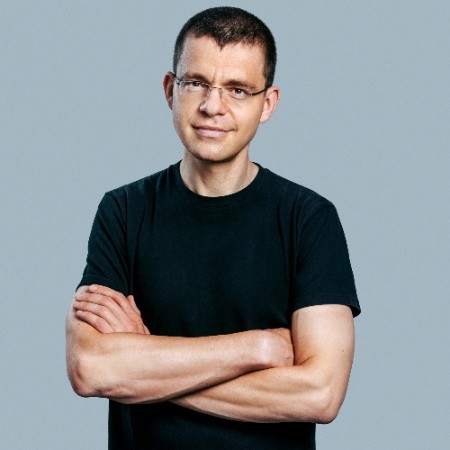
Max Levchin
CEO of Affirm
19
APPEARANCES
16
PODCASTS
Sep 18, 2026


Melissa LeeHOST
So how do you think about the impact on your business? I mean, obviously, more loans and ones that perform are good, but in other ways, in terms of headcount or productivity?

Max LevchinGUEST
Well, certainly this model launch and the reason we're so excited about it, it's fundamentally about saying yes to more people, giving more folks access to credit while maintaining the same or better levels of loss.
Max LevchinGUEST
So we are finding efficient ways of lending money to people where we otherwise might have said no. It's an unequivocally good thing.
Max LevchinGUEST
It is a product of 15 years of doing research and building AI and machine learning models.
Mike SantoliHOST
I know this is a simplistic question, but what makes it AI? I mean, if we've been doing versions of this, we have a decision-making algorithm trying to knit together all of the different inputs that might determine somebody's creditworthiness, what has been the leap, if there has been one, through the kind of AI tools in particular?


Max LevchinGUEST
To add a little bit more color to it, so the year at Google was definitely a challenge in the sense that I was still coming to terms that I ran for like over five years a company in social media that I had no business running.
Max LevchinGUEST
We had a financially very positive outcome for a lot of people, but ultimately it never sort of scratched the sort of entrepreneurial itch that I thought I was, I was scratching.
16 MINS LATER


Lisa MateoHOST
But what are they buying? Are they buying these high expensive items or are they using this program to buy things like, you know, to pay for utility bills, to do things like that? What are they buying and what are they using it for?
Max LevchinGUEST
Again, in our portfolio, By far, we are called upon to finance homewares, sporting equipment.
Max LevchinGUEST
So everybody's buying something for their kids if those are going back to school.
Max LevchinGUEST
Generally speaking, we are not huge fans of financing recurrent transactions and take steps to make sure our consumers don't give themselves false sense of security by stretching something that is a subscription into a longer subscription.


Joe KernenHOST
That, that, that surprises me that it, that it, that it's that, uh, positive for them to, to bring you in.
Max LevchinGUEST
That is to say, as more consumers show up to merchants saying, "Hey, I'd like to use Affirm to buy this," merchants hear their customer feedback.
Max LevchinGUEST
More consumers say, "Wait a second, that's a fantastic alternative to what I got right now." And they use us more, and so the flywheel keeps going, and that's where the growth comes from really.

21:32

Um, how are you using those values and that culture to decide what you will do and y- what you're not gonna chase?
Max LevchinGUEST
One sort of litmus test for me has always been if there's a margin being made in an industry, does the person paying the margin, supplying the extra money, if you will, understand that they are in fact the source of money? If the answer is not really, that is a fantastic place for us to go shine a light on because no one's gonna be upset if we say, "Wait a second, like do you know that you're overpaying by...
Max LevchinGUEST
Did you know that you're paying for this? Like you may think you're getting a deal.
Max LevchinGUEST
You're not." So that, that's always been a sort of like a honeypot for me where like, ooh, people are getting taken advantage of.
Max LevchinGUEST
Um, we won't touch things where we feel the market is efficient because we, we are first and foremost mathematically driven company, so showing up with some sort of a, "We'll sell it cheaper," or, "We'll undercut on price," is not part of the culture, and I, you know, I'm ...
14 MINS LATER
36:54
If, let's say, 15 years from now, how profound a change are we in for in the world of credit?

Max LevchinGUEST
Every state views us as an entity they care about, and the federal regime looks at us through their own set of rules and regulations.
Max LevchinGUEST
And it's critical to be at the table, because if you're not, you'll be on the menu.
Max LevchinGUEST
And- I spent a lot of time interacting with regulators, in part trying to make sure they understand that we're a little bit different.

Danny FortsonHOST
How do you think this is gonna go? And maybe you can speak to it through your kind of affirm lens of like, you know, would you switch to a Chinese open source model because it's, you know, a fifth or a sixth of the cost? And like, what does that mean for Claude or, or Anthropic if all of a sudden like people start switching en masse and, you know, their growth rate goes from 5X to 1X or whatever.

Robert CroakHOST
For folks who haven't internalized what agentic commerce means yet, paint the picture for them, because from a year from now, someone asks Gemini to plan a trip to Europe, what does the checkout experience actually look like, and where does Affirm sit in it?
Max LevchinGUEST
It's a great question, and, you know, the future is super interesting and exciting, and it's fun to try to participate in both predicting and building it.


Tim FerrissHOST
And while capitalism is not a panacea for all things, and there are plenty of warts and risks, and, you know, humans respond to incentives, as someone who came here at 15 or 16, I would just love to hear you speak for a few minutes on what you're seeing and what your thoughts are.
Max LevchinGUEST
I'm pretty worried, not to sort of go all dark immediately, but I think people without the questionable benefit of growing up in the collectivist paradise, to quote the current mayor of New York, don't understand just how corrupting it is.
Max LevchinGUEST
It's this, you know, me for my fellow men and share and share alike and do the right thing because it's the right thing to do, not because there's a financial incentive to do it.
Max LevchinGUEST
All those things sound amazing, and so it, the, it's seductive, the idea of a worker's paradise without the greedy lenders, capitalists, bankers, sort of all, all the sort of things we were fed as children, or I was fed as a child in Soviet Union.
Max LevchinGUEST
People who work hard should have more, and people who are great even though they're not capable of producing valuable things in society because they're good people should have everything that I have even though I'm working harder than they are." Those things sound pretty good, but they inevitably require a bunch of structural change that just does not work thanks to human nature and many obvious things like it.
Tim FerrissHOST
Are there structural or systemic problems that have contributed to that? Is it mostly sort of demagogues using whatever talking points they think they can leverage to attract votes, et cetera? What are the ingredients in the cocktail that are contributing to this current phenomenon, in your mind?


Max LevchinGUEST
No, well maybe but I do think that the world is currently, the headlines are dramatically underestimating how much easier it is to start building these things and to bring them to completion if you actually understand how the underlying stuff works.
Max LevchinGUEST
I don't know if you read, it's a great short science fiction story from 1914 by E.M. Forster called The Machine Stops.
21 MINS LATER


Max LevchinGUEST
And so when we started the company, had a s- sort of multiple reasons why we didn't want to do this.
Max LevchinGUEST
One, we wanted to build a brand, and we wanted our story to be, "Hey, you can rely on us not to take advantage of you when you were sloppy or when you actually have had something bad happen." Just as importantly, we wanted to attract the brightest minds.
Max LevchinGUEST
In a typical conversation you have with somebody who is in machine learning or data science or really good computer scientist-Who works on Wall Street.
Max LevchinGUEST
Yeah, so, so what made you go join a hedge fund? They say, "Well, I really love financial mathematics, like bond math, like sort of complicated compounding curves, the sort of really interesting distributions you get out of it.
8 MINS LATER

speaker_0HOST
Others wanna jump ship and do something completely different.
Max LevchinGUEST
My last startup in between the other payments startup was not in payments, and it turns out that I'm very good at climbing this one mountain.
Max LevchinGUEST
But also, it, the reason I'm good at it is because I love depth and I love getting deep and deep, deeper and deeper into payments, into how to make payments more expedient, more transparent in the case of Affirm.
Max LevchinGUEST
Like, I've never touched credit until Affirm, and now I, you know, maybe with- without false humility, I think w- we are definitely one of the very best credit underwriters in the world and are just getting better and better.
9 MINS LATER
speaker_0HOST
How, uh, is, is, uh, AI changing how you think about international expansion? Does it, does it make teams more efficient in terms of adapting the product for different markets, everything from language to just simply being able to ship more code? Or is, uh, i- i- is international, is your, like, international GTM just, like, much more like we know what it takes to launch a new market, if AI makes it slightly more efficient, great, but it's not gonna change the strategy?

Max LevchinGUEST
You know, the exciting thing is that literally everything we have been working towards is coming together and working incredibly well.
Max LevchinGUEST
We held a similar event three years ago, and promised investors we'll get to $50 billion of gross merchandise volume, our merchant sales that we power, and we will do so by maintaining, while maintaining our profit margins between 3 and 4%.

Caroline HydeHOST
What does that look like in terms of how I'm going to be having a relationship with Affirm going forward?
Max LevchinGUEST
You know, the exciting thing is that literally everything we have been working towards is coming together and working incredibly well.
Max LevchinGUEST
We held a similar event three years ago and promised investors we'll get to $50 billion of gross merchandise volume, our merchant sales that we power.
Caroline HydeHOST
What does that look like in terms of how I'm going to be having a relationship with a firm going forward?


Max LevchinGUEST
I mean, a lot of Affirm is about having fun while doing what we think is really important work, and the, the Big Nothing is no exception.
Max LevchinGUEST
It's a name of our shopping event, so it, it's the second one, so, you know, it's too early to say how many times per year we'll do it, but it's the first one this year.
Max LevchinGUEST
You know, you and I share views on sort of what the lending industry writ large does wrong, and that's, you know, it hides the fine print.
7 MINS LATER
JordyHOST
Uh, what's, uh, what's, what's driving that? Obviously, there's some seasonality, but, um, what, what are the inputs?
Max LevchinGUEST
That, that thing is still absolutely on fire, growing over a hundred percent year-over-year, both active users, uh, transactions, like every metric you can imagine, I think it's growing triple digits.
Max LevchinGUEST
We decided we're gonna invent our own shopping holiday, uh, call it the Big Nothing, because basically, everyone got a zero percent APR deal.
6 MINS LATER
JordyHOST
Mm


Max LevchinGUEST
"And ideally, take as long as possible, 'cause that's when we make the most money." So, the obvious answer is, of course, obvious.
Max LevchinGUEST
Make a plan that you commit as a lender that you'll never change, and don't charge late fees.
Max LevchinGUEST
If you agree to those design principles, you are not going to make more money if someone is late, and you're not going to make more money if they take longer to pay you back.
Max LevchinGUEST
Obviously, you'll make less money, because getting money to lend isn't free either.
Max LevchinGUEST
We have to pay for our sources of capital as, you know, as everybody else does, which means that it immediately rotates you sort of 180 degrees where you say, "I only want to lend money-"...
21 MINS LATER
JordyHOST
Yeah.
Max LevchinGUEST
... which means that our own capital or the capital that we lend out is some form of sourced.
Max LevchinGUEST
You have to be because at any given time somebody may choose to no longer participate.
16 MINS LATER


Guy RazHOST
[laughs] But, but you, you walked out of college clearly, like, fired up to, to, to start something.
Max LevchinGUEST
Uh, the, the very seminal moment of sort of like, this is what I'm gonna do with- for the rest of my life, was when the very first company failed.
Max LevchinGUEST
We drove up to Chicago, the four of us, to try to raise money and were rejected.
Max LevchinGUEST
We actually went to, um, I think Leo Burnett, one of the large advertising agencies at the time, and they were sort of like, "Yeah, uh, you guys have no idea what you're talking about.
Max LevchinGUEST
It's not gonna hunt." And so, and this was our last ditch attempt to save the company, and so we were driving back to Champaign completely silent, the four of us in one car, and just kinda like, "This, this is it." Like, end of the road.
22 MINS LATER
Guy RazHOST
Did you ask him to be the CEO, or, or did he sort of say, "You know, I, I should, I should probably be the face of this thing 'cause I'm a little bit better at presenting"?

speaker_2UNKNOWN
When are you forced to hire B team, and how do you think about that?
Max LevchinGUEST
The story about knowing the letter grade of every person you hire in your company, whether it's two thousand people like Affirm, but that's just silly.
Max LevchinGUEST
People are these days coached and trained and fine-tuned to be exceptional interviewees.
Max LevchinGUEST
And so somebody coming in and telling you their life story, like you know they have watched probably an interview you conducted with someone who's a professional interviewer who spelled out what it looks like when you're hiring an A player.
Max LevchinGUEST
You know, someone's gonna be like, "Hmm, extreme personality is very important.
23 MINS LATER
speaker_2UNKNOWN
Did you learn anything about messaging from the first time?Taken to the second time