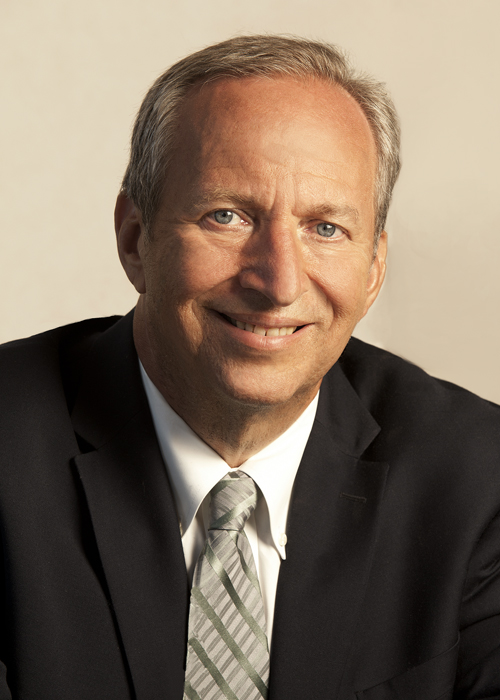
Lawrence Summers
Economist and former United States Secretary of the Treasury
9
APPEARANCES
2
PODCASTS
Sep 16, 2026

speaker_1ADVERTISER
Hilton, for the stay.
Lawrence SummersGUEST
distinction between, uh, the two kinds of shocks is that in a disinflation shock, interest rates are up, and that is why output is down.
Lawrence SummersGUEST
In a financial breakdown shock, output is down, and that is why policy interest rates or safe, uh, interest rates are reduced.
Lawrence SummersGUEST
From that perspective, it's very clear what the current, uh, episode is as expectations of future output have declined, as asset prices have declined.
Lawrence SummersGUEST
One has seen very substantial, uh, declines in, uh, Treasury, uh, bond yields and in, uh, the federal funds rate.
Lawrence SummersGUEST
For those who are aficionados of such things, I will mention that for a period of a week, the five-year TIPS yield was significantly ne-- was negative, at one point reaching negative twenty-two, uh, basis points.
Lawrence SummersGUEST
And that there was a brief three-hour period in Japan when the one-month Treasury bill was yielding not two basis points, not one basis point, but literally zero basis points as a consequence of various machinations in the money market that had the character of an extreme flight to safety.
13 MINS LATER
speaker_1ADVERTISER
Hilton, for the stay.
speaker_8ADVERTISER
Number one sportsbook for live betting based on available live market data.
Lawrence SummersGUEST
Curve in some form, in almost all of the forms in which the Phillips curve, uh, came, was quite skeptical of the role of macroeconomic policy in affecting average levels of output through time.
Lawrence SummersGUEST
Very little room for Art Okun's dedication to closing output gaps or maintaining a higher pressure economy as a way of spurring economic growth or as a way of promoting a more equal, uh, income, uh, distribution.
Lawrence SummersGUEST
Art's la- the last decade of Art's professional work was directed at, uh, questions that in one way or another, uh, relate, uh, to, uh, these, uh, equations.
Lawrence SummersGUEST
His final book was entitled, uh, Prices and Quantities, and his dominant professional preoccupation was, uh, in his last years with how the rate of inflation could be brought down with a minimum level of the output gap with, as he would have put it, a minimum sacrifice, uh, ratio.
Lawrence SummersGUEST
It's not hard to understand why these questions relating to inflation and output were preoccupations of Art's during his, uh, professional, uh, lifetime.
56 MINS LATER
speaker_9UNKNOWN
If the government seeks to stabilize as a way of avoiding these, uh, perverse positive feedback consequences, doesn't that very government action itself create the possibility for increased expectations of the government to continue doing that, and therefore the government gets to a point where it says no, it will have created its, its own positive feedback mechanism that is perverse in itself?


Lawrence SummersGUEST
And my high order prediction is that there's a good chance that my granddaughter's experience is gonna be more like my grandmother's.
Lawrence SummersGUEST
Is it the same kind of transformation? You point out that the nature of AI is different than, uh, the nature of a lot of what happened in that period, and I'm not gonna argue for the fundamental similarity.
Lawrence SummersGUEST
I, I would note that in some sense, what drove everything during my grandmother's lifetime was basically a large amount of science found practical application in an ability to change modes of production and change the products that could be produced, and that it was the acceleration of scientific progress and its application that was the fundamental driver then.
17:49
And but fundamentally, do you think the human nature will change as well?
Lawrence SummersGUEST
Uh, Angus, it's very, very good to be with you and to have this conversation.
Lawrence SummersGUEST
There's a great deal, um, that I have learned from you and a great deal of warmth that my family and I have experienced from you over many years, uh, for which I am grateful.
Lawrence SummersGUEST
I decided to become an economist when at a very young age it occurred to me that a doctor saw a certain number of patients in a lifetime.
Lawrence SummersGUEST
But if an economist could think of something that contributed to the unemployment rate being one-tenth of one percent lower for one month, that was a hundred and sixty thousand families in which breadwinners would have their children see them go to work rather than be discouraged at home, and that that would make an enormous contribution.
Lawrence SummersGUEST
So I too am seized with the moral importance and significance of what we do, and I too am seized with the magnitude of the social, uh, problems, the poverty, the distress that is felt within American society.
53 MINS LATER

28:38
They are freely available, but 20% you get a certificate and it trades, I don't know, at a discount or hopefully down the road if some other bank jumps in at par."
Lawrence SummersGUEST
I have a, um, general doctrine that I call huff and puff and pay, which is that the policymakers who in the early stages of crisis, um, and confidence crisis give the strongest moral hazard speeches and impose the most brutal solutions on the people who they think are responsible end up authoring the largest, uh, bailouts.
Lawrence SummersGUEST
And I would give as examples of that, uh, doctrine the actions of, uh, Treasury Secretary Paul O'Neill in the spring of 2001 when he gave very strong moral hazard speeches and two weeks later was supporting the largest bailouts in history for Turkey and Argentina.
Lawrence SummersGUEST
I would give the authorities who justified their non-action in Lehman on moral hazard, uh, grounds and found themselves guaranteeing the whole financial system within, uh, two, uh, within, uh, two weeks.
Lawrence SummersGUEST
I would give the British authorities who gave terrific moral hazard speeches after Northern Rock and found themselves authoring very large, uh, bailouts.
Lawrence SummersGUEST
I lack the-- I, as a policymaker, lack the courage, uh, to attempt- The experiment, uh, suggested, uh, by my friend, uh, Brad in your question, I rather suspect that if Brad were a policy maker, he might lack, uh, the, uh, courage, uh, of it.
Lawrence SummersGUEST
And I'm reminded of, uh, the wisecrack, uh, made with respect to those who, um, advocated such approaches in the very early 1930s, that that was the kind of thinking that made the Depression great.
12 MINS LATER
8:10
I don't know whether he thinks that inflation is coming back down or not, but, uh, perhaps Larry can, um, you know, s- how do you see that now? Do you see inflation coming down again, or what are the right steps or the right diagnosis what's going on? And to what extent, uh, you know, for example, pricing power might play a role as well, and it came up in a discussion, uh, over Twitter and other places.
Lawrence SummersGUEST
Paul and I are much closer to being in agreement now than we were when we had this conversation a year ago, a year ago on the subject of inflation.
Lawrence SummersGUEST
I think I would put substantially more emphasis still on demand than Paul would.
Lawrence SummersGUEST
Uh, imagine that potential GDP is fixed and can't be exceeded because the people aren't there, and you stimulate demand substantially.
Lawrence SummersGUEST
Then you'll see substantial inflation, but you won't see, um, output ahead of potential GDP.
Lawrence SummersGUEST
So using what happens to output as a measure of supply versus demand can easily be misleading in, uh, the context of, uh, a, uh, in the c- in the c- in a context where there are, uh, supply constraints.
Lawrence SummersGUEST
I don't think a year ago I was enamored of the employment ratio as a measure.
53 MINS LATER
8:15
Thanks a lot, Larry, for being with us, and, uh, we're looking forward to it.
Lawrence SummersGUEST
Uh, much of our discussion is about public good provision, and you have provided an important public good to the economics profession and to the broader world by, uh, hosting these seminars, and I'm glad to have an opportunity, uh, to, uh, return, uh, to, uh, this, uh, this important, uh, forum.
Lawrence SummersGUEST
There's a lesson one learns when one works in Washington, which is the important of-- importance of managing expectations and managing them downwards so that you can surprise positively.
29 MINS LATER
38:05
And can you see the Belt and Road Initiative, for example, also as a public good provision by investing in infrastructure in Africa and all this, or is this very different from the public good you have in mind and what the US should provide or the other advanced economies should provide?
Lawrence SummersGUEST
Markus, thank you, and thank you for the terrific public good you have provided, uh, through, uh, the Markus, uh, Academy.
Lawrence SummersGUEST
Uh, some of this, I suspect, was set off by my Washington Post column about, uh, 10 days ago.
Lawrence SummersGUEST
I don't, as an economist out of government, have views as to what the right political strategies, uh, are, and certainly I've got enormous respect for President, uh, Biden and the very, very serious and able people who comprise, uh, his economic, uh, team.
Lawrence SummersGUEST
And I think it is clear that, uh, it is urgently important to provide relief so that we do not have a K-shaped, uh, recovery.
39 MINS LATER
41:30
And what happens to the emerging market economies? Now, what happens if the h- US were forced to raise interest rates to some extent? What are the repercussions for the rest of the world? Perhaps if, if you can elaborate on that, on the implications of the exchange rate and the emerging economies in particular.
1:52
And the question is to Larry, you know, how should we do it? Should we change the intellectual property rights? Should we pass it on to other countries, developing countries for free? Or what should we do? What's, uh, what's your thinking on, on this dimension?
Lawrence SummersGUEST
Uh, this, in round numbers, um, the pandemic costs the United States $80 billion a week, and it costs the world $200 billion, um, a week.
Lawrence SummersGUEST
Uh, at those stakes, roughly anything you do that's in the area of science and innovation that produces any meaningful acceleration of the moment we get a vaccine is a positive.
Lawrence SummersGUEST
So I think the first broad insight that needs to be shaping is, uh, that, uh, is that insight.
Lawrence SummersGUEST
And so anything in any normal amount of money that accelerates things by one day, um, will have been, uh, way, uh, worthwhile.
Lawrence SummersGUEST
And it doesn't feel to me like we are committing resources in a way that reflects that basic judgment of, uh, absolute, uh, necessity.
25 MINS LATER
28:39
Is U.S. doing it, overdoing it? Will China use its digital money technology lead to essentially weaponize it to some extent or get, gain influence in other countries? And what do you learn from history about this? What do we learn from the Imperial Germany in the late 19th century, you know, trying to gain influence from the UK? And, uh, is there anything, uh, you know, we can learn from history and, uh, in order to avoid mistakes we made in the past?