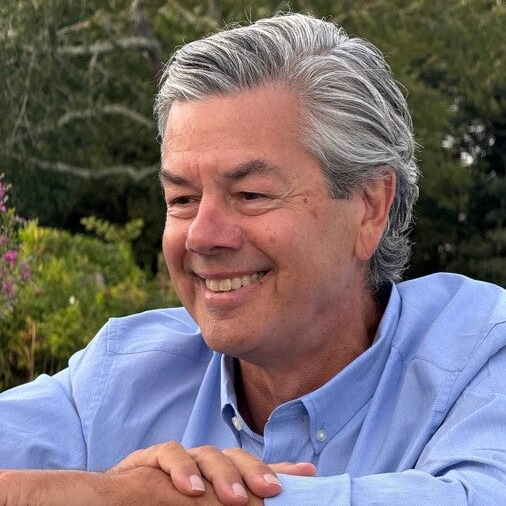
John Fullerton
Founder and president of Capital Institute; former JPMorgan managing director and author of Regenerative Capitalism, a leading voice in regenerative economics.
4
APPEARANCES
4
PODCASTS
Sep 21, 2026


Daniel MarinoHOST
You know, many organizations are either on Epic or they're on Cerner, they're using an EHR that has some level of a patient portal, right? Where does that technology piece come into play? You know, and does that really go against some of the patient access goals? In other words, are patients truly leveraging their portal and the connectivity around that portal with the physician like they should? Or is that a huge opportunity to really begin to better manage some of the access challenges?

John FullertonGUEST
to have that capability when it comes to health care because they're using very similar technology in a number of different other industries.
John FullertonGUEST
But I think we're kind of dropping the ball still is just meeting in the middle.
John FullertonGUEST
I think whether you're looking at online scheduling, mobile communication, waitlist automation, anything like that.


Daniel MarinoHOST
You know, many organizations are either on Epic or they're on Cerner, they're using an EHR that has some level of a patient portal, right? Where does that technology piece come into play? You know, and does that really go against some of the patient access goals? In other words, are patients truly leveraging their portal and the connectivity around that portal with the physician like they should? Or is that a huge opportunity to really begin to better manage some of the access challenges?
John FullertonGUEST
to have that capability when it comes to health care because they're using very similar technology in a number of different other industries.
John FullertonGUEST
But I think we're kind of dropping the ball still is just meeting in the middle.
John FullertonGUEST
I think whether you're looking at online scheduling, mobile communication, waitlist automation, anything like that.


Dave ChapmanHOST
... any thoughts about how you would respond to that? How, or how you feel about it? I- is it the right question, even?
John FullertonGUEST
Um, what, what I know is true is that we conflate, um, the problems of the industrial meat system, which requires growing grains, clearing the Amazon to grow more grains to feed more cattle.
John FullertonGUEST
Um, I've experienced, uh, ranches in the United States and, uh, have knowledge of them in New Zealand and Australia and South Africa, um, uh, in fact, i- in Argentina, all around the world, where by shifting the management practice, you can easily double if not triple the stocking rates, meaning the animals per acre, on what are natural grasslands.
John FullertonGUEST
Um, the, the thought of cutting down a, a tropical rainforest to grow grass, uh, or to grow food for animals is, is industrial thinking that is, is very shortsighted.
John FullertonGUEST
Um, there is massive capacity to, um, uh, increase the animal stock on the existing grasslands of the world if they're managed in a holistic, uh, in a holistic way.
8 MINS LATER


John FullertonGUEST
What we talked about earlier, ecological economics, in my book I call this the first leap over the first fence.
John FullertonGUEST
This is the profound shift because Herman Daly and colleagues Essentially, reimagine the economy as embedded in the biosphere, not as a separate system.
24 MINS LATER
