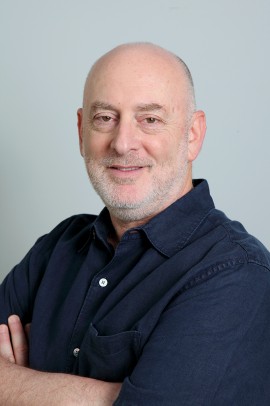
S. Jay Olshansky
Professor
7
APPEARANCES
6
PODCASTS
Jun 27, 2026

Cindy LeeGUEST
And he's managed to wrangle all the big Blue Zones researchers together onto an academic paper about it.
Jay OlshanskyGUEST
You know, there's a lot of egos involved and a lot of these folks have worked on this for more than a quarter century.

Madison ConnaughtonCORRESPONDENT
And he's managed to wrangle all the big Blue Zones researchers together onto an academic paper about it.

Jay OlshanskyGUEST
You know, there's a lot of egos, uh, i- involved, and a lot of these folks have worked on this for more than a quarter century.
Jay OlshanskyGUEST
Historically, Blue Zones were not all evaluated the same way, right? They used different criteria.


Joe JohnsHOST
Maybe to help frame it a little bit, can we talk a little bit about life expectancy and the work that you all have done on that? And then link that to how prepared people are for how long they will live.

Jay OlshanskyGUEST
So just to give everyone a frame of reference, back in 1900, life expectancy was about 50%.
Jay OlshanskyGUEST
It was so low back then because of high infant, child, and maternal mortality.
Jay OlshanskyGUEST
So during the course of the 20th century, that was brought down by public health.
Jay OlshanskyGUEST
And some people predicted that it was just going to continue higher and higher into the 21st century.
19 MINS LATER


Dan BuettnerHOST
You're kind of the buzzkill when it comes to this unmitigated optimism that we're gonna live longer.
Jay OlshanskyGUEST
It's a realistic check based on what the human body has been telling us all along.
Jay OlshanskyGUEST
There is a lot of hype in the field of aging where people embellish and exaggerate what we can and cannot do.

S. Jay OlshanskyGUEST
Let me explain why I'm giving you a definitive no, not an ambiguous no, but a definitive no.
S. Jay OlshanskyGUEST
In 1989, I attended a conference that was run by George Martin, a well-known scientist in the field of aging.
S. Jay OlshanskyGUEST
And at that particular conference, the issue of the upper limit to human longevity came up.
S. Jay OlshanskyGUEST
And I really didn't have a lot of ideas at the time on what that might be.
10 MINS LATER

Brent FransonHOST
So I think this assumption that you can add some meaning, and I would call 10 years meaningful, but some number of years to your life by just treating yourself well, that doesn't seem crazy to me, but what's your perspective?
S. Jay OlshanskyGUEST
For females, about five percent probability of making it to a hundred, even once you've made it to middle age.
S. Jay OlshanskyGUEST
Now, again, these probabilities have always been low, and they were much, much lower a hundred years ago.
S. Jay OlshanskyGUEST
So you have to realize when you go from close to zero percent survival to a hundred up to one to two percent, which is where we are today, it's a pretty dramatic increase.
S. Jay OlshanskyGUEST
It doesn't sound like a lot, but it's really hard to get one to two percent of the population living to a hundred.
S. Jay OlshanskyGUEST
Let me emphasize, it may not sound like, like I'm talking about a high number.
13 MINS LATER

Devin KatayamaNARRATOR
Could science keep someone alive until they're 150 years old?
Jay OlshanskyGUEST
My good friend thought that it was possible, and I said, no, it's not possible.
Jay OlshanskyGUEST
The process of living itself leads to the degradation, the continuous degradation that ultimately leads to the demise of mind or body.
Jay OlshanskyGUEST
The question is when and what can we do to to do what's the most important thing, in my view, which is to enjoy life while we're here.