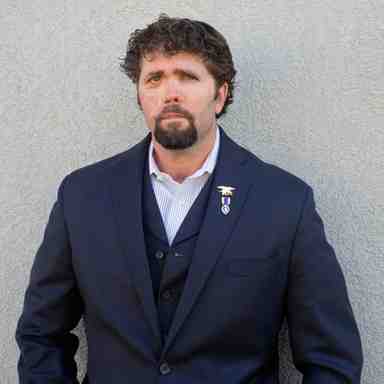
Jason Redman
Author
21
APPEARANCES
15
PODCASTS
Oct 27, 2026


Jason RedmanGUEST
and I think it's such a profound thing and a relatable thing and you'll appreciate this.
Jason RedmanGUEST
And when I ran a nonprofit, I created, myself and Matt Thompson, a ranger friend of mine, we created an event called Jumping for a Purpose.
Jason RedmanGUEST
And we took wounded warriors and families of the fallen, we threw them out of airplanes.
Jason RedmanGUEST
And a lot of people were like, oh my God, why would you do that? And the reason being is in life, when you go through trauma, there's a natural tendency to not ever want to do that thing again.
5 MINS LATER
speaker_2NARRATOR
yeah.

Jason RedmanGUEST
... because so many people, when terrible things happen to them, and, and- And it's hard to be human.
30 MINS LATER


Megyn KellyHOST
But give me a minute on it because I think my sons will enjoy it, and I think a lot of people love hearing about just what we put you guys through in order to call yourself a SEAL.
Jason RedmanGUEST
But at the flip side of that coin, I kinda knew what I was getting myself into.
Jason RedmanGUEST
I actually served with one of the East Coast SEAL units before I went out to BUD/S.
36 MINS LATER


Jason RedmanGUEST
We are becoming a nation of individuals who are being convinced, um, because of the color of your skin or your, you know, gender or your gender persuasion or where you came from or any of this, that you're a victim, and that you cannot help yourself, that somebody else has to help you, which I unequivocally, unequivocally don't believe in.
Jason RedmanGUEST
I have a brand new book called Make Money Easy, and if you're looking to create more financial freedom in your life, you want abundance in your life, and you want to stop making money hard in your life, but you wanna make it easier, you wanna make it flow, you wanna feel abundant, then make sure to go to makemoneyeasybook.com right now and get yourself a copy.
Jason RedmanGUEST
I really think this is gonna help you transform your relationship with money this moment moving forward.


Sage SteeleHOST
But when you're faced with the reality of like, okay, I know I feel different, but now I know I look different.
Jason RedmanGUEST
I talk so often about life and I survived this vicious life ambush only to step into this, or I survived this vicious enemy ambush only to step into what I call a life ambush.
Jason RedmanGUEST
Emotional and mental bullets and bombs are significantly more painful than the physical ones.
Jason RedmanGUEST
The aftermath of some sort of traumatic event oftentimes is the life ambush that follows and and navigating like yeah you're facing years of being put back together and i think in the beginning trying to navigate that you know in the beginning like blaming myself like boy you made a bad decision and like i had to accept you know i think it took about a week to finally say no you didn't you did things according to our tactics what happened happened stop beating yourself up you can't change the past all we can do is drive forward so that was kind of the first catalyst um And the second became, I mean, don't get me wrong, there's a little bit of anger and like, where do I go from here? And I'm going to be broken and disfigured my whole life.
21 MINS LATER

Doug BopstHOST
I think from my experience in like when you're rebuilding your life and what I've heard from other people, a lot of it comes down to how do you get those small wins and rebuild confidence when you're moving forward? What were some of the things you did early on to help you rebuild your self-worth and confidence to, to build momentum, to, to change and to transform?
Jason RedmanGUEST
When I talk about those three rules, lead yourself, lead others, lead always, lead yourself is the most critical thing.
Jason RedmanGUEST
You should be looking in the mirror every day and ask yourself, how well did I lead myself today? If I have goals, did I execute on those goals? Did I hold myself to the highest standards? Am I working to be the elite version of myself? The answer is no.
Jason RedmanGUEST
I mean, because there are a lot of people who are super talented in areas of their life and they can get away with being, I'll be honest, when I was younger, I bet I was only operating at about 60 to 70% of what I was capable of.
12 MINS LATER
Doug BopstHOST
falling into the victim mindset like when when life throws us one of these ambushes and i think it's tough i think people are more likely to fall into it when like something happened that wasn't their fault and some like life experience happens that sets them back for a period of time like what's your advice to people that have a habit of falling into the victim trap when when life throws them curveballs

Jordan MulliganHOST
When you was 17, 18, that you got into sort of the tr- training of the military, what was that experience like, your first, you know, your first time? Did you know what you was, you know, coming to expect because of your, the family that you'd been around and stuff?
Jason RedmanGUEST
The, the first training school I went to in the Navy was here in the Virginia Beach area.
speaker_7MODERATOR
Could you paint a picture for somebody who doesn't know anything about what that training looks like? Like, the, the, the tougher days.

Travis ChappellHOST
How many minutes elapsed between getting shot, waking up being like, oh, I don't even know what's going on, just trying to stay awake here until you're waking up in a surgery center a few hours later?
Jason RedmanGUEST
So I was pinned down for probably 35 minutes, which is a long time to be shot at by big bullets.
11 MINS LATER
speaker_0ADVERTISER
Because
Megyn KellyHOST
Um, so it's scary, but yeah, so as a professional soldier, it, y- I guess you look at it a little differently.
Jason RedmanGUEST
My thoughts and prayers to not only the pilots and their families, but to the su- CSAR crews that are now launching on what they do best.
Jason RedmanGUEST
That package, once it launches, if we didn't already have some high level of air superiority, we've even, we've, we've upped the ante exponentially in the levels of jamming and things we're doing.
16 MINS LATER


Jason RedmanGUEST
You look at right now what Abigail Spanberger is trying to do to the state of Virginia.

Gina LoudonHOST
How major is that? And how much of a consideration should the midterms be in President Trump's mind?

speaker_3ADVERTISER
And I'll be honest,
Jason RedmanGUEST
So many people get confused in this life and they define things that happen to them as a bad day.
Jason RedmanGUEST
Cause that means you have the ability to deal with whatever problem or challenge you're facing.
Jason RedmanGUEST
Real bad days leave permanent scars, physical, mental, emotional, financial, and sometimes they'll cost people their lives.
34 MINS LATER

Ed MylettHOST
Is that, is that part of what you did to put yourself back together, both emotionally and physically?

Jason RedmanGUEST
The first punch happened with Iran, with the penetration into Iran to take out the nuclear facilities.

Dan BallHOST
If Petro keeps saying, come get me, could we pull off another one of these? Would it be easier in a Cuba or a Colombia? Are they as, I doubt it, sophisticated as Venezuela? Would it be easier?
Dan BallHOST
We did strikes by drones, strike by choppers, by jets, whatever, and if guys were climbing out of pickup trucks and tanks and everything else, could you please tell me what the rule was when you guys were in combat? Did you have to stop, pull back, and go render aid, or did you take out the terrorist until they were dead? How'd it work?
Jason RedmanGUEST
I think a big problem that's occurring in American society, and I will admit some of this, I feel like it started to occur in the war on terror, is this blurring between the rule of law and the law of armed conflict.
Jason RedmanGUEST
And they want to apply the rule of law, thinking that they should receive due process and they should be questioned and they should be read their Miranda rights and all these different things.
Dan BallHOST
Oh my gosh, where's the war crime? That's what we're doing to the terrorists in the boats with the


Jason RedmanGUEST
It's truly an honor to be here for the Navy 250th honoring the greatest naval force the world has ever seen.
Jason RedmanGUEST
Now you have to understand, there's a lot of history packed into the last 250 years, but make no mistake, the history of the United States Navy from its beginning to today was built on a foundation of choice and sacrifice.
Jason RedmanGUEST
We chose to raise our hands and swore an oath to the Constitution, a choice to sacrifice our freedom, our earning potential, and even worst case, our very lives, to fight against all enemies foreign and domestic who presented a threat against the sovereignty and people of the United States of America.
Jason RedmanGUEST
In order to understand the full context of what you are a part of, I think it is important to remember our history.
11 MINS LATER
speaker_4SOUNDBITE_SPEAKER
The most inspiring men are those who carry the seal of an American hero-
Jason RedmanGUEST
It's truly an honor to be here for the Navy 250th, honoring the greatest naval force the world has ever seen.
Jason RedmanGUEST
Now, you have to understand, there's a lot of history packed into the last 250 years.
Jason RedmanGUEST
But make no mistake, the history of the United States Navy from its beginning to today was built on a foundation of choice and sacrifice.
Jason RedmanGUEST
We chose to raise our hands and swore an oath to the Constitution a choice to sacrifice our freedom, our earning potential, and even worse case, our very lives to fight against all enemies, foreign and domestic, who presented a threat against the sovereignty and people of the United States of America.
9 MINS LATER
Jason RedmanGUEST
When they tried to tear Pete down and say he did this and he did that, I was there.

Steve GruberCORRESPONDENT
Jason Redman, tell the folks who maybe are hearing your name or are seeing you for the first time, your story, your personal story, uh, a little bit.
Jason RedmanGUEST
When they tried to tear Pete down and say he did this and he did that, I was there.

Steve GruberCORRESPONDENT
Jason Redman, tell the folks who maybe are hearing your name or seeing you for the first time your story, your personal

Jason RedmanGUEST
And he did, and, and, uh, and that, uh, I mean, amazing, and that journey was incredible.
Jason RedmanGUEST
But I remember feeling depressed, like, "Where do I go from here?" But this is where this journey-...
Jason RedmanGUEST
Um, the one last thing that kind of made me come to this, this pinnacle or this, this intersection was about all that time, I had somebody else there come into the room and, and they were, um, they were having a conversation with me and then I started to drift off.
36 MINS LATER
Megyn KellyHOST
What was it? How would you describe what you were doing in your marriage that was not so great?
Jason RedmanGUEST
Well, I think, uh, for many of our warriors, you know, so many people wanna focus on the physical wounds, and obviously mine I wear on my face, so they really stand out.
Jason RedmanGUEST
I mean, really, that individual is lost trying to find themselves and where they go from here.
10 MINS LATER
Megyn KellyHOST
So like, a lot of it, like, it was brave of Erica to say, "I see you drifting away from me, and I see you not talking to me, and I can feel the separation, like, on a fundamental level," and it was brave of you to, to say, "You're right." So how did you get to that? Like, there, you know right now, there are other guys listening to this, like, "I don't think I can talk about this."


Tom ShillueHOST
Uh, Jay, you're, you know, notably a positive person and, and were all throughout your recovery. Do you, besides what you have inside you, do you think that that positivity was bec- helped because of Erica or, or was it, some of it for Erica?
Jason RedmanGUEST
Um, we talk about in the book, you know, as a spouse, a- and I think anyone in this life, having self-awareness of the impact of your words and your attitude is a really powerful thing. And there's no doubt, we had some really hard times. I mean, when, when they brought me home, we had three young kids and, and even though we had an at-home nurse that came in a few times a week, Erica was really taking care of me. I mean, I was, uh, non-ambulatory. I c- you know, I couldn't move. I, you know, I had to have a wheelchair. Um, you know, they're feeding me through a stomach tube. She had to grind up meds. Um, trachs are very, um, high maintenance and Erica had to help with the trach. And I think at any point, it would've been easy for her to say, "Why did you do this to us? Why did you choose this job?" And, and even if she felt that, and she told me she never did, even if she felt that or, or if she had said that, that would've been very difficult for me. I was already struggling to stay positive. And I think self-awareness of that, I mean, whatever you're going through, if a partner is going through maybe, um, a job loss or maybe they're going through some sort of health issue or maybe they're going through some major external family crisis, whatever it is, having your spouse support you regardless of what they think sometimes, you know, they're your most important teammate. And they should be supporting you, not attacking you or, or, you know, shooting... we, you know, I jokingly say, "Don't shoot your teammate." Um, and she was that way. So yes, it made it easier for me to be positive. I'm a positive person, and having that support was huge, and it showed me how strong she is through that whole thing.
Tom ShillueHOST
I know that, uh, awareness of, of, of mental health for veterans, um, you know, h- i- is certainly... It's better than it was decades ago and it gets better all the time. How are services for the military within the VA? Is there anything? Marriage counseling, for example.
Jason RedmanGUEST
Um, you know, there's a lot of tremendous doctors, nurses and people in the VA. There's also a lot of bloat and massive bureaucracy and very old and antiquated systems. Um, the biggest challenge to so many of our veterans is when they have a need, number one, they may not be aware that there is a solution to that need, and number two, navigating all that, uh, paperwork, bureaucracy. And then deciding where's the best place to go. Is it the VA? Is it the benevolent organizations? So, I, I would say the awareness is better. Are the solutions all better in the flow? I don't know. I mean, I'm involved in a brand new company, Turbo Vets. That, that is our goal. We are revolutionizing the way we're managing, uh, veteran disability and benefits for life so that we can expedite and make more efficient using AI automation integration technology. At the end of the day, that's really what we need to do. If they're aware that there's a problem, in this case marriage, you know, P: "Hey, I could use a marriage counselor." Are there... There... I know for a fact, there's a lot of great benevolent organizations that are happ- happening, uh, with that. I know... Shout out to Debbie Lee, mom of fallen SEAL Mark Lee. Um, her org- America's Mighty Warriors has marriage retreats. I know Taya Kyle, the wife of Chris Kyle, she runs marriage retreats to take care of our military law enforcement fire. So the resources are there, we just gotta do better about connecting those who need them.

