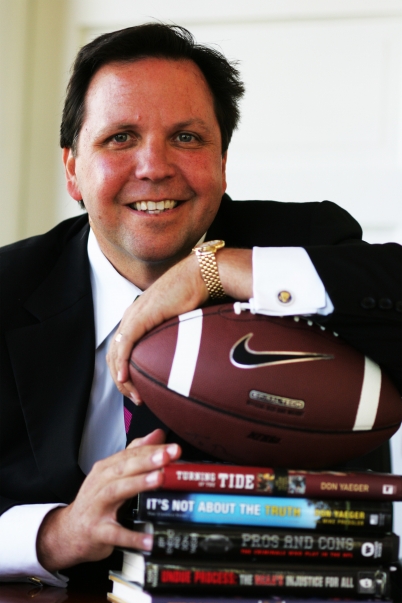
Don Yaeger
American author
8
APPEARANCES
7
PODCASTS
Sep 28, 2026


Joe PardavilaHOST
How important was it? The fact that you saw people obviously starting with your dad, but then these other greats that you were able to study from, tell me about that idea for, for anyone who picks up your book in terms of wanting to be a storyteller or improve their storytelling, this idea of like, it's good to look at the best storytellers for you to become a better storyteller.

Don YaegerGUEST
It's funny because for years when people asked me how did I become a good enough writer to be one of the 30 writers in the entire world for Sports Illustrated, right? When people had asked me, you're in elite company as a journalist, as a writer, how did you do that? And my answer was always really simple.
Don YaegerGUEST
I would ask myself when I read something that was really well done, I wonder what inspired that person, the writer, to use that language.
8 MINS LATER

Darren LaCroixHOST
So Don, when did you first realize you wanted to be a speaker? And when did you realize you needed some help? And Fripp was the one.
Don YaegerGUEST
So I was at Sports Illustrated as a senior writer and associate editor was my title, but there are only 30 senior writers at Sports Illustrated in the whole world.
Don YaegerGUEST
And over the last few years of the 12 years I was there, they actually had a speaker's bureau.
Don YaegerGUEST
The idea of actually trying to take content and deliver it in front of a group of people that will sit in judgment of you, it's a lot easier to be a writer and never actually listen to people who, because you're never sitting next to somebody that's actually reading your work, very seldom.
28 MINS LATER
Darren LaCroixHOST
But going from that to presenting and speaking on the stage, telling stories differently, what were some of the breakthroughs you had along the way?


Don YaegerGUEST
Now, the reason I say that phrase is because for a moment, I understand the psychology of storytelling.
Don YaegerGUEST
I understand how my words can affect other people, a good storyteller's words can affect other people.
Don YaegerGUEST
And by just simply saying the words, "I don't know what it looked like at your house growing up," and I pause, which gives you a second to think about Thanksgiving at your house growing up, which means from there forward, we're in the story together, right? We're, we're actually...
Don YaegerGUEST
It's us talking about our ex- our Thanksgiving in, in different, in different households.
19 MINS LATER


Don YaegerGUEST
He says, today I'm going to let 20 of you go one-on-one with the greatest player of all time, which is awesome, right? Tap yourself on the chest.
22 MINS LATER


John JantschHOST
I mean, that's, I mean, that proves your point, doesn't it? I mean, that's what people connected with.

Don YaegerGUEST
The second of the universal truths is that it is the story behind the story that is the story.
Don YaegerGUEST
But it's the things that made that happen That absolutely, that's the real story.
John JantschHOST
Are there like three or four core stories that every business needs to have and be able to tell kind of at the drop of a hat?


Don YaegerGUEST
"So, but, but I pat everybody on the back." But his whole model of leadership was this concept that you need to have a series of standards that you will hold everyone to.
Don YaegerGUEST
And sometimes your best players will push that envelope and try to see, "Do you really mean that for me? I'm the best player." He had Bill Walton, right? One of the greatest centers of all time.
Don YaegerGUEST
And so one day at, for Bill's senior year, he was the two-time National Player of the Year.
5 MINS LATER

Don YaegerGUEST
Like, we went up and down the aisles, and everybody was high-fiving," 'cause you know what? We, we weren't in the red.
Don YaegerGUEST
We were, we were, we were turning a corner and, and suddenly that celebration played into the belief and mindset.
Don YaegerGUEST
You can, you can block me out." But, uh, I'm sitting there and I'm watching the Super Bowl, and as you know, Atlanta's up twenty-eight to three, middle of the third quarter, late in the third quarter.
Don YaegerGUEST
The prognosticators had, had Atlanta with a ninety-nine point six percent chance of winning, right, at that stage.
Don YaegerGUEST
Because never in the history of the Super Bowl had any team come back from more than fifteen points down.
12 MINS LATER