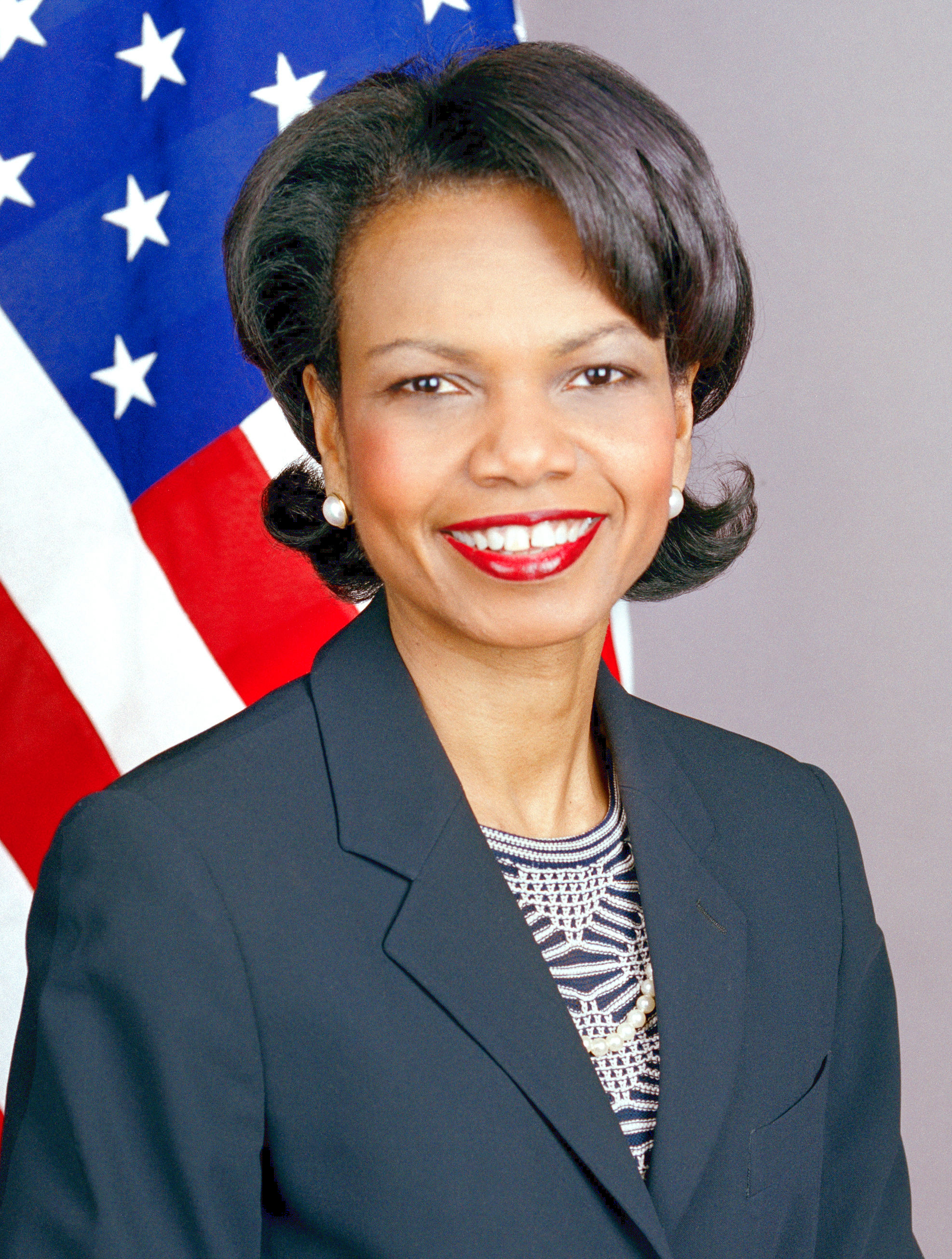
Condoleezza Rice
Political scientist and former United States Secretary of State
8
APPEARANCES
8
PODCASTS
Sep 22, 2026


Condoleezza RiceGUEST
But the sense of family, it really, really stuck with me that that was the very first thing that you thought.
Condoleezza RiceGUEST
I do want to say one thing to General Cain, because something in what you said, our paths crossed in a strange way.
14 MINS LATER


Condoleezza RiceGUEST
Here is this Black woman from the South, uh, the segregated South, taking an oath of allegiance to a Constitution that once counted her ancestors as three-fifths of a man, promising to protect and defend it against all enemies, foreign and domestic.
Condoleezza RiceGUEST
And oh, by the way, sworn in by a Jewish woman Supreme Court justice named Ruth Bader Ginsburg, who was my neighbor.
Condoleezza RiceGUEST
And of course, he would never have imagined it, and I wouldn't have as a little girl in Birmingham, and, and Ruth, when she was just trying to get her voice heard in law school.
Condoleezza RiceGUEST
We keep trying on the basis of our values, on the basis of our resilience, on the basis of our belief in one another to make that more perfect union, and it is never going to be done as our work.


Condoleezza RiceGUEST
... with the, uh, leaders of not very, from their point of view, important countries, but she actually, uh, might have been right.
Condoleezza RiceGUEST
So, uh, what does that transition depend on? That, that, that transition from the moment of revolution, the moment of throwing off the old, to the moment of, uh, the democratic flourishing and ultimately, uh, democratic consolidation Uh, the first is I think you do have to account for circumstances.
Condoleezza RiceGUEST
Um, and I'll come back to this in some of the cases that I want to talk about.
Condoleezza RiceGUEST
But you have to say that, uh, if you are fortunate in your circumstances, uh, it's a lot easier.
Condoleezza RiceGUEST
And, uh, in fact, the United States was really rather fortunate in its circumstances, having from the time of the arrival of, uh, the settlers, the col- the colonists on this land, uh, they found, um, not a completely open, um, field, but a pretty open field compared to what others would see.
Condoleezza RiceGUEST
In other words, the institutional landscape was theirs to shape in a way because there was not a, a great deal of competition, uh, from other organized, uh, forces at the time.
35 MINS LATER


Condoleezza RiceGUEST
Well, I have to start with the fact that this was in Birmingham, segregated Birmingham, at the height of the civil rights, uh, movement, '63, but this was a community that was very kind, loving, almost cocoon-like.
Condoleezza RiceGUEST
I, I lived in a little neighborhood not too far, uh, from my father's church.
59 MINS LATER


Condoleezza RiceGUEST
Yes, and part of what came with that was a sense of trying to engage the mind, not just the immediate heart.
Condoleezza RiceGUEST
And I think my father in particular was was that way, somebody who could engage people who were different.
Condoleezza RiceGUEST
I remember that his friends ranged from people like Stokely Carmichael, you know, the founder of the Student Nonviolent Coordinating Committee, you know, a person who was in absolute black power and sometimes talked even about violence.
Condoleezza RiceGUEST
all the way up to people like Reverend Ralph Abernathy, a name that unfortunately should not have disappeared from history.
Condoleezza RiceGUEST
He was a local pastor, and he was the person that Martin Luther King actually depended on to organize Birmingham.
9 MINS LATER


Christopher MimsHOST
... y- obviously you're not talking about specific companies, but if you could give us an example of a trend.
Condoleezza RiceGUEST
Well, for, you know, going back for a while, uh, on supply chains, for instance, uh, we had talked to companies about diversifying supply chains because, uh, it was pretty clear that a combination of Chinese policy, which made some elements difficult, and the fact that you were starting to get a backlash in the United States, uh, and we used to always say, "When you think about risk, uh, don't leave it to the risk officer, 'cause it's not gonna be the risk officer who's testifying before Congress.
Condoleezza RiceGUEST
Uh, do some simulation with it, and think about a contingency planning at this point.
Condoleezza RiceGUEST
If this goes this way, what would we do?" We encourage companies to have what we call, uh, indicators.
14 MINS LATER
Christopher MimsHOST
How are we gonna maintain this technological lead, which you've described as being so critical for us to run fast and run hard, um, if university funding, and specifically research funding, is under threat?


Russ AltmanHOST
How do you think about that? And I'm sure you were thinking about all of these things even as you were making these kinds of decisions.
Condoleezza RiceGUEST
Well, I have thought a lot about it because, uh, I, I often say that th-A lot is not known about us.
Condoleezza RiceGUEST
People just don't understand a lot about us, but unfortunately, some of the things that they understand, they don't like.
Condoleezza RiceGUEST
And so, I think we do have to work to address the gulf that's beginning to develop between institutions like ours and the broader public.
Condoleezza RiceGUEST
And the way that I think we address that is, first of all, we say that the, the notion of elite doesn't mean that we are elite in terms of the students that we serve.
Condoleezza RiceGUEST
Uh, when we look at our, our student body, and I'm sure you experience this, you'll stand in front of a class and you've got a fourth generation Stanford student, but you've also got, uh, the child of an itinerant worker, because we do have a very high proportion of first gen students, and so we have to let that be known, that we still are a place of upward mobility.
11 MINS LATER


Alex KantrowitzHOST
And if you put restrictions on China from taking this core material being made in Taiwan, I think the US even believes Taiwan is or says Taiwan is part of China, um, and says, "You c-" y- tells China, "You can't use these chips," you don't think that China is gonna go invade Taiwan to get them?
Condoleezza RiceGUEST
Well, let me unpack that for a moment because I think there's several important points, uh, there.
Condoleezza RiceGUEST
The first is that you asked how do we win or how do we, uh, deal with the fact that China is r- We run harder and faster.
Condoleezza RiceGUEST
Um, was talking to some people in the administration, the Trump administration, who tried to get a preemption on states having their own laws about, uh, AI, their own restrictions on AI.
Condoleezza RiceGUEST
Can you imagine if you're a young AI company and you've got restrictions in Delaware and Texas and California and they're all different? So we have to be careful that we don't just get in our own way, and we have to continue to innovate and innovate quickly.
7 MINS LATER
Alex KantrowitzHOST
So if you think about what's happening across universities, is that the solution?