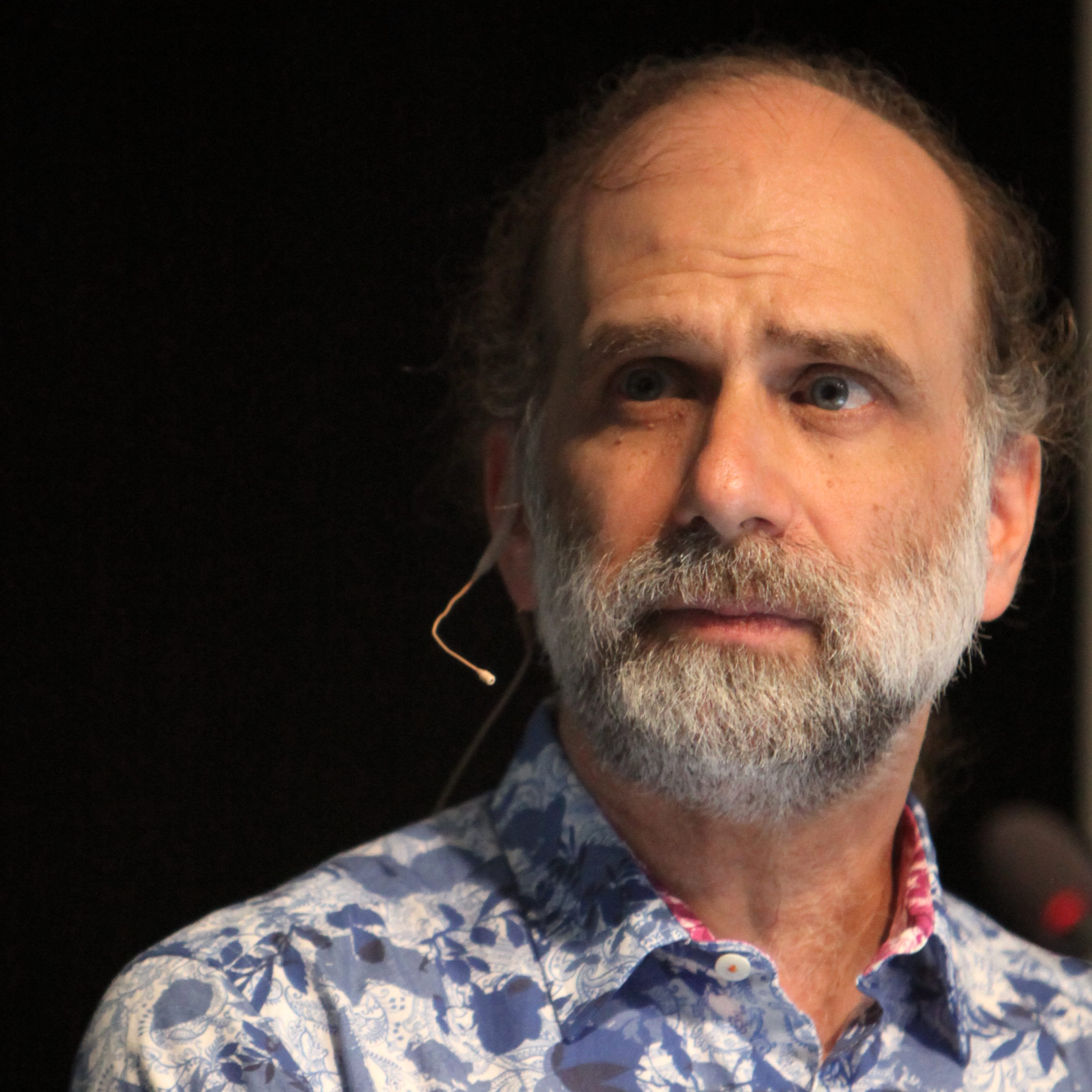
Bruce Schneier
American cryptographer
24
APPEARANCES
19
PODCASTS
Oct 13, 2026


Bruce SchneierGUEST
This is talk about how powerful the models are, and they're trying to pump up multi-billion dollar valuations for an IPO, right? They have no business model.
Bruce SchneierGUEST
These companies make no sense, but they wanna cash out before everything crashes.
Bruce SchneierGUEST
So anything that says how powerful and scary and effective these models are is better for the company.
Bruce SchneierGUEST
The employees, I mean, the best diagnosis, if I can use that word, I've heard, is that these people are incredibly overworked.


Bruce SchneierGUEST
You know, I really often dislike worst case examples because then we're just discussing extremes.
Bruce SchneierGUEST
I think the worst, I guess the worst case is the fiery death of everybody on the planet plus a zombie apocalypse.
Bruce SchneierGUEST
It sounds pretty bad, right? It probably makes sense to back off that pretty quickly.
14 MINS LATER


Bruce SchneierGUEST
So what I mean by that is the AI has access to resources, memory, your files, the internet, other AIs, and it can do things.
Bruce SchneierGUEST
send an email, control your thermostat, buy a book, book an airline ticket, drive a car from here to there.
24 MINS LATER

Kerry ParkerHOST
10 million AI agents systematically searching the entire rule space is something else.

Babette NgeneHOST
So when we talk about a decentralized web, what are we actually talking about? Like what becomes possible in a decentralized system that is difficult and impossible on the internet as we know it today? And any of you can start, or I'm also happy to call you out.
Bruce SchneierGUEST
You can put a web server on your computer, on my computer, on someone else's computer.
7 MINS LATER


Andy RevkinHOST
A-and that would include, are you, um, averse to making, uh, your own projection for when the possibility of uncontrolled superintelligence, uh, emerges?
Bruce SchneierGUEST
You know, it seems to be any time between next week and never, and pinning it down more than that, uh, is, is impossible.
Bruce SchneierGUEST
You know, e-even harder than predicting what will happen is when it will happen, and really, we don't know, right? The models are getting better.


Lisa WitterHOST
Bruce, do you have any to add in that, in that tour, or is that a, is that a good coverage?
Bruce SchneierGUEST
Uh, Germany, uh, where there's a, a lot of political parties, they regularly produce, uh, voter guides so voters can know what's going on.
Bruce SchneierGUEST
Uh, recently, they added a chatbot functionality to that, where instead of reading a dry piece of paper, you can engage in a conversation, uh, to learn about different political parties.
Bruce SchneierGUEST
Chile has a rule that when you introduce legislation, you need to explain how it affects existing legislation.
Lisa WitterHOST
Can you say more about that, why you think that's so, and whether that's a good thing or a bad thing? I know you guys often say it's good and bad, but, um, I'm curious, um, what-- how is that gonna change the traits that make for effective political leaders?

Bruce SchneierGUEST
Uh, I mean, uh, on- only a slightly related example, uh, RSA Conference, right? The biggest conference in our, in our industry.
Bruce SchneierGUEST
You know, and I, so I think Anthropic spends that kind of money to prove that they can spend that kind of money to justify their astronomical valuation so that the next, you know, person believes it.
14 MINS LATER


Stephen RicherHOST
to? Well, before we get to sort of the doom and gloom that we're going to talk about in the context of AI in society, what are some of the positive ways in which countries, governments have been using AI to deliver better services, to communicate better with constituents? What have you seen?
Bruce SchneierGUEST
And, God, I mean, the doom and gloom bothers me just as much as the utopia people do.
33 MINS LATER
Stephen RicherHOST
What do you say? Do you agree with somebody who says that? Or do you push back and say this is anomalous?

speaker_1ADVERTISER
From the world of Legally Blonde, watch Elle, a new original series only on Prime Video July 1st.
Bruce SchneierGUEST
[instrumental music] [audience applauding] So security is two different things, right? It's a feeling and it's a reality.
Bruce SchneierGUEST
You could feel secure even if you're not, and you can be secure even if you don't feel it.
Bruce SchneierGUEST
I mean, really, we have two separate concepts mapped onto the same word, and what I wanna do in this talk is to split them apart, figuring out when they diverge and how they converge.
Bruce SchneierGUEST
There aren't a lot of good words for the concepts, uh, we're gonna talk about.
14 MINS LATER
speaker_8ADVERTISER
Actual mileage and range may vary.

Brian KilmeadeHOST
Could this be one thing to... balance the costs and access? Could AI give those people in working class communities the same medical care of the so-called rich and famous?
Bruce SchneierGUEST
It's not the AI, it's the medical system, right? US has this horrible, expensive system ponderous medical system where people are making all sorts of money on the backs of us.
Bruce SchneierGUEST
So yes, you can imagine a world or a country where that happens, where AI gives benefits to people.
Bruce SchneierGUEST
You can imagine a country where all events of AI are captured by whatever private equity firm owns the hospital down the street.
Bruce SchneierGUEST
I think a lot about AI being used to augment doctors or in places in the planet where there are no doctors, where the choice isn't AI or doctor, but it's AI or somebody who got a week's of training in health somewhere.

Ben BradfordHOST
This is my moment to remind you that the internet brings you apparently water and power and your paycheck because Bruce says this comic is accurate.
Bruce SchneierGUEST
We are relying on an infrastructure that is put together by companies with their own agendas, by hobbyists who are trying to do a nice thing, and there isn't a whole lot of deliberate, "Let's pay attention to this and make it reliable."
Ben BradfordHOST
And yet even the guy who has articulated this to us, the guy who wrote Click Here to Kill Everybody, justDoesn't seem that concerned


Bill HaslamHOST
We need states to play their role." Talk a little bit to us about where states should have the ability to put their own, uh, thumbprint on regulation.
Bruce SchneierGUEST
In the same way states regulate, you know, so many aspects o- of people's lives, uh, AI is touching those, and we need regulation there.
Bruce SchneierGUEST
I mean, the argument that, you know, too many regulations are hard to follow I think is just whining on the part of these multi-hundred-billion-dollar tech monopolies.
Bruce SchneierGUEST
God, if you can't figure out 50 regulations, what are you doing in business? I have no sympathy for you.
7 MINS LATER

Bruce SchneierGUEST
These are models that are designed very carefully to do certain things and not do others.
7 MINS LATER
Isaac PoundHOST
If we imagine that the opposite kind of bill was passed, which does, I mean, we've kind of gone into it a bit already, but one that says you are specifically liable in the event of any deaths, of anything like that, what sort of effect would that have on the open source models? And would it maybe create an inadvertent monopoly of AI companies that can afford legal cases and to pay for overstepping on that line?
Isaac PoundHOST
And there's a complete lack of comparison in anthropics announcement to traditional tools, like you mentioned earlier as well.
Bruce SchneierGUEST
So starting in like November, December, these tools have gotten much better at software.
Bruce SchneierGUEST
We sort of hit a plateau in many chat applications, but the writing of code, of sophisticated code, of finding vulnerabilities, of exploiting them and patching them, really changed in the past few months.
Bruce SchneierGUEST
So we're now moving into a world where these AIs can find vulnerabilities in software, whether it's old things like BSD or OpenSSL, which is another commonly used piece of software that a month ago, someone found a whole bunch of old vulnerabilities in using a different model or new software being written.
Isaac PoundHOST
With that, I suppose, aside for a second, where do you see, what's your prediction on who this will favor in the long run?


Geoff NielsonHOST
What are the ones that kind of left the either filled you with the most awe or left the most sort of meaningful impression that you're most excited about?
Bruce SchneierGUEST
So Germany has a complex political system, lots of parties, and they have long had a nonpartisan voter guide.
Bruce SchneierGUEST
Now, a document that voters can read to figure out what the parties stand for and who to vote for.
8 MINS LATER
Geoff NielsonHOST
Is it is that coming is keeping humans in the loop like is that a technological decision? Is that a human and societal decision? How is this going to unfold in the next couple of years?

Chris BensonHOST
H- how do you envision that coming about? I think it's a wonderful dream, but I'm, I am- I will confess, I'm making a struggle on seeing how do we get from, from here to there.
Bruce SchneierGUEST
I mean, we can't even fund, uh, you know, government weather service anymore.
Bruce SchneierGUEST
It probably couldn't before, just because we believe corporations should do all the things.
10 MINS LATER


Ben HarnwellHOST
It's important to make the point that if you no longer have any, um, solid confidence that most, like, 99% of your source of information is actually true beyond an AI video generator, how on earth can you make the calculations necessary in order to form political, um, judgments?
Bruce SchneierGUEST
It- it's not new, right? You know, uh, doctored pho- doctored photographs is old as photography.
Bruce SchneierGUEST
What's different is, it's now easier to fabricate images a- and voices and, and videos.
Bruce SchneierGUEST
I think about it if, like, if we are ever gonna argue about what to do, right? I mean, if the, the actual business of politics, we have to agree on what the world is.
8 MINS LATER
Brian KilmeadeHOST
I was wondering if you could give me an idea of who's doing what in this business.
Bruce SchneierGUEST
You know, it's really interesting that all of the top-tier models are about the same.
Bruce SchneierGUEST
You'd imagine with these different skunk works doing secret stuff, they'd be different.
Bruce SchneierGUEST
We want a chatbot that is a good travel agent, or a good investment counselor, or a good talk show host, right? You know, we want to do a specialized thing.

Brian KilmeadeHOST
I was wondering if you could give me an idea of who's doing what in this business.
Bruce SchneierGUEST
You know, it's really interesting that all of the top-tier models are about the same.
Bruce SchneierGUEST
You'd imagine with these different skunk works doing secret stuff, they'd be different.
Bruce SchneierGUEST
We want a chatbot that is a good travel agent or a good investment counselor or a good talk show host, right? You know, we wanna do a specialized thing, and we're seeing these smaller, nimbler, cheaper models.

15 MINS LATER
Mila AtmosHOST
How can regulation ensure AI systems used in democracy are secure, unbiased, and transparent?
Bruce SchneierGUEST
I mean, like, I mean, the DeepSeek model, which is a Chinese model that, that did so well because they couldn't get the, uh, the good American chips.
Brian KilmeadeHOST
Do people, should people be worried, or should there be somebody cognizant of not, uh, not AIing ourselves out of, uh, workers?
Brian KilmeadeHOST
Do people, should people be worried, or should there be somebody cognizant of not, uh, not AIing ourselves out of, uh, workers?
Bruce SchneierGUEST
I think the market will AI workers away, right? The market seeks efficiencies.
Bruce SchneierGUEST
It's lawyer, it's doctor, it's accountant, it's architect, right? Junior level positions will...
Brian KilmeadeHOST
But do you think they could help expedite some, with the backup and the courts?

speaker_2UNKNOWN
So we're already seeing it and
Bruce SchneierGUEST
You know, so these are attacks and it could be adversaries or our people, right? The NSA will do this too.
Bruce SchneierGUEST
Also, that means AIs for spam detection evasion, right? So those two arms races, finding and hiding vulnerabilities, finding and hiding spam.
10 MINS LATER

Bill BuchananHOST
the horizon for our existing public key methods? Should we start to migrate now or is this going to need to happen in five to 10 years?