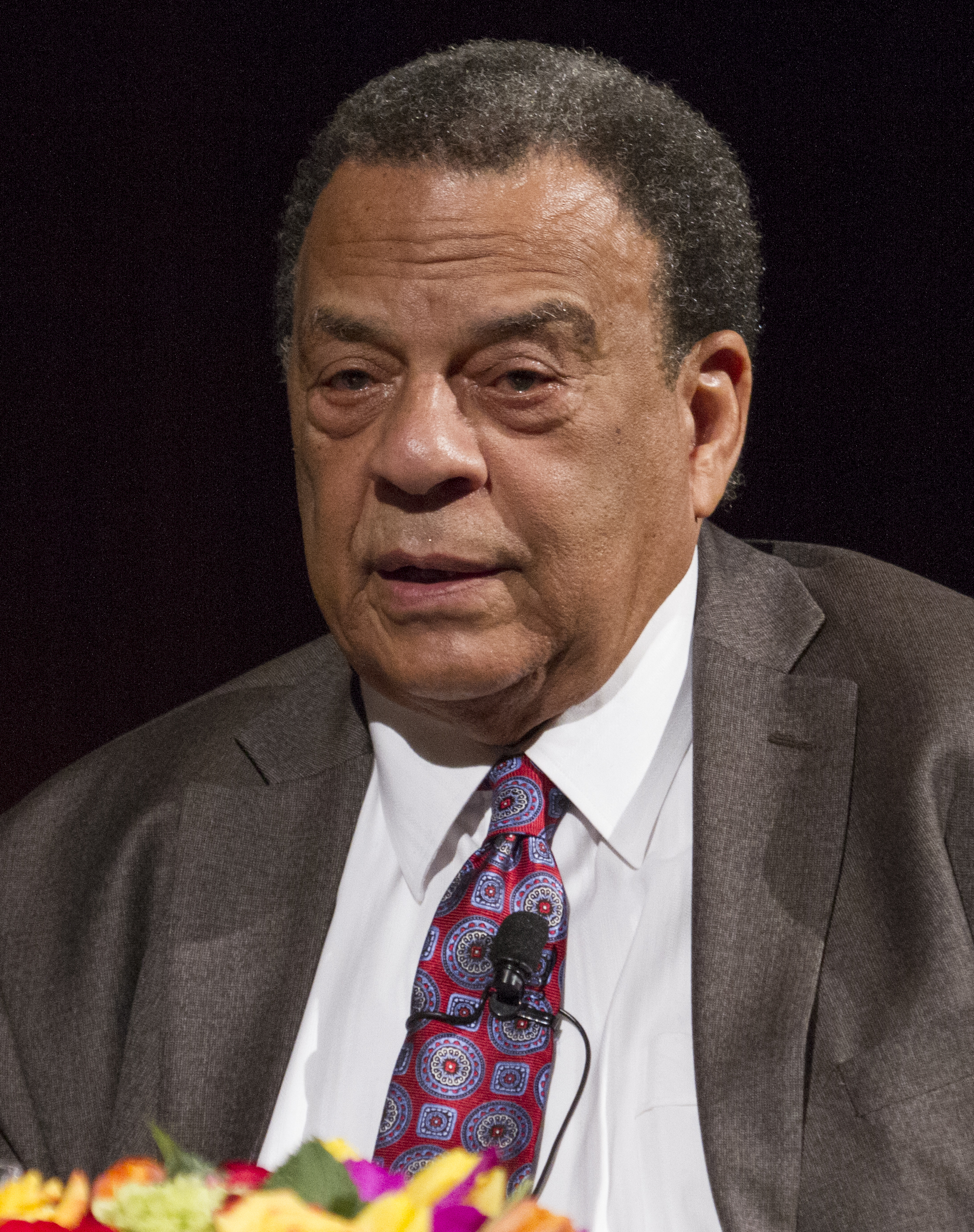
Andrew Young
Activist and former United States Ambassador to the United Nations
13
APPEARANCES
9
PODCASTS
Sep 16, 2026


Andrew YoungGUEST
And from my personal experience, both as an individual and then working for the organization, I can tell you, number one, we make it as easy as possible for you.
Andrew YoungGUEST
We have three different programs, not just our community-based program, but we have our Mentor 2.0 program where that's curriculum-led and you have a few more prompts in place to help you get that relationship started.
Andrew YoungGUEST
Every single one of our matches has a match support specialist assigned to that match.
Andrew YoungGUEST
And that person has one-on-one conversations every month with our bigs to talk through how the relationship's going and help coach you through that.
Ron Herold Jr.HOST
So are you meeting with the kid like in person one hour a week? You taking them somewhere?


Brad GuzanHOST
As you guys both grew in your careers and throughout society and your impact on society, what would you guys say? How has Atlanta, you know, basically the history of this city, how has that changed in creating a better a better today tomorrow?
Andrew YoungGUEST
And one of the first problems we took on was trying to develop a mass transit system.
Andrew YoungGUEST
And so we had to organize the whole metropolitan area to get people to vote for a one cent sales tax.
9 MINS LATER
Joe FryhoferHOST
What was it like for you both to see Atlanta, as you said, Ambassador Young, really pull together and make it such a festivity of humanity? What was that like to take in this past
Andrew YoungGUEST
Um, what that means is we pair children with adult mentors, uh, through three different programs, and essentially it's quite easy.
Kevin GrayHOST
How can they get involved, and what's the easiest way that folks can get involved with Big Brothers Big Sisters?

13:27

How would this agreement be viewed by the main player here, the CBH group?
Andrew YoungGUEST
I think these kind of asset-like supply chain models for grain are not, that's not unusual.
Andrew YoungGUEST
On the east coast, there's at least 11 of these, or eight, I think, of these particular operations successfully exporting grain.
Andrew YoungGUEST
The good thing about these kind of systems is that they're not a high-cost kind of structure.
Andrew YoungGUEST
They are able to turn up and turn down in terms of production and be responsive to production.
Andrew YoungGUEST
They're also largely catered for niche type or parcel based freight opportunities and marketing opportunities.
17:00
Why did you choose the Geraldton port as a starting point here when you're aware of the problems, the challenges, the surge issues, if we start there, for example? Why did you choose Geraldton?

Jim CowieHOST
maybe it's maybe not the same likeness, but I often think with the wild fishery in Scotland, do you feel on your side that taking ownership and the industry does a certification?
Andrew YoungGUEST
You know, on the tuna side, You got to remember that there's really two main bluefin tuna fisheries around the world, right? There's the Pacific bluefin tuna, which is the largest part of that fisheries in Japan, and the largest market for bluefin in the world is in Japan.
Andrew YoungGUEST
So there's the Pacific bluefin, which is caught either in Japan uh wild caught but a very small percentage of it is wild caught in north american waters and then we have our own uh mexican bluefin operation but same species as as as is it is being farmed or wild caught in japan and then you have the atlantic bluefin which their migratory pattern is...
Andrew YoungGUEST
Again, the fish are very similar in terms of their scientific structure, but there are some differences.
Andrew YoungGUEST
And then you have the Atlantic bluefin, which is mostly caught in the Mediterranean area.
26 MINS LATER


Geoff BennettHOST
I spoke with him earlier today, and asked him about Reverend Jackson's role in pushing for civil rights.
Andrew YoungGUEST
Well, Reverend Jackson was the second or third generation, but, uh, in a way, he, he, he follows best under the generation of students coming out of the, uh, the '60s and the sit-ins.
Andrew YoungGUEST
And, uh, he was a member of the group in North Carolina, uh, A&T, uh, Agriculture and Technical College, uh, that, uh, that, that started the sit-ins.
Andrew YoungGUEST
This was, uh, five years after Martin Luther King started the, uh, Montgomery bus boycott.
Andrew YoungGUEST
It was this background, uh, and the fact that he grew up in the Negro church, that, uh, prepared him for leadership.
Andrew YoungGUEST
Uh, so much so that, um, he, uh, he often quiet- in the b- early days, uh, tried to imitate Martin Luther King.
Geoff BennettHOST
What did his voice as a preacher allow him to do, allow him to say, that a traditional politician could not?


Andrew YoungGUEST
And so we were keeping them in the church, and I was standing in the doorway, and Jesse came up and said, You've been out here since the march was over.
Andrew YoungGUEST
He said, If you don't mind, if you can trust me to hold this door, you can go get you a couple hours sleep.


Andrew YoungGUEST
He never had a million dollars a year to work with the entire time we had the movement going.
Andrew YoungGUEST
And so I was trying to help him raise some funds, and went to my church up here, the United Church of Christ, and, and asked them.

Andrew YoungGUEST
King and the Episcopal bishop." And she said, "Well, I can't do that." She said, "I don't know Dr.
Andrew YoungGUEST
"Y- you come here, and I'll get you to see the bishop." So then I had to go see the bishop and explain to him that we about to move 50 more Black folk into your already 90,000 people, [laughs] and we intend to tear up your town.
51 MINS LATER
Andrew YoungGUEST
H- He needed to be in a bigger city than Montgomery, and, uh, but he couldn't afford to live in Atlanta except with his parents.
Andrew YoungGUEST
He never had a million dollars a year to work with the entire time we had the movement going.
Andrew YoungGUEST
And so I was trying to help him raise some funds, and went to my church up here, the United Church of Christ, and, and asked them.
Andrew YoungGUEST
They founded, uh, a number of colleges: Howard, and Tuske, uh, Talladega, Tougaloo-

Andrew YoungGUEST
King and the Episcopal bishop." And she said, "Well, I can't do that." She said, "I don't know Dr.
Andrew YoungGUEST
Y- "You come here, and I'll get you to see the bishop." So then I had to go see the bishop and explain to him that we bout to move f- 50 more Black folk into your already 90,000 people, [laughs] and we intend to tear up your town.
51 MINS LATER

Andrew YoungGUEST
Because th- their generations that fall into the categories of my children and grandchildren and great-grandchildren, and, uh, I'm very...
Andrew YoungGUEST
Well, I'm a preacher too, and as, as an old hymn, "My hope is built on nothing less than Jesus' love and righteousness." And, um, I, I, I, I, um, I, I just hope and pray and believe that, um, this country is really too solid, uh, to bow down to Baal.

Ari MelberHOST
You mention coming up, uh, in an environment like this, coming up with what you just referenced, Nazi Party, the anxiety, the threats, uh, and so I, I'll warn you as a, as a speaker yourself, I got about two minutes here for you, but what do you say to people who look at this and do feel afraid or discouraged? What do you say based on y- your history, the, the courage of you and the people you worked with?

speaker_15UNKNOWN
(laughs)
Andrew YoungGUEST
And I said, "I've lived in New Orleans and Marion, Alabama, and Atlanta, and Thomasville, Georgia," but I- I said, "I really don't know Birmingham." He said, "Well, you got a couple of months to..." He said, "And you got about 30 days to meet someone." I said, "Why?" He said, "Well, if we're gonna have demonstrations there, somebody has got to go and sit down with the responsible leaders in the community and explain to them why we're having demonstrations." And so, I remembered that I'd been at a conference in Michigan, and there was a group there from, uh, the Episcopal Church.
Andrew YoungGUEST
I just picked up the phone and called the Episcopal Church in Birmingham, and the lady who I had met at University of Michigan answered the phone.
9 MINS LATER
speaker_15UNKNOWN
(laughs)