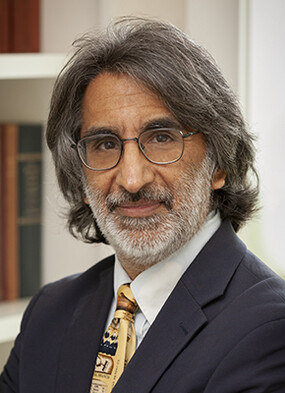
Akhil Reed Amar
American legal scholar
7
APPEARANCES
4
PODCASTS
Jul 9, 2026


Akhil Reed AmarGUEST
It turns out that John Roberts's, you know, the 10 biggest cases of the Roberts Court, I actually think I agree with nine of, with John Roberts in nine of them, and five are on the left and five are on the right.
Akhil Reed AmarGUEST
They're not all originalist narrowly understood, but on the l- left, okay, three this term, Cook- And, um, uh, tariffs, um, and birthright citizenship.
Akhil Reed AmarGUEST
On the conservative side, I actually, as an originalist, think that Roe was problematic, so, you know, Dobbs, I can, you know, is, is actually, um, uh, sound.
9 MINS LATER


Akhil AmarGUEST
And, by the way, I have a podcast, and you can listen to that podcast, too, on Marcus Constitution, and we play some clips from the oral argument this week, and you can listen to them.
Akhil AmarGUEST
Never until Trump II, the second Trump administration, has any president tried to de-citizenize, deny a passport, deny a Social Security card to an American-born baby on the grounds that the baby did not have at least one parent who was a citizen or green card holder.
Akhil AmarGUEST
Never in all of American history, they have appointed to two particular individuals from 1885, never litigated situations.
Akhil AmarGUEST
And those individuals, the State Department basically withheld some papers, but they weren't arguing birthright citizenship.
15 MINS LATER
17:56

But we'd like to get the view of your view on this matter and where this stands in terms of international law and law in the United States, because there's also the military code of conduct as well that deals with war crimes, as has been pointed out by six Democratic members of Congress who were threatened with a seditious conspiracy and a grand jury refused to just issue a true bail and threw this nonsense out.
Akhil AmarGUEST
And there's nothing wrong with being a politician is how, you know, we achieve things is, is political things, political ends.
Akhil AmarGUEST
So Lincoln, Lincoln believes there are at least 10 ways to read all men are created equal.
11 MINS LATER

David FrenchHOST
And I guess at the end of the day, the question that I have, why does it matter if we locate unenumerated rights in privileges or immunities or substantive due process or, say, Ninth Amendment, the, the different way-- places in which we can locate it? Isn't it the kind of the same analysis either way? In other words, what's implicit in the concept of ordered liberty? What's a, a long-standing recognized right that existed, say, at the time of the founding or the ratification of the Fourteenth Amendment? Isn't that what we're basically doing and then attaching a label to that, attach-attaching a set of words to that?
Akhil Reed AmarGUEST
One, I think it's always advantageous if what the court does can be connected to the Constitution.
Akhil Reed AmarGUEST
In a democratic society, it's very nice for ordinary people to understand what is being done, at least in theory, in the name of the Constitution.
Akhil Reed AmarGUEST
I think it's an advantage if an eighth-grader can look at the thing and actually not say, "Huh, I thought substance was the opposite of process," which an eighth-grader might do, or a twelfth-grader.
Akhil Reed AmarGUEST
I read Roe versus Wade, and I thought I was the idiot because everyone else was talking about this as if it was a thing, you know, and it was like the emperor's, you know, new clothes, and I thought I was the only fool.


Akhil Reed AmarGUEST
Lincoln should be, actually, he didn't know he was supposed to give a speech.
Akhil Reed AmarGUEST
He just comes here in Philadelphia-... and it's Washington's birthday, and, and so he should be talking about Washington.
Akhil Reed AmarGUEST
But no, he can't do any- he has to talk about the Declaration, 'cause for him, the Declaration is the foundation for the Constitution, so it's really interesting.
24 MINS LATER


Sarah IsgurHOST
If one is an originalist, whatever that might mean, how are we supposed to think about the Declaration of Independence, the Constitution, and the second founding, the post-Civil War Amendments, the 13th, 14th, and 15th, and you add the 19th as well? But really, you start with the Declaration of Independence, but I think it's been this really hard tension for a lot of originalists of what role the Declaration of Independence is supposed to play in our hearts and our minds and our hopes and our dreams.
Akhil Reed AmarGUEST
So that is the biggest and best question about American identity, uh, about our country, and about constitutional law.
Akhil Reed AmarGUEST
It was the US, the United States, we, the people of the United States, and our origins are in July 1776.
10 MINS LATER
David FrenchHOST
How much did the Declaration pl- What kind of role did that moral statement from the Declaration sort of play in the build-up and the lead-up to the Civil War? How much was it, uh, the incompatibility of the moral ideal with the present reality of slavery that weighed on this country?


Bari WeissHOST
So you don't feel like this is an exceptionally precarious moment the way that I think a l- I think a lot of people do feel that way.
Akhil AmarGUEST
I, I think it is an exceptionally precarious moment, but so was the 1850s, so was the 1770s, so was the 1780s, so was the 1790s and the, the what ha- ultimately was a-... peaceful transition of power from, from, um, Adams to Jefferson.
Akhil AmarGUEST
So the historian in me says, "Yeah, wow, I'm living in interesting times, but so have a lot of other people." And when I look around the world and I see how much, you know, this is precarious, but, but my parents, my mom passed away three years ago this week, and I think about her all the time.
Akhil AmarGUEST
But my parents were born under, um, a British king halfway across the world that didn't care about them enough, and a British Parliament in which they couldn't vote halfway across the world.
Akhil AmarGUEST
And I understand a little bit through my family story what John Adams and Sam Adams and Patrick Henry and, and James Otis and the other people I talk about in the book.
Akhil AmarGUEST
I kinda get a sense of, you know, how they felt 'cause my parents tell me stories about, um, um, what they felt as youngsters.
7 MINS LATER