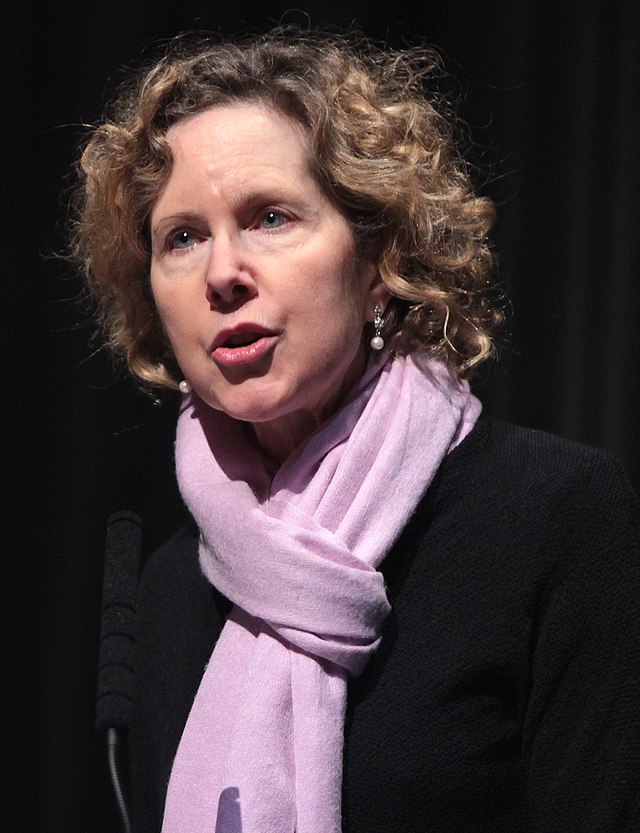
Heather Mac Donald
American commentator and essayist
48
APPEARANCES
30
PODCASTS
Oct 6, 2026


Heather Mac DonaldGUEST
... drunken bacchanals, uh, which is m- sexual modesty, even, God forbid, chastity and, and male chivalry.
Heather Mac DonaldGUEST
Uh, and we're supposed to believe that that's all, uh, oppressive and patriarchal, and that men and women, males and females are absolutely equal on the sexual battleground field, and that the female libido is just as active, just as, uh, voracious, omnivorous as the male libido, all of which is completely untrue.
Heather Mac DonaldGUEST
Uh, so the females are strong women together, and yet it turns out the way these campus rape narratives work is that it is still, uh, completely on the male's responsibility.
Heather Mac DonaldGUEST
He may be drunk, she may be drunk, but in traditional terms, and this is what the Ingalls suit is, is pushing back against, the male is responsible both for himself and for the female.

Blake NeffPANELIST
... era of Title IX policies, Heather, two minutes here, you should lay out what are we bringing back if we allow this story to grow out of control with the narrative they're trying to sell us?


Heather Mac DonaldGUEST
... drunken bacchanals, uh, which is m- sexual modesty, even, God forbid, chastity and, and male chivalry.
Heather Mac DonaldGUEST
Uh, and we're supposed to believe that that's all, uh, oppressive and patriarchal, and that men and women, males and females are absolutely equal on the sexual battleground field, and that the female libido is just as active, just as, uh, voracious, omnivorous as the male libido, all of which is completely untrue.
Heather Mac DonaldGUEST
Uh, so the females are strong women together, and yet it turns out the way these campus rape narratives work is that it is still, uh, completely on the male's responsibility.
Heather Mac DonaldGUEST
He may be drunk, she may be drunk, but in traditional terms, and this is what the Ingels suit is, is pushing back against, the male is responsible both for himself and for the female.
Blake NeffHOST
Title IX policies, Heather, two minutes here, you should lay out what are we bringing back if we allow this story to grow out of control with the narrative they're trying to sell us?


Heather Mac DonaldGUEST
Uh, the male libido, if you release it from traditional norms of chivalry, of sexual propriety, of protecting women, uh, it will be extraordinarily crude and gross and aggressive.
Heather Mac DonaldGUEST
And the idea of female modesty and chastity, another completely taboo word these days, but yes, chastity was an, an, a thing.
38 MINS LATER

Heather MacDonaldGUEST
I have no objection in theory to those being the rules, especially today when the sort of social informal stigma against grotesquely promiscuous sex has been wiped out by radical feminism.
Heather MacDonaldGUEST
about it being a federal mandate, and it's not because I'm some radical libertarian, and this is a dilemma in all of the university reform, the campus reform that the Trump administration is trying to do.
Heather MacDonaldGUEST
He's strengthening the precedent for the left to take over universities again, and it's not as if he's doing anything that is so new because the left has been imposing its mandates, but Doing it when we do it, it strengthens the precedent and it will make it all the more likely that the left takes the power and runs with it.
Heather MacDonaldGUEST
You could have you could imagine, you know, our solution is going to be that every male needs to be have 60 hours a week of sexual harassment training, that that's the way we're going to be combating this problem.
19 MINS LATER
Will ChamberlainHOST
And then we can actually put real pressure on the universities and get them to, you know, return to a probably much less popular, but much more virtuous institution.

AnushaHOST
And I'd love for you to share with us, you know, how reliable is lab work when it comes to these symptoms? And if you are having even symptoms that aren't within the 52 or 3, what do you do with that information and how can you move forward?
AnushaHOST
And you being a breast cancer surgeon and specialist in our pre-viva program of cancer risk, can you talk to us about that? changes in the evidence-based medicine around hormonal replacement, MHT, HRT, and how do the benefits outweigh the risk?


Carine HajjarHOST
And so I'm wondering what's causing these teen takeovers and what is the solution to them?
Heather Mac DonaldGUEST
I'm reluctant to break the taboo at this point, but I think if you're going to understand this, you need to step apart from conventional media usage.
Heather Mac DonaldGUEST
And the only time the mainstream media acknowledges that is when they've got an expert bashing whites for their racial panic in being concerned about large groups of violent black teens.
Heather Mac DonaldGUEST
So that needs to be put in the context of certain problems that are happening in certain segments of the black community, not everybody.
Heather Mac DonaldGUEST
You know, there's a whole range of behaviors, and I'm talking here simply about averages, not about any individual.
Heather Mac DonaldGUEST
But you do have... a family breakdown level within the Black community that is frankly catastrophic when you have 68, 69, sometimes 72 percent of children born out of wedlock.
20 MINS LATER
Carine HajjarHOST
And do you think that we're going to sort of hit a moment where it's just too much to bear and you're going to see major city leaders say, all right, we have to start compelling treatment in these cases? Or are we going to keep seeing the self-rationalization of harm reduction that you sort of see in these progressive circles?


Heather Mac DonaldGUEST
I'm going to, again, bring up a very taboo topic, which is I think another element of this, not for everybody, but I think it is there.
Heather Mac DonaldGUEST
that is the result of the oppositional culture that came in in the 1960s where blacks who until then had been doing their best, it breaks one's heart to see the efforts to be accepted by bourgeois society, by white society, by graduating, you know, joining fraternities and insurance companies and going to church.
Heather Mac DonaldGUEST
and still getting shut out despite efforts to be law-abiding bourgeois Americans, that ended sadly in the 1960s when you had the celebration of black power and oppositional culture with Malcolm X saying, We're not going to even try to assimilate into white society any longer.


John PhillipsHOST
But the permissive attitude about drugs to me was original sin when it comes to homelessness because that's when the dominoes started falling.
Heather MacDonaldGUEST
The vagrant population has two overwhelming characteristics, mental illness and chemical addiction.
Heather MacDonaldGUEST
The sort of medical industry refers to this population as the MICA population, mentally ill chemical abusers.
Heather MacDonaldGUEST
And you can see them on the streets of San Francisco, these scarecrow white addicts that were absolutely destroyed in the 60s.
Heather MacDonaldGUEST
living off the public dime, stealing, destroying any hope for urban renewal.
John PhillipsHOST
What should I do about these County public health departments that are technically doing something illegal in my jurisdiction?

Heather Mac DonaldGUEST
Well, I think it's both a, uh, financial self-interest because, yes, there are huge, uh, lobbies, interests that are, uh, have enormous profits on the line with this phony narrative about it's the lack of affordable housing.
Heather Mac DonaldGUEST
I think it's also an ideological interest where I think for the advocates and for many of these left-wing politicians, having vagrants on the streets is visual proof that America is a heartless society, that capitalism doesn't work, that the free market in housing doesn't work, that we need government housing, that we need more transfer of wealth from the hardworking to the non-working.
Heather Mac DonaldGUEST
Uh, and so, you know, I think there's a investment politically in the status quo.
Heather Mac DonaldGUEST
Uh- Any time there's a, a, a brief whiff of honesty in the mainstream media, occasionally you get sotto voce reporting on the, uh, shelter resistance phenomenon, which I have witnessed numerous times.
Heather Mac DonaldGUEST
I've done reporting on the ground in Skid Row, uh, in the Tenderloin in San Francisco, uh, you know, you name it, uh, in Santa Ana Civic Center, and I've witnessed the vagrants be offered housing and services by these feckless outreach workers who, again, they have a stake in keeping the status quo as bad as possible.
John PhillipsHOST
But the permissive attitude about drugs to me was original sin when it comes to homelessness because that's when the dominoes started falling.


Heather MacDonaldGUEST
do? This couldn't happen without a concerted campaign of deception and Orwellian misrepresentation of what the reality is.
Heather MacDonaldGUEST
Soto-Martinez, in making his case, called the homeless, and I use that phrase in scare quotes because what we're really talking about here is drug-addicted, mentally ill vagrants.
Heather MacDonaldGUEST
Homelessness itself was an Orwellian renaming of a very different reality, but we'll just use it for shorthand.
Heather MacDonaldGUEST
And, you know, to be neighborly, you have an open arm, you extend a welcome, you invite people in for some cookies or, you know, housewarming parties.
8 MINS LATER

34:02

What do you think this charter, the Toronto Youth Employment Charter, will do practically?
Heather McDonaldGUEST
Well, and I'm glad you mentioned you saw some momentum, right? That there is, even though the percentage of jobs with, by the way, in Toronto is higher than the provincial and national averages.
Heather McDonaldGUEST
and community organizations to unlock jobs and I got to spend time with many young people who've had their first job this morning.
Heather McDonaldGUEST
It was incredible including the youth cabinet from the City of Toronto who've been so much part of this.
36:06
How would you recommend to families and young people to break through like that?
Heather Mac DonaldGUEST
Well, I think it's both a, a financial self-interest because, yes, there are huge, uh, lobbies interests that are, uh, have enormous profits on the line with this phony narrative about it's the lack of affordable housing.
Heather Mac DonaldGUEST
I think it's also an ideological interest, where I think for the advocates and for many of these left-wing politicians, having vagrants on the streets is visual proof that America is a heartless society, that capitalism doesn't work, that the free market and housing doesn't work, that we need government housing, that we need more transfer of wealth from the hardworking to the non-working.
Heather Mac DonaldGUEST
Uh, and so, you know, I think there's a investment politically in the status quo.
Heather Mac DonaldGUEST
Uh, any time there's a, a, a brief whiff of honesty in the mainstream media, occasionally you get sotto voce reporting on the, uh, shelter resistance phenomenon, which I have witnessed numerous times.
Heather Mac DonaldGUEST
I've done reporting on the ground in Skid Row, uh, in the Tenderloin in San Francisco.
John PhillipsHOST
But the permissive attitude about drugs to me was original sin when it comes to homelessness because that's when the dominoes started falling.
John PhillipsHOST
But the permissive attitude about drugs to me was original sin when it comes to homelessness because that's when the dominoes started falling.
Heather MacDonaldGUEST
The vagrant population has two overwhelming characteristics, mental illness and chemical addiction.
Heather MacDonaldGUEST
The sort of medical industry refers to this population as the MICA population, mentally ill chemical abusers.
Heather MacDonaldGUEST
And you can see them on the streets of San Francisco, these scarecrow white addicts that were absolutely destroyed in the 60s.
Heather MacDonaldGUEST
living off the public dime, stealing, destroying any hope for urban renewal.
John PhillipsHOST
What should I do about these county public health departments that are technically doing something illegal in my jurisdiction?

Randall BockHOST
That seems to always be part of this, that whatever standards are set up, if people can't meet it, we change the standards.
Heather MacDonaldGUEST
Well, that was George W. Bush who used that phrase, and maybe Gerson wrote it for him.
18 MINS LATER
Randall BockHOST
Is there any kind of putting the genie back in the bottle or whatever the term would be? Is there any going back? Do we see anything like that?


Dan ProftHOST
Do you agree with, uh, Steele's formulation, though, this culture of deference that he described?
Heather Mac DonaldGUEST
It's behind the entire conceit that is so poisonous of disparate impact, which holds that if any, uh, constitutional colorblind law enforcement activity has a disparate impact on Black criminals, it must be a racist practice, and therefore it must be dismantled.
Heather Mac DonaldGUEST
Uh, and, and it's behind the groveling offering of services, uh, to youth, more services, more free stuff, as a bribe to stop the teen takeover phenomenon.
Heather Mac DonaldGUEST
These people have all the opportunities pache- you know, contrary to Brandon Johnson, uh, if they stay in school, don't get involved in crime, graduate, uh, wait until they are married to have children, they will not be poor.

Heather Mac DonaldGUEST
Well, it's certainly gone down from the post-George Floyd, the race riot high, where you had the largest increase in one year in homicide, nearly 30% in, in American history.
Heather Mac DonaldGUEST
It simply couldn't stay at that, uh, very, very elevated rate, which of course was made up mostly, overwhelmingly, by additional Black victims who'd been killed by Black perpetrators.
Heather Mac DonaldGUEST
Uh, but there has been generally, uh, baby steps on the part of some law enforcement agencies to engage in the essential proactive policing again, uh, that y- you know, says to officers, "We want you not just to react to crime after the hap- after it happens, which is a little late, but to actually use your powers of observation on the street if you see suspicious behavior.
26 MINS LATER


Carl JacksonHOST
I'm like, what does that have to do with you being a nut job when you leave your home?
Heather Mac DonaldGUEST
Well, you're not helping people by excusing bad behavior because that's not a way to advance in society.
Heather Mac DonaldGUEST
There still are occasional gatekeepers and barriers to entry if you have a criminal record, if you have not developed those habits of self-control.
Heather Mac DonaldGUEST
And right now... society at large is so saddled with racial guilt that it thinks that it's doing blacks a favor by absolving them from personal responsibility and coming up with these really i think unjustified explanations that this is all due to systemic racism the fact is as you say carl there are millions of blacks who are absolutely law-abiding who want the police who believe in order who are terrified by these kids that don't engage in this type of behavior.
Heather Mac DonaldGUEST
But sadly, the proportions of those who do within the black community are much, much higher than in other racial groups.
Heather Mac DonaldGUEST
And to give them a pass on bourgeois norms and self-control is making sure that they will stay in the ghetto.
8 MINS LATER

Carl JacksonHOST
I'm like, what does that have to do with you being a nut job when you leave your home?
Heather Mac DonaldGUEST
Well, you're not helping people by excusing bad behavior because that's not a way to advance in society.
Heather Mac DonaldGUEST
There still are occasional gatekeepers and barriers to entry if you have a criminal record, if you have not developed those habits of self-control.
Heather Mac DonaldGUEST
And right now... society at large is so saddled with racial guilt that it thinks that it's doing blacks a favor by absolving them from personal responsibility and coming up with these really, I think, unjustified explanations that this is all due to systemic racism.
Heather Mac DonaldGUEST
The fact is, as you say, Carl, there are millions of blacks who are absolutely law-abiding, who want the police, who believe in order, who are terrified by these kids.
Heather Mac DonaldGUEST
But sadly, the proportions of those who do within the black community are much, much higher than in other racial groups.
9 MINS LATER


Andrew KlavanHOST
Does that have anything to do with this or am I grasping at straws? I mean, is this really just a black culture problem?
Heather Mac DonaldGUEST
Well, are you talking about the street vagrancy or about teen takeovers? I would say the street vagrancy is absolutely about the closing of mental institutions and the rise of Thomas Sass, the libertarian theorist of sort of mental history, mental illness, who claimed that, well, mental illness was just a social construct that the uptight bourgeoisie impose on the nonconformists among us.
Heather Mac DonaldGUEST
And then the received wisdom as well, it was also Ronald Reagan who wanted to save money and shut down the mental institutions.
Heather Mac DonaldGUEST
It's repeated so often that preposterously maybe I'm inclined to accept that as a default explanation absent refutation.
Andrew KlavanHOST
Is there a path back? I mean, do you have any kind of optimism about this at all?


Lisa BootheHOST
So what, what role has this influx of legal aliens played in the homeless crisis?
Heather Mac DonaldGUEST
Well, it's contributing to it at this point, but it, we had this crisis for a long time before the big welcome mat and, and additional set of incentives for illegal aliens to come to.
Heather Mac DonaldGUEST
Trying to decide what a cause is for a very complex social phenomenon is very difficult.
Heather Mac DonaldGUEST
And as you articulate, it is already a lot to notice that government, I call it the great inversion, it has, it has overturned the traditional values that has always governed, uh, and, and motivated governments.
6 MINS LATER

Heather Mac DonaldGUEST
Well, it's contributing to it at this point, but we had this crisis for a long time before the big welcome mat and additional set of incentives for illegal aliens to come to.
Heather Mac DonaldGUEST
And trying to decide what a cause is for a very complex social phenomenon is very difficult.
Heather Mac DonaldGUEST
And as you articulate, it is already a lot to notice that government, I call it the great inversion.
8 MINS LATER


Brad SmithHOST
So removing the human lens and then subdividing it in this kind of Marxist way into categories and see how you see it from your quote-unquote victim stance.
Heather Mac DonaldGUEST
Well, you put your finger on one of the greatest ironies of recent intellectual history.
Heather Mac DonaldGUEST
Again, I don't want to put off your readers with things that sound patently absurd, and they are patently absurd, but one of the standard tenets of this so-called deconstruction and post-structuralism, which were the dominant literary fields in the 1970s, was that there was no such thing as the self, that human beings were merely an epiphenomenon of language.
Heather Mac DonaldGUEST
And again, please, I'm not expecting anybody to think that I'm saying anything significant or meaningful.
12 MINS LATER
Brad SmithHOST
I just want to know, because I only have you for a short time here, like what, how does this all tie into what you believe is the feminization of these uh, academic institutions? Like how has the feminization, uh, of these institutions led to a decline in the academic erosion that has led to the society creating people looking from emotional points of view rather than factual points of view?


Heather Mac DonaldGUEST
You could say society's being feminized in terms of the decline of rationality, the rise of completely insane public policy based on a failure to cost-benefit a- a- analyze things like with COVID.
Heather Mac DonaldGUEST
You know, we're gonna shut down the entire economy, uh, put millions of small business owners permanently out of work in order to allegedly, as, as the governor of New York, Andrew Cuomo, said at the time, "If we save just one life, it's worth it." I'm sorry, that's not a valid, uh, way of, of measuring things.
Heather Mac DonaldGUEST
Um, so you have the rise of irrationality in the public sphere, but with regards to females themselves, you could almost, in...
Heather Mac DonaldGUEST
This isn't the proper term, but in one sense, and I'm-- It's a very specific one that I'm gonna explain.
Heather Mac DonaldGUEST
It's the masculization of females because what I've observed and written about is the hysteria around so-called campus rape that was really big under President Obama, and you had the Obama, uh, White House drafting these rules for sexual assault hearings on college campuses that were a complete travesty.
43 MINS LATER


John BickleyHOST
Have we seen any letting up at all f- of the i- you know, defund the police narrative? Has it just taken on more different rhetoric? Is that what's happening?
Heather Mac DonaldGUEST
No, it has let up, uh, but not, not sufficiently, and there has not been enough of a discourse in... that is affirmatively in the opposite direction saying that the police, there's no organization that cares more about Black lives than police departments.
Heather Mac DonaldGUEST
They are putting themselves on the line every single day to try and protect the thousands of law-abiding, hardworking Black residents of high-crime neighborhoods, and when the police back off, very predictably, we've seen this again and again after moments of mass hysteria about phony police racism, uh, crime goes through the roof.
Heather Mac DonaldGUEST
In 2020 after the George Floyd riots, you had the largest single increase in homicide in this nation's history, 29%.
Heather Mac DonaldGUEST
Everybody's celebrating now that, that crime is coming down, but it's coming down from an unprecedented high.
Heather Mac DonaldGUEST
Uh, so it's a little early to, to celebrate as far as I'm concerned when you still have these completely grotesque it- assaults that are going on in cities by drug-addicted, mentally ill people who should be in prison or in, in mental i- institutions.
Heather Mac DonaldGUEST
But nevertheless, though, though crime remains at a completely unacceptable rate, the property crime, the assaults, there has been baby steps towards giving secret permission to the cops to try and be a little bit more proactive, to do a little bit more of the essential broken windows policing.
speaker_7UNKNOWN
If the current policies continue and these trends continue, what do you expect crime and policing in some of these major cities to look like a few years down the line?


Scot BertramHOST
Explain for us briefly once again what that meant and what real changes we might see or have seen since the change by President Trump's administration.
Heather Mac DonaldGUEST
Well, in a nutshell, disparate impact theory substitutes phantom racism for actual discrimination because it became very difficult to find sufficient examples of, of real virulent discrimination by mainstream institutions against qualified Black individuals.
Heather Mac DonaldGUEST
But you had to keep the anti-racism juggernaut going, and so disparate impact theory was developed in order to do so.
Heather Mac DonaldGUEST
The original civil rights acts that were passed in the 1960s at the height of the sort of active civil rights era banned employers from deliberately and intentionally discriminating against qualified Black applicants.
Heather Mac DonaldGUEST
So if you had, you know, if you were a, a business seeking a lawyer and a Black lawyer showed up who was the most qualified, you could no longer say, "I'm not gonna hire you because you're Black." Uh, or you couldn't not hire him because he was Black without explicitly saying so.
Heather Mac DonaldGUEST
And the federal government said that's just not, that, that sort of deliberate discrimination is not compatible with our understanding of equal protection and civil rights in this country.
Scroll for more appearances