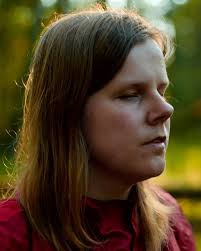
I record the sounds of birds and animals whenever I can in Poland, visiting our huge forests and wetlands.
It was a remote part of the Amazon basin.
First we traveled to Lima and from there to Puerto Maldonado, which is near the border with Bolivia.
And after that, it's four hours by riverboat to the Tambopata Nature Reserve.
My father went with me as a guide because I was born blind.
The thing that struck me especially was the smell of jungle plants, very often sweet in this very, very hot, humid air.
This is our first day in the jungle.
In the morning, We heard the call of the reptile and the monkey.
Beautiful, amazing, majestic sound.
Very, very loud from the depth of the jungle.
Perhaps you may hear they were really close just above us.
It seemed to me that there were perhaps two or three.
And perhaps you may also hear all the background, all the echo, the reverberation that is created when those monkeys start to call.
I wanted to record the Colorado clay lick, the famous clay lick at the Tambopata Nature Reserve.
It is the riverbank where parrots gather almost every day to eat the clay for its sodium content.
I wanted to leave the microphone exactly at the spot where the birds gather.
The most difficult thing for me was the narrow jungle paths through the undergrowth.
Lots of roots, lots of twigs, lots of tree logs.
This was something that made me really uncertain during my first hour.
Our Peruvian guide took the machete and he started cutting through the dense vegetation.
As I'm blind, I cannot visit certain places very often and I try to compensate for that by leaving the microphone for as long as possible.
I decided to leave the recorder at the Kleilich for five days.
The rest of this transcript — segmented and speaker-labeled, so you land on the exact moment something was said
Search every transcript — by keyword, by phrase, or by meaning, across every show Radar indexes
Trends — what is surging across podcasts, measured against its own baseline
Alerts — when a name you follow appears in a newly indexed episode
No account is needed to search Radar.