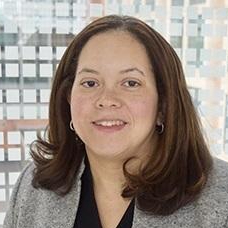
Mercedes CarnethonHost
Tiffany Powell-WileyGuest
Fatima RodriguezGuest
Brad MaronHostUm, I'm turning now to our first guest, who I know well, Dr. Fatima Rodriguez.
In June, a number of cardiovascular organizations, the ACC, AHA, the American Diabetes Association, and the American Society of Nephrology, released the first-ever guideline dedicated entirely to the cardiovascular kidney metabolic syndrome, or the CKM syndrome, and it was co-published in Circulation and JACC.
Uh, we've had the pleasure of working together before at, at Circulation, but welcome back and tell us where you are now.

I'm the section chief of preventive cardiology, and I serve as the vice chair of clinical research for the Department of Medicine.

I focus a lot of my work on cardiovascular prevention, guideline-based care, so really appropriate for this discussion, and use of AI for early detection of atherosclerosis.

And as you mentioned, I served as the vice chair for the CKM guideline alongside a longtime, uh, friend and colleague, Dr. Chiadi Ndumele, who was the lead of the chair for the guideline.
Uh, the CKM guideline flows from the presidential advisory defining the CKM syndrome that was published in 2023, and it essentially retires and expands the 2013 obesity guidelines, if I understand correctly.
What was the gap in clinical practice that made a unified CKM framework necessary rather than continuing to manage these conditions independently?

Yes, exactly as you said, the cardiovascular, kidney, metabolic conditions, they often occur together, yet they are often treated apart, and this is really because of the way we silo our care.

All of these conditions share upstream drivers and the same pathophysiology, which really starts with dysfunctional adiposity.

And we also have now therapeutic convergence across multiple therapies, the GLP-1 receptor agonist, SGLT2s, and nonsteroidal MRAs, just to mention a few, that have benefit across multiple systems and multiple axes, and it really demands having integrated decision-making.

As you said, this expands across the prior obesity guidelines to really focus more on joint management of these conditions and builds on with formal recommendations from the presidential statement in 2023 defining CKM syndrome.

Yeah, that was extremely helpful for me to hear, and thanks for giving, uh, not only a very clear explanation, but also the context that we all need to understand how we've arrived to this point.

I think one of the questions that a lot of clinicians are learning to approach here when thinking about CKM is what the spectrum of this clinical disorder involves.

Now, the guidelines promote a stage zero to stage four framework, and maybe if you can talk a little bit about that, it might be helpful for our audience to hear.

So it's important to think about this really as a framework and not as a label, but a trigger for specific actions.
Um, I'm turning now to our first guest, who I know well, Dr. Fatima Rodriguez.
In June, a number of cardiovascular organizations, the ACC, AHA, the American Diabetes Association, and the American Society of Nephrology, released the first-ever guideline dedicated entirely to the cardiovascular kidney metabolic syndrome, or the CKM syndrome, and it was co-published in Circulation and JACC.
Uh, we've had the pleasure of working together before at, at Circulation, but welcome back and tell us where you are now.

I'm the section chief of preventive cardiology, and I serve as the vice chair of clinical research for the Department of Medicine.

I focus a lot of my work on cardiovascular prevention, guideline-based care, so really appropriate for this discussion, and use of AI for early detection of atherosclerosis.

And as you mentioned, I served as the vice chair for the CKM guideline alongside a longtime, uh, friend and colleague, Dr. Chiadi Ndumele, who was the lead of the chair for the guideline.
Uh, the CKM guideline flows from the presidential advisory defining the CKM syndrome that was published in 2023, and it essentially retires and expands the 2013 obesity guidelines, if I understand correctly.
What was the gap in clinical practice that made a unified CKM framework necessary rather than continuing to manage these conditions independently?

Yes, exactly as you said, the cardiovascular, kidney, metabolic conditions, they often occur together, yet they are often treated apart, and this is really because of the way we silo our care.

All of these conditions share upstream drivers and the same pathophysiology, which really starts with dysfunctional adiposity.

And we also have now therapeutic convergence across multiple therapies, the GLP-1 receptor agonist, SGLT2s, and nonsteroidal MRAs, just to mention a few, that have benefit across multiple systems and multiple axes, and it really demands having integrated decision-making.

As you said, this expands across the prior obesity guidelines to really focus more on joint management of these conditions and builds on with formal recommendations from the presidential statement in 2023 defining CKM syndrome.

Yeah, that was extremely helpful for me to hear, and thanks for giving, uh, not only a very clear explanation, but also the context that we all need to understand how we've arrived to this point.

I think one of the questions that a lot of clinicians are learning to approach here when thinking about CKM is what the spectrum of this clinical disorder involves.

Now, the guidelines promote a stage zero to stage four framework, and maybe if you can talk a little bit about that, it might be helpful for our audience to hear.

So it's important to think about this really as a framework and not as a label, but a trigger for specific actions.
The rest of this transcript — segmented and speaker-labeled, so you land on the exact moment something was said
Search every transcript — by keyword, by phrase, or by meaning, across every show Radar indexes
Trends — what is surging across podcasts, measured against its own baseline
Alerts — when a name you follow appears in a newly indexed episode
No account is needed to search Radar.