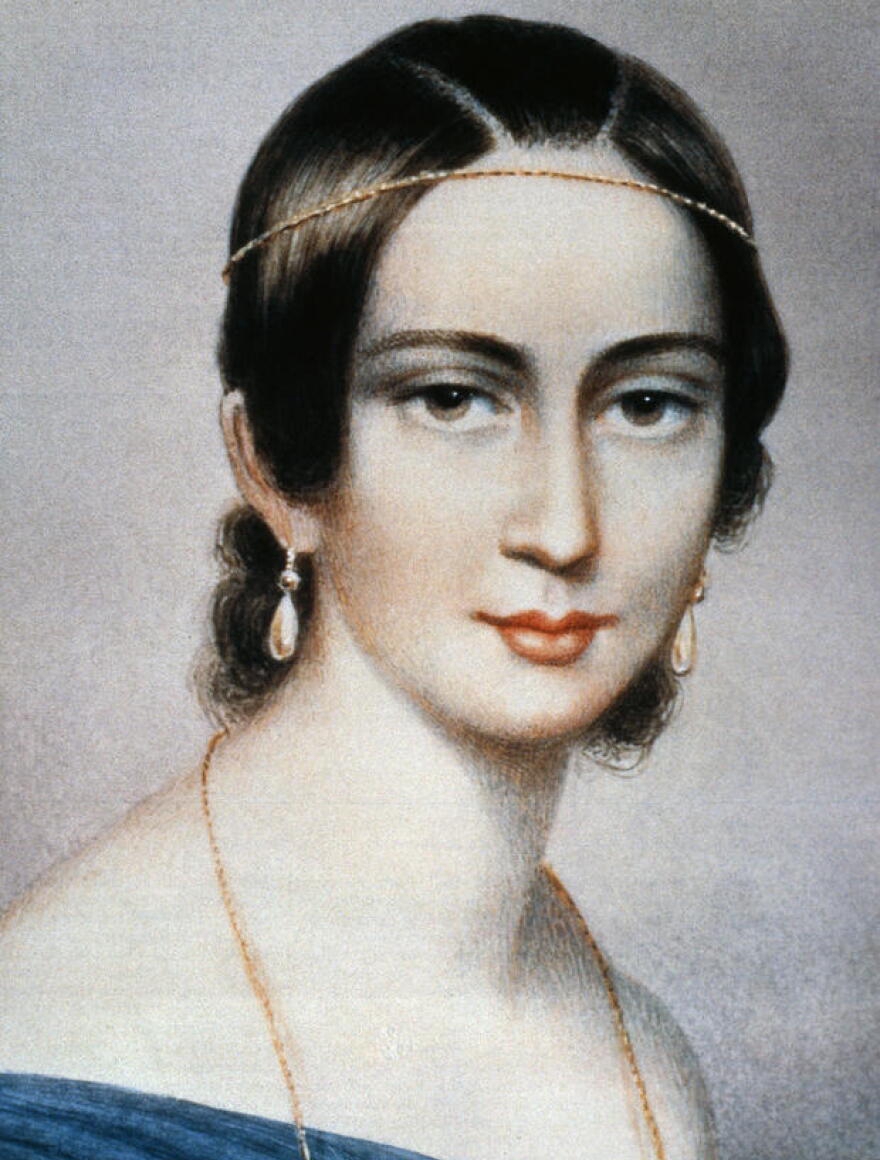
[playing piano] And by the way, this piece represents both Florestan and Eusebius.
[playing piano][piano music] So that was really the first intro work.
Uh, she wrote a mazurka that had the exact opening bars.
In fact, some of the, some of the editions that you find [lips smack] of the, uh, Davidsbündlertänze will have the mazurka as written by Clara Schumann at the end just for reference.
And next we go into a us- pure Eusebius-style work.
This is a very, very almost depressive work, if you think about it.
[piano music] Very spider-like to my ear.
It's in 6/8 time.
It has a very waltz-like feel almost.
It's not quite the same melody at all, but just the feel of it has, it has some kind of mysterious spider-like element to my ear.
So it's, uh, it's pure Eusebius.
The difficulty in playing Schumann often comes with the fact that he transitions from these characters, sometimes within the work, in the piece.
These are a set of discrete pieces.
You could, by all means, play certain pieces out of, out of the work in isolation.
You cannot easily do that with other works like the Humoreske, which is a continuous cycle of pieces, but all kind of melded together.
And Carnaval also is lent well to playing individual pieces if, uh, if obviously, you know, that's your, that's your choice, or, uh, more importantly, if your, if your teacher or your school will allow that.
But, uh, this is, this is the beauty of playing some of these works.
I find that giving these somewhat more song-like works to younger students can be a motivation for them to later wor- l- learn the larger work.
In fact, that's what I did with a few pieces growing up.
I played, um, one or two pieces out of them, and later, when I was at a sufficient level, I went back and learned the rest of it.
And it really gives you an interesting perspective to do that, that you don't get, um, normally.
[playing piano] And by the way, this piece represents both Florestan and Eusebius.
[playing piano][piano music] So that was really the first intro work.
Uh, she wrote a mazurka that had the exact opening bars.
In fact, some of the, some of the editions that you find [lips smack] of the, uh, Davidsbündlertänze will have the mazurka as written by Clara Schumann at the end just for reference.
And next we go into a us- pure Eusebius-style work.
This is a very, very almost depressive work, if you think about it.
[piano music] Very spider-like to my ear.
It's in 6/8 time.
It has a very waltz-like feel almost.
It's not quite the same melody at all, but just the feel of it has, it has some kind of mysterious spider-like element to my ear.
So it's, uh, it's pure Eusebius.
The difficulty in playing Schumann often comes with the fact that he transitions from these characters, sometimes within the work, in the piece.
These are a set of discrete pieces.
You could, by all means, play certain pieces out of, out of the work in isolation.
You cannot easily do that with other works like the Humoreske, which is a continuous cycle of pieces, but all kind of melded together.
And Carnaval also is lent well to playing individual pieces if, uh, if obviously, you know, that's your, that's your choice, or, uh, more importantly, if your, if your teacher or your school will allow that.
But, uh, this is, this is the beauty of playing some of these works.
I find that giving these somewhat more song-like works to younger students can be a motivation for them to later wor- l- learn the larger work.
In fact, that's what I did with a few pieces growing up.
I played, um, one or two pieces out of them, and later, when I was at a sufficient level, I went back and learned the rest of it.
And it really gives you an interesting perspective to do that, that you don't get, um, normally.
The rest of this transcript — segmented and speaker-labeled, so you land on the exact moment something was said
Search every transcript — by keyword, by phrase, or by meaning, across every show Radar indexes
Trends — what is surging across podcasts, measured against its own baseline
Alerts — when a name you follow appears in a newly indexed episode
No account is needed to search Radar.