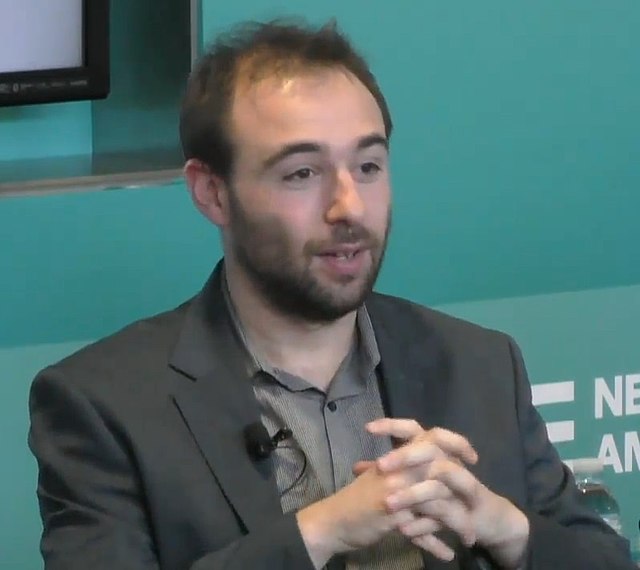
Yascha Mounk
German-American political scientist and academic
11
APPEARANCES
6
PODCASTS
Sep 6, 2026


Jacob SchulzHOST
Yasha, what would you say to that? What would you say to people who make a comment maybe that part of what was at stake here is a referendum on her success and her time in office?

Yascha MounkGUEST
Well, I think it's hard to make the case that that was really what was going on because, you know, those three candidates, one of whom was from within Merkel's own party and, broadly speaking, from within the ideological wing of Merkel's own party, which is to say that he is sort of a moderate within the party.
Yascha MounkGUEST
He's not one of the people who wanted to push the party back towards a more right-wing, more conservative party.
Yascha MounkGUEST
The second was the vice chancellor in her own government, the head of the Social Democratic Party, but somebody who'd worked very closely with Merkel and who in many ways seemed to campaign as a sort of Merkel lookalike.
Yascha MounkGUEST
you know, very calm, not really pushing the policy agenda very actively, somebody who has sort of good judgment, but not a lot of sort of great rhetorical firepower or a lot of desire to sort of be an Obama-like transcendent figure.
Yascha MounkGUEST
And then third, I suppose, was the head of the Green Party who stood for most of a contrast with Merkel, but who themselves actually would have probably liked to enter a coalition with her party under the right circumstances, ideally with them as the senior partner and Merkel's conservatives as a junior partner, and who wasn't overly critical of Merkel's legacy either.
Yascha MounkGUEST
So I think there was actually a broad consensus within the main parties that it's time to move on.
12 MINS LATER
speaker_2ADVERTISER
So I have argued in a piece in The Atlantic a couple of months ago that for the first time in a very long while,

Yascha MounkGUEST
So there's a lot of different questions in there, and I agree with you on part of that, and I disagree with part of it, so, so let me roll through.
Yascha MounkGUEST
So, so the first distinction that is very important as context, as, as you well know, Bret, is the distinction between the content of speech and the time, place, and manner of that kind of speech, right? So I am a free speech absolutist in the sense that I think the content of a speech has to be free.
Yascha MounkGUEST
But of course, that does not mean, and has never meant according to anybody- But the time, place, and manner should be free.
Yascha MounkGUEST
So if you are in the middle of a chemistry class and somebody starts shouting whatever political views, and certainly political views that are offensive, I think the professor is absolutely within their right to say, "We're talking about chemistry here.
6 MINS LATER

Bret StephensHOST
So then at that point, as these campuses become more and more difficult for, especially for Jewish students, 'cause that's what we're talking about here, is there any point at which we say, y- you know, this, this is just-- we've taken this principle too far, and the defense of free speech rights is coming at the expense of a different set of rights for a minority that doesn't need to be exposed to particular forms of speech?

Jeremiah JohnsonHOST
You know, I, I think the media environment has a, a lot to do with this in, in terms of why people are so dissatisfied all the time about everything.
Yascha MounkGUEST
I've, I've had him on the podcast for a couple of conversations, so if people are interested, they should go and, uh, look at those episodes.
Yascha MounkGUEST
I think the, the thing that is quite persuasive in Martin's book is the somewhat nihilistic impact this might have, right? Where, um, the ability of what he calls the periphery of his self-organizing publics, of his people who come together for some cause very quickly, and they might also very quickly dissipate, to take on power, to challenge hierarchies, um, is really strong.
Yascha MounkGUEST
But the ability to actually organize and impose a structure of their own or to, uh, coherently put forward an alternative program is really weak.
Yascha MounkGUEST
And so what you get is this lurching from one thing or another, uh, and, and there's a kind of nihilistic, really carnivalesque, uh, element to it.
14 MINS LATER
Jeremiah JohnsonHOST
I, I don't know if, I don't know if they'll always win, but they will always have an advantage is what I would say.


Yascha MounkGUEST
Um, yes, I think there's, there's, there's two problems with the attempt to import proportional representation to the United States.
Yascha MounkGUEST
Um, the first is that there's simply no good evidence that proportional representation in general, uh, works better, and the second is that without completely scrapping the Constitution and starting from scratch, it wouldn't be possible to use it in the United States.
Yascha MounkGUEST
So on, on the first point, you know, Germany, uh, was for a long time a system whose-Politics worked relatively well.
Yascha MounkGUEST
But of course, there's many countries whose politics was famously incoherent because of proportional representation.
Yascha MounkGUEST
When you look at much of Italy's post-war history, uh, when you look at Israeli democracy, at many other countries around the world that had systems of proportional representation, uh, where you had, as in the case of Italy, more than prime- one prime minister per year because you always had seven, eight different political parties involved in trying to form some kind of governing coalition.
10 MINS LATER


Ron SteslowHOST
And so I wonder, essentially, where did that come from? And, uh, and I think this is a good segue to how we got to the popular version of a lot of the intellectual, uh, uh, thought that you're discussing, and how did it harden into, um, this orthodoxy after the twenty sixteen elections?
Yascha MounkGUEST
There, there are, I think, some origins in some of these traditions for that idea.
Yascha MounkGUEST
There's a, a famous article by, by a critical race theorist about sort of the backpack that you carry and the idea that sort of various forms of oppression, um, sort of a-a-add weight, add load to that backpack.
Yascha MounkGUEST
Um, and so when you have sort of, you know, each identity that you have that is sort of marginalized, um, means that you, you, that you have to walk around with a backpack that's heavier.
Yascha MounkGUEST
Um, but of course, if you, if you, if you simplify it in the kind of ways that you then often see in educational settings or in other settings, it becomes a problem, right? To say that, you know, irrespective of the context, um, you know, you can just add up these identities, and that'll tell you how oppressed, uh, uh, you are, right? And so it might be that somebody who's the child of somebody whose dad is a British aristocrat and whose mother is, you know, a, a, a Brahmin in, in India who grew up very affluent and at the top of, you know, one of the longest standing, uh, social hierarchies in human history and who, you know, comes to the United States to, you know, uh, go to an elite high school and then, you know, to college at, in the Ivy League.
32 MINS LATER
Ron SteslowHOST
Um, can you elaborate on, on why the two are fundamentally incompatible, and what you believe is the solution for a society that seems increasingly fragmented by group identities and sort of obsessed with group identities?
Ron SteslowHOST
So broadly speaking, um, how would you characterize the, the current political moment in America, and what ultimately made you decide to write this book in, you know, in light of the five alarm fire on the right? And how were you thinking about, for example, the idea that writing critically about the left might help the right?
Yascha MounkGUEST
They mean a lot to me because that was a goal that I had in writing this book, to elevate the level of discussion and discourse about this, to actually understand these ideas.
Yascha MounkGUEST
My argument, by the way, is that, uh, as you know, that this is not a form of cultural Marxism, but that's a misunderstanding of the ideology.
Yascha MounkGUEST
It is not the same ideas that have always been part, for example, of a Black political tradition in the United States, uh, in people like Frederick Douglass or the civil rights movement.
Yascha MounkGUEST
It is, in fact, uh, written and conceived in direct opposition, in explicit opposition to many of those ideas.
22 MINS LATER
Ron SteslowHOST
And so at what point did the more modern thinkers like Kimberlé Crenshaw pick up on these ideas and, and when does the arrival of critical race theory happen?
Yascha MounkGUEST
I forget whether that commission has seven people on it or nine people on it, right? But if, if you manage to replace, you know, five of them and have your own guys in there, well, then the electoral commission is going to systematically, uh, try to skew the elections in your favor.
Yascha MounkGUEST
And that's happened in Hungary in, in a number of ways, both with changes to the electoral system, with, you know, fining the opposition parties very large amounts of money for practices in which the governing party also engaged, but somehow wasn't investigated and wasn't fined.
Yascha MounkGUEST
But in the United States, uh, you know, elections are really decentrally administered, and that makes it easy to have chicanery here or there, right? Like, for some local election official somewhere in America to be a weird partisan hack who really doesn't do their duty, um, uh, you know, for, uh, mishaps like the hanging chads in Florida in two thousand, right? Um, because it's, it's a little amateurish, because it's not one big central apparatus.
8 MINS LATER

Yascha MounkGUEST
Why is it a trap? I think we live in a deeply diverse country in the United States.
Yascha MounkGUEST
One of the things that attracts me to living in New York City rather than in Stockholm or Copenhagen or somewhere is the amazing cultural diversity we have, which enriches the city in a million ways.
Yascha MounkGUEST
And I certainly don't share a kind of 1950s, 1960s vision of American identity.
Yascha MounkGUEST
Where to be a good American, you sort of have to become indistinguishable from each other.
14 MINS LATER
Yascha MounkGUEST
There's, there's this kind of sense that, you know, there's sometimes this criticism of the left, it was made a little bit more a few years ago, that the problem with young people today is that they're all these unique little snowflakes, right? I think we are all unique snowflakes.
Yascha MounkGUEST
I think we are all different from each other, even for the six billion human beings in the world, or more than that now, we actually all come with our own idiosyncratic views of the world, and aspirations, and talents, and flaws, and I think that is something we should honor.
Yascha MounkGUEST
I think, weirdly, one of the ways in which this lure fails is that the sense of recognition and of affirmation in the individuality that people actually do, I think, seek, they will never get from this kind of identity politics outlook.
Yascha MounkGUEST
Because all it says is, "You are defined by the intersection of your identities," right? If I know that you're white, and that you're male, and that you're Jewish, and that you're whatever, that will give me who you are.

Yascha MounkGUEST
It's interesting, but I think the experience in the Soviet Union was quite different from the experience that my parents and grandparents had in Poland, because the nature of those states was actually quite different, right? The Soviet Union was a multinational state, and it embraced a form of sort of diversity and a form of sets of quotas and sort of treating citizens on the basis of the national origin.
Yascha MounkGUEST
So you had not just a Soviet passport, but a stipulation of a nationality in that passport.
Yascha MounkGUEST
And so you might be Russian, or you might be Armenian, or you might be Jewish.
Yascha MounkGUEST
Those were kind of thought of as equivalent nationalities within the Soviet Union.
Yascha MounkGUEST
And so there was actually tremendous effort paid to flattering and building up those communities.
28 MINS LATER
Yascha MounkGUEST
It's interesting, but I think the experience in the Soviet Union was quite different from the experience that my parents and grandparents had in Poland because the nature of those states was actually quite different, right? The Soviet Union was a multinational state, and it embraced a form of sort of diversity and a form of sets of quotas and a sort of treating citizens on the basis of the national origin.
Yascha MounkGUEST
So you had not just a Soviet passport, but a stipulation of a nationality in that passport, and so you might be Russian, or you might be Armenian, or you might be Jewish.
Yascha MounkGUEST
Those were kind of thought of as equivalent nationalities within the Soviet Union, and so there was actually tremendous effort paid to flattering and building up those communities.
Yascha MounkGUEST
But then, of course, they were also subordinate, not just to the Soviet state, but to the Russian majority in key ways.
27 MINS LATER