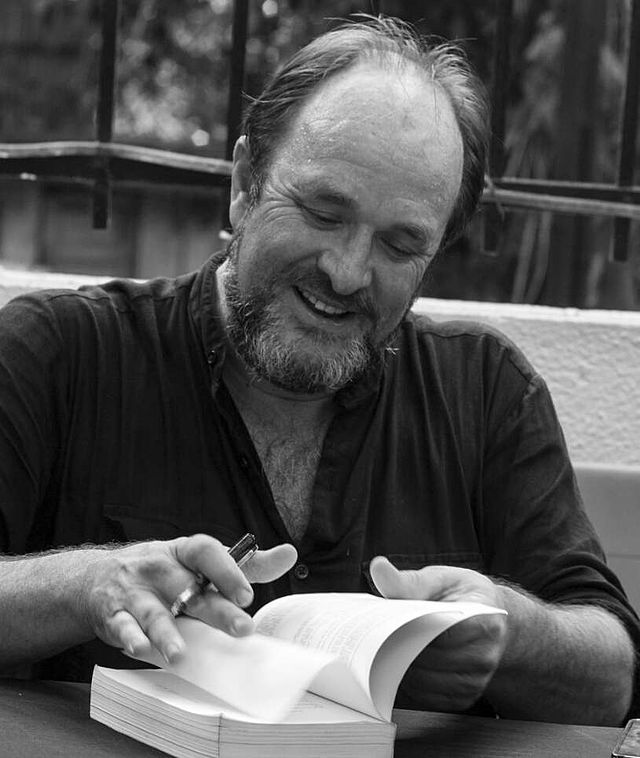
William Dalrymple
Scottish historian
7
APPEARANCES
7
PODCASTS
Jul 5, 2026


William DalrympleGUEST
It's a place that is associated with the, uh, with the god Dagon, who's the, a storm god associated also with cereals and, uh, and fertility.
William DalrympleGUEST
It's referred to, uh, as Ashdudu by the Assyrians in their, their s- uh, uh, stellar, uh, and inscriptions.


Zack PolanskiHOST
Why is this not taught in schools, and what is the benefit of where, when it is taught?
William DalrympleGUEST
I've made this point a lot, and teachers correct me that it is possible to do at A Level modules on the British Empire, that they are available, but they're not core curriculum, and very few people do them, and very few teachers feel equipped to do them.
William DalrympleGUEST
There are schools, particularly in London, with big minority catchments that make a point of doing it, but they are, you know, a tiny proportion of the whole, which means that most British people are entirely ignorant about what is, for better or worse, the most important thing Britain ever did.
William DalrympleGUEST
Britain, through its empire, completely changed the face of the world over about three or four hundred years.
William DalrympleGUEST
Not only did they change it within a sort of local European context, but they completely upended flows of global trade and ecosystems which had existed for millennia.
31 MINS LATER


Charles MalletHOST
And so just as an easy opener, what I would put to you or ask you is, what does it say about British history that outside the Foreign Commonwealth and Development Office sits a statue of Robert Clive of India?
William DalrympleGUEST
I spent the last 25 years writing four books on the East India Company, which is, I suppose, my special subject.
William DalrympleGUEST
They are The Anarchy, White Mughals, Return of a King, and The Last Mughal.
William DalrympleGUEST
And between them, they now appear as a sort of box set of the company quartet.
William DalrympleGUEST
And it's a story which I think is surprisingly little known because I think people tend to think of the... story of British imperialism as being a state enterprise led by the state and the British Army and the Royal Navy and commanded from Downing Street.
William DalrympleGUEST
And I think it's often forgotten that a great deal of the work of empire, and this is not just the case with the British Empire, but it was also the case with the Portuguese and the Dutch and many others, were led by private corporations.
38 MINS LATER
Charles MalletHOST
And I suppose the overlay is what was at that point the intent? Can we work backwards from now in terms of what it is we appear to be seeing Israel trying to do? And can we trace that back to 1917 and beyond? So the...


William DalrympleGUEST
For movable statues, sort of picture, you know, statues of Queen Victoria at major road junctions and stuff, they move them to the outskirts of the city where they create a park.
William DalrympleGUEST
So in Delhi we have Coronation Park, which is the most fascinating place where you can go out to and you see all the viceroys in a great big crescent.
William DalrympleGUEST
And then in non-movable imperial objects, for example, the Mutiny Memorial on the Delhi Ridge, which was a commemoration put up to the British troops who died in the greatest anti-colonial uprising ever, 1857, which...
William DalrympleGUEST
The British call the Sepoy Mutiny and the Indians call the First War of Independence.

speaker_7UNKNOWN
(energetic music)
William DalrympleGUEST
I am one of the hosts of Empire: The Global History Podcast from Goalhanger.
William DalrympleGUEST
You may remember my appearances on The Rest is History when we talked about Afghanistan and the East India Company.
William DalrympleGUEST
As the Ashes return down under, Anita Anand and I have launched a brand new Empire series on the history, politics, and extraordinary cultural power of cricket.
William DalrympleGUEST
In the first episode, we dig into the origin of the Ashes, England versus Australia, a rivalry born in the age of empires and still shaping identity on both sides of the world.


Sean MoncrieffHOST
And while these various powers have had control of it, the native population in Gaza have, it's probably too strong to say, been unaffected by it, but has life gone on continuously?
William DalrympleGUEST
Now, see, this is one of the really important things because it's always been in the vested interest of Israel to deny that the Palestinians have any roots in the land or any continuity to its history.
William DalrympleGUEST
And there are many different distorted versions that try and undo that essential fact.


William DalrympleGUEST
That's th- the really attractive thing at the center of this whole story, is that, uh, many other religions, um, were spread by either colonialism or by outright conquest.
William DalrympleGUEST
The fact that you have the modern Indonesian airline, Garuda, named after the vehicle of, uh, of Vishnu, uh, in- in Hindu mythology, the fact that the largest Hindu temple in the world is not in India but in Cambodia at Angkor Wat, the fact that the largest Buddhist monument in the world is in Borobudur in Java.
William DalrympleGUEST
And there's a whole period of history from about 200, uh, BCE to 1200 AD when Sanskrit has the same role in Asia that, you know, medieval Latin had throughout Europe in- in the Middle Ages or what French was as the international language of diplomacy in the 19th century, the fact that all Tolstoy's characters are speaking to each other in French.
William DalrympleGUEST
If you were in 10th century Java or if you were in Afghanistan in the seventh century, you'd be speaking Sanskrit if you were a courtly, civilized ambassador moving from country to country or if you were a scholar.