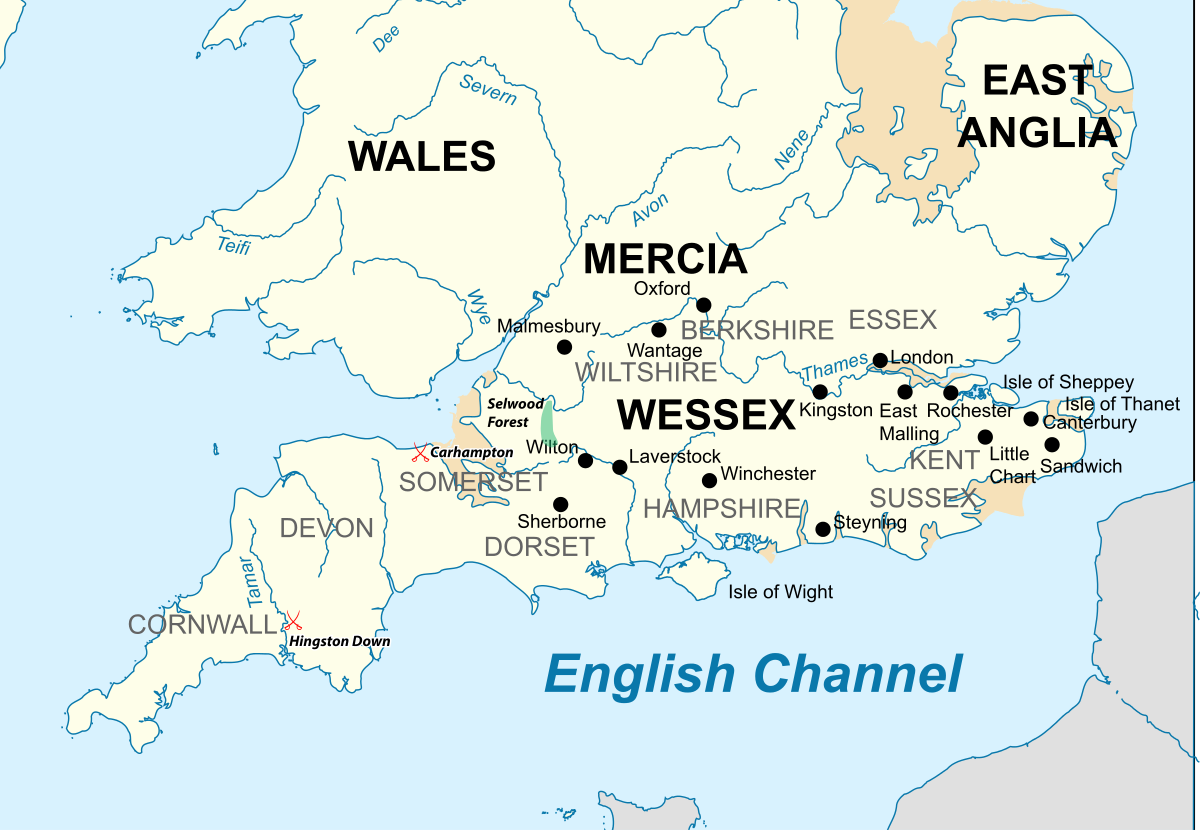
Wessex
414
MENTIONS
81
EPISODES
66
PODCASTS
Search complete. 414 mentions across 81 episodes found for "Wessex".
Nov 1, 2026

Kara SchallenbergNARRATOR
The followers of Ida and Serdic, on the other hand, brought to their settlements in Britain all the superstitions of the Elbe.
Kara SchallenbergNARRATOR
While the German princes who reigned at Paris, Toledo, Arles, and Ravenna listened with reverence to the instructions of bishops, adored the relics of martyrs, and took part eagerly in disputes touching the Nicene theology, the rulers of Wessex and Mercia were still performing savage rites in the temples of Thor and Woden.
Kara SchallenbergNARRATOR
The Continental Kingdoms, which had risen on the ruins of the Western Empire, kept up some intercourse with those eastern provinces where ancient civilization, though slowly fading away under the influence of misgovernment, might still astonish and instruct barbarians, where the court still exhibited the splendor of Diocletian and Constantine.
Kara SchallenbergNARRATOR
where the public buildings were still adorned with the sculptures of polycletus and the paintings of apelles and where laborious pendants themselves destitute of taste sense and spirit could still read and interpret the masterpieces of sophocles of demosthenes and of plato from this communion britain was cut off her shores were to the polished race which dwelt by the bosporus objects of a mysterious horror such as that with which the ionians of the age of homer had regarded the straits of scilia and the city of the lacedragonian cannibals Here was one province of our island which, as Procospius has been told, the ground was covered with serpents, and the air was such that no man could inhale it and live.

Charlie HigsonHOST
But we're also going to step outside the rhyme and I'm going to talk about Edward's older sister, Aethelflaed, who was in many ways as important to this story as Edward.
Charlie HigsonHOST
Just to recap slightly, Britain, England, call it what you will, had been divided up into these various tribal areas, such as Northumbria, Strathclyde, Mercia, Wessex, Kent, East Anglia.
Charlie HigsonHOST
And the rulers of the different regions called themselves kings, but they're not kings really as we would recognise them in the modern sense.
Charlie HigsonHOST
They were more tribal leaders.
Charlie HigsonHOST
There was no sense that these were countries and there was certainly no sense that the whole thing added up to a country, the country of England.
Charlie HigsonHOST
The two most dominant of these areas were Mercia which had been founded by the Angles, the Anglic tribes who had come over from the mainland and Wessex which had been founded by Saxon tribes.
Charlie HigsonHOST
and the two of them had always been fighting for dominance.
Charlie HigsonHOST
At any one time a king from one region might get very strong and take over the other, but then they would die and the king from the other region would get stronger and take things back.

Alice LoxtonHOST
And the people of Britain, they need a hero, someone who can stand up to the terrifying invaders.
Alice LoxtonHOST
And on the stage steps probably the most iconic Anglo-Saxon king, Alfred the Great, King of Wessex.
Ben HendersonHOST
Oh, yeah.
Ben HendersonHOST
I'm very pleased we finally got Alfred on the show.
Ben HendersonHOST
He's obviously famous for promoting things like literacy and education as well as standing up to the Vikings, isn't he?
Alice LoxtonHOST
That's it.
Alice LoxtonHOST
And he became King of Wessex in the year 871.
Alice LoxtonHOST
He was 21 or 22 years old.

Aaron BastaniHOST
But anyway, stuff like that, you know, really joined up infrastructural thinking, I think is really positive.
Aaron BastaniHOST
And another one as well, Michael, is Wessex is back.
Aaron BastaniHOST
Where is Wessex? Wessex is back.
Aaron BastaniHOST
What does Wessex cover? So Wessex, obviously, is the kingdom of Wessex, was the antecedent sort of political entity to the kingdom of England, with Alfred the Great and Æthelred and all these people, right? Just like Piedmont is the kind of antecedent kingdom to the kingdom of Italy.
Aaron BastaniHOST
And then they unite England.
Aaron BastaniHOST
Wessex becomes an earldom.
Aaron BastaniHOST
And then in 1066, it's gone.
Michael WalkerHOST
Yeah.

Adam CoxHOST
I love metaphor and I love history as well.
Adam CoxHOST
And the client that I was working with had ancient family connections to the ancient Wessex counties of Cornwall.
Adam CoxHOST
And there was a real kind of connection to that place in history.
Adam CoxHOST
This particular client had PTSD and hypervigilance and would have difficulty sleeping.

Nathen AminGUEST
But the King, he got his way.
Nathen AminGUEST
And on the 20th of September, 1486, the Tudor Prince was born in a priory in the heart of the former capital of the Kingdom of Wessex and early England.
Nathen AminGUEST
Now, of course, this is Tudor Con.
Nathen AminGUEST
You're not going to be surprised at all to learn that when this boy was born, he was given the name Arthur.

Kevin DeYoungGUEST
This is a different Boniface, sometimes known as Apostle to the Germans.
Kevin DeYoungGUEST
Apostle to the Germans, but he was born in Wessex, England, around 680.
Kevin DeYoungGUEST
So we're squarely in what we call the Middle Ages.
Kevin DeYoungGUEST
At an early age, Winfrith, that was his name.

Mary McGeehanHOST
Where would you like to begin?
Carl VennerstromGUEST
Well, we could begin – so he's from Wessex, which was a kingdom in England.
Carl VennerstromGUEST
It was split up into a number of kingdoms, and he lived from 849 to 899.
Carl VennerstromGUEST
Okay.
Carl VennerstromGUEST
And Wessex and the rest of England was on hard times.
Carl VennerstromGUEST
In the 7th century, a few hundred years prior and then into the 8th century, there was a period of blossoming in England.
Carl VennerstromGUEST
So a number of missionaries have been sent from Rome by Gregory the Great, another great.

Eric LudyHOST
That nickname is going to come hundreds of years later.
Eric LudyHOST
He was just Alfred King of Wessex.
Eric LudyHOST
But how did he become king? And if you go back to the beginning of this series, he is the most unlikely guy to become king.
Eric LudyHOST
Why? Well, there are five kings before him.
Eric LudyHOST
But that's still, it's not going to happen.
Eric LudyHOST
But it did.
Eric LudyHOST
So the extraordinary passing of the five kings of Wessex.
Eric LudyHOST
So listen to what I'm going to call 17 years of tragedy and pain.
71 more episodes mention Wessex.
Create an account to see the whole feed, search across every transcript, and follow the entities you care about.