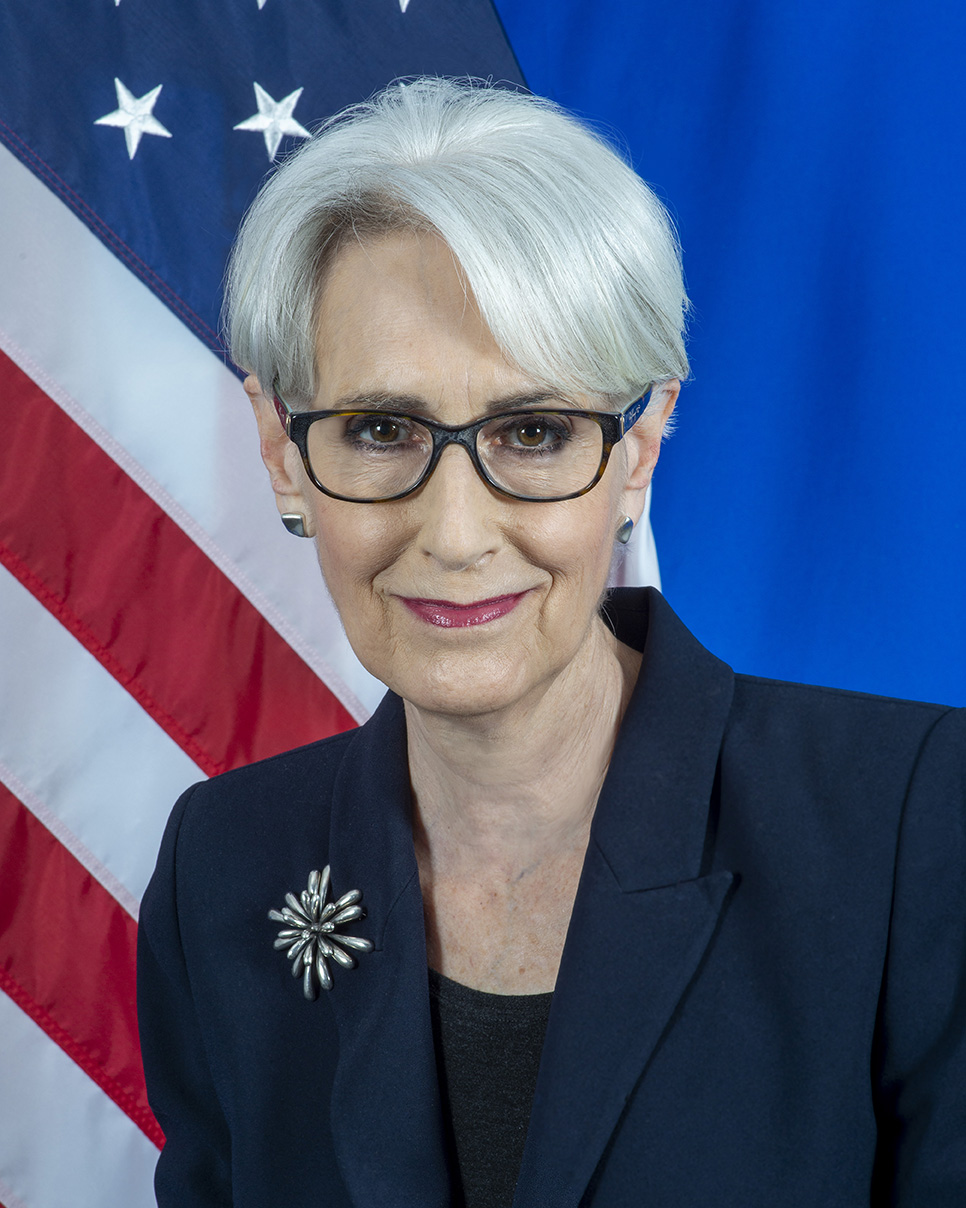
Wendy R. Sherman
Former United States Deputy Secretary of State
45
APPEARANCES
25
PODCASTS
Oct 29, 2026


Wendy ShermanGUEST
You know what, Nick, I actually think it's a bigger question because I think American presidents, Democrat and Republican, we keep making the same mistake, which is we fight for in a way that we think works for the rest of the world without regard to the cultures, the history and the reality of other countries and other places.
Wendy ShermanGUEST
You know, I came of political age during the Vietnam war and I protested that war for quite some time.
Wendy ShermanGUEST
And ultimately it made a difference but we thought we were fighting a conventional war for democracy and the North Vietnamese fought a guerrilla war.
Wendy ShermanGUEST
We applied the same approach in Iraq, the same approach in Afghanistan, the same approach with Iran, without regard to the culture, the history.
18 MINS LATER

Sara JacobsGUEST
But again, in the name of competing with China, we're actually eroding the very things that would be our competitive advantage.

Andre GunawallaHOST
But I mean, on the U.S. side, what were the toughest set of negotiations that you had to take, both with Congress, but also with people and entities in the administration?
Wendy ShermanGUEST
Well, I think in the administration, we had a really good process where everybody was at the table.
Wendy ShermanGUEST
And I was very lucky because the president, Susan Rice, the national security advisor, Secretary Kerry, really gave me the authority I needed to lead the team.
Wendy ShermanGUEST
and we had constant meetings internally within the administration to make sure that we were all on the same page and heading in the same direction.
Andre GunawallaHOST
Is that? And for a younger audience, is that a fact of life in today's politically polarized context? Or has that always sort of been a thing historically, that the opposition has historically sought to undercut some negotiations, some deals and so on back in the 80s, the 50s, the 40s? Or is that just a new thing that we are only dealing with in the 21st century?

24:41

To think that there are certain people who still believe that they can, you know, negotiate and do what you all tried to do for decades, bring peace to that region.
Wendy ShermanGUEST
Yes, I was very, um, heartened [laughs] that there's still people, Israelis and Palestinians, who have hope.
Wendy ShermanGUEST
Um, we all want to have hope to get to peace in the Middle East and peace in the world.
Wendy ShermanGUEST
As you point out, we're living in a time, uh, that I don't think [coughs] any of us quite expected, with the- Putin's, um, illegal and horrific invasion of Ukraine continuing, Ukrainians being extraordinarily resilient and continuing to wage a war against, uh, this horrible leader.
Wendy ShermanGUEST
We hear President Trump saying after the US midterms, uh, he might return to military action using very violent words, uh, annihilation at the UN in his remarks in Baltimore yesterday, talking about, uh, blowing, uh, Iran to hell.
7 MINS LATER
32:40
So where do you think there might be an opening in this current moment, where Iran just keeps escalating, to, to, to end this, and how do you think it's gonna end?

Anderson CooperHOST
Do you think any progress is gonna be made on anything of substance during this visit? Obviously, there's been a lot of focus on, on AI in just the last two weeks.
Wendy ShermanGUEST
I think it'd be fantastic but [laughs] unexpected, and I don't expect it If President Trump and President Xi decided here's how they could each get a Nobel Peace Prize, by coming together on artificial intelligence and really working together to create guardrails.
Wendy ShermanGUEST
It's actually in Xi's interest to do so because he wants stability, particularly as he approaches a year from now when the next five-year plan for the Chinese Communist Party is put in place.
Wendy ShermanGUEST
So stability is critical to him, and he doesn't want artificial intelligence to take over, uh, his desire to not only control China, but ultimately to control the world and replace the United States as the greatest power on Earth.
Wendy ShermanGUEST
I think we might get a hotline, uh, but that might be a hotline between Treasury Secretary Bessent and, uh, Vice Premier, uh, Li Keqiang.
Anderson CooperHOST
It's interesting, though, you think they could get a Nobel Peace Prize if they actually did make some sort of agreement on, on AI.
Anderson CooperHOST
Ambassador Sherman, given this latest move by the president, I mean, do you see any coherent strategy, um, from this administration on Iran right now?
Wendy ShermanGUEST
I see another tactical maneuver out of great frustration on the president's part.
Wendy ShermanGUEST
Uh, the war has increased energy prices for Americans, hurt farmers who rely on fertilizer, um, hurt our hospitals who rely on helium for their MRI machines, and of course, it's stunted the world economy because of the cost of fuel.
Wendy ShermanGUEST
So this is a war of choice by the president that has led nowhere except to reduce our credibility around the world and to put himself in a cul-de-sac and a stalemate where he just tries one tactic after another without a strategy.
Anderson CooperHOST
I mean, given your, your, you know, years of, of dealing with Iran, h- how do you think the Iranians are looking at this, the Iranian leadership is, is looking at this administration?


Joshua YaffaHOST
And I want to talk about, before we get to the formal period, the JCPOA talks that you led, if you could explain in this context and more generally the interplay between informal and formal in diplomacy, why? Why back-channel talks are necessary? Why can't you just get straight down to talking about the real business at hand at a table with the counterparty, right? Why do you have to do this cloak-and-dagger, clandestine series of meetings in third-party capitals? How did that work, and why did that matter in the Iran case, and what may be a larger lesson from that?
Wendy ShermanGUEST
So I'm going to go back one more step, because it's important for all of us to understand that for a decade, Europe... had been talking with Iran and trying to make progress.
Wendy ShermanGUEST
And ultimately, a resolution was passed at the United Nations that said that the high representative of the European Union would lead a negotiation with a P5 plus one, or as Europeans like to say, the E3 plus three.
Wendy ShermanGUEST
So, I want to give tribute to Europe because they understood a great deal about Iran, which they could share with the United States.
Wendy ShermanGUEST
Now, why do we need a back channel? It's very interesting what happened in the case of the United States.
21 MINS LATER
Joshua YaffaHOST
Walk me through the calculations around leverage and credibility in both situations.


Wendy ShermanGUEST
It has been disastrous, not only for the people in the United States, but for people all around the world, and for the people [laughs] in Iran, uh, which is how he started all of this, but their lives are worse, not better.
Wendy ShermanGUEST
Um, so given where we are, I think we are all glad that the Strait of Hormuz is opening.
Wendy ShermanGUEST
I think it's, um, good that they are negotiating, but what is really occurring is not clear because the United States is saying one thing and Iran is saying something else.

Maeve McMahonCORRESPONDENT
And just based on your assessment on what we know so far, on your understanding of the framework of deal, what is your first takeaway, if you like?


Jon FinerHOST
Talk to us about that experience and, and the, what its absence means in terms of the ultimate result.
Wendy ShermanGUEST
I think, um, my favorite was Baghdad, uh, where we, all of the teams got stuck in a sandstorm [laughs] for an extra day.
Wendy ShermanGUEST
Um, look, one of the things that's so striking about how the Trump administration is doing this are two things.
Wendy ShermanGUEST
One, it's really just Kushner and Witkoff, uh, and maybe one or two other people.
34 MINS LATER


Wendy ShermanGUEST
Um, you don't know whether a deal has worked, an agreement has worked, unless you have very, very good monitoring and verification.
Wendy ShermanGUEST
Uh, back in the time of the JCPOA, we had the most extensive monitoring and verification, not only by our intelligence community, but by the Atomic, International Atomic Energy Agency, including electronic means, including people who could go in any place any time and see what was happening, people on the field, on the ground.
Wendy ShermanGUEST
So yeah, if your only answer is we're gonna bomb them again, you may not even know when somebody is cheating on you unless you've got those eyes on the ground all of the time and really, really good verification and monitoring.
30:07
Uh, that's the first time, uh, a president of the United States waging a war has referred to the stock market as the barometer for him about how well his war was going.

Kaitlan CollinsHOST
Why are you backing off your initial goals, Mr. President? My lead source tonight is Ambassador Wendy Sherman, who led the team that negotiated the 2015 nuclear deal with Iran under President O- Obama, and it's great to have you here tonight because now that we've seen the confirmed copy of this agreement that we all saw the president signing tonight at, at Versailles, what are your first thoughts?
Wendy ShermanGUEST
You know, the president said that he wanted unconditional surrender from Iran.
Wendy ShermanGUEST
In fact, looking at this MOU, such as it is, it's really as if the United States is unconditionally surrendering.


Kasie HuntHOST
I mean, what does it tell you that the terms of this memorandum of understanding are still a mystery?
Wendy ShermanGUEST
Well, I think it tells us that they're very nervous about what's in it and how it will be seen.
Wendy ShermanGUEST
My own sense is the president wants this victory lap on Friday when they have a in-person signing with the vice president, ostensibly, and then have the markets and the price of oil go down during the week.
Wendy ShermanGUEST
In the things that have come out that purport to be the agreement It is very broad.
Wendy ShermanGUEST
And it's interesting, Casey, I went back and read the president's speech when he pulled out of the Joint Comprehensive Plan of Action, the ostensibly Iran nuclear deal that I was privileged to be part of negotiating.

Nicolle WallaceHOST
Ambassador Sherman, just tell us what you understand to be the state of play.
Wendy ShermanGUEST
There is a memorandum of understanding ostensibly that is a set of principles in agreement to begin real negotiations, but nobody knows even what the memorandum of understanding is, as you've pointed out, Nicole.
Wendy ShermanGUEST
The Congress doesn't know, the American public doesn't know, [laughs] Israel doesn't know, our Gulf partners don't know, and the G7 that the president is meeting with now don't know either.
Wendy ShermanGUEST
They've been told verbally that everything is fine, the Strait of Hormuz is open, the blockade will go, we'll negotiate an agreement, but there has really been nothing that has happened.
Wendy ShermanGUEST
The president has acted as both the arsonist and the fireman, but there isn't just one fire, and there are lots of embers, and he hasn't really tackled them.
Wendy ShermanGUEST
I absolutely believe [laughs] that this is partly because it's Thursday evening, and as you said, he said the stock market's up a thousand points.
Anderson CooperHOST
... is what you negotiated, what, what was done after years and, and a lot of hard work.

Nicolle WallaceHOST
Um, Ambassador Sherman, let me start with you and your thoughts on these, um, these very notable, as I call them, ride or die allies of Donald Trump, sounding very public alarms about what's been reported about a possible deal.
Wendy ShermanGUEST
I feel like it's a little bit of deja vu because when we were doing [laughs] the, uh, JCPOA, the Joint Comprehensive Plan of Action, better known as the Iran nuclear deal, uh, these were the voices that were saying it is a bad deal.
Wendy ShermanGUEST
Uh, indeed, it was a deal that was quite sustainable for a long time and certainly could have been extended through swift and good negotiations.
Wendy ShermanGUEST
Um, before the president started this war of choice, this ill choice, uh, the Strait of Hormuz was open.
21 MINS LATER
Anderson CooperHOST
Ambassador Sherman, i- if the war ends with a gradual reopening of the strait, potential sanctions relief in return for Iran removing or degrading its highly enriched uranium, what kind of position will the regime be in?
Wendy ShermanGUEST
Well, Anderson, the president clearly decided on a war of choice, I would say ill choice, uh, because as you know, the Strait of Hormuz was open before this war began.
Wendy ShermanGUEST
It is now a key leverage point for Iran, as is, and Ambassador Crocker knows this so much better than I do, uh, we now have Gulf partners and allies, uh, wondering if they're going to be the targets, and even though they wanted to see Iran gone, they now realize they, uh, are drawn into this war, and they'd like it to be over.
Wendy ShermanGUEST
Uh, the president has used a time-honored way to deal with domestic critics as well as try to get somewhere here by speaking about others joining the Abraham Accords.
Wendy ShermanGUEST
When you can't find your way through a difficult situation, and this is a really bad one, you try to open up the aperture to try to change the dynamics.
Wendy ShermanGUEST
All of that said, I think what we're seeing now is all of the parties, the United States, Iran, Israel, uh, taking their last best shots, and none of us really know what's going on behind the scenes, whether the Qataris were actually able to try to move this forward.
Wendy ShermanGUEST
But the final point I want to make, Anderson, is that if the president can get the Strait of Hormuz opened and the blockade over, there is a long way to go to take care of the highly enriched uranium and the lower enriched uranium and to ensure that Iran will never have a nuclear weapon, let alone their missiles, their terror, their support of Hamas, Hezbollah, the Houthis.

Wendy ShermanGUEST
I think President Trump likes to get quick wins, and he thought he could lay down what was necessary, they could agree on the top lines, and he could have that quick win.

Asma KhalidHOST
If that was the case back then, is it your sense, I know they're different people, I know the terrain is different, that Iran also wants a deal or wants a deal as much as the US and this Trump administration wants?


Wendy ShermanGUEST
And you know, as I wrote in the book, he and I became grandparents at the same time.
6 MINS LATER
Anderson CooperHOST
Between the level of distrust, the president bragging about a deal, the Iranian pushback of those remarks, how difficult would it be to have a successful round of negotiations at this point?
6 MINS LATER

Kaitlan CollinsHOST
Ambassador Sherman, what is your take as someone who has spent, uh, a lot of time doing the negotiating on, on a different front with a different team? Um, but what has that, what has that experience taught you about what we're seeing right now?
Wendy ShermanGUEST
Uh, the best that could happen would be a set of principles, and then it would take weeks, probably months, maybe even longer, to actually fill in all of the details because let's say there was an agreement to remove the many thousands of pounds of, uh, about 1,000 pounds of, uh, highly enriched uranium underneath Isfahan.
Wendy ShermanGUEST
How do you enforce it and verify it? Um, there are just lots and lots of technical details to what the president's trying to do.
Kaitlan CollinsHOST
Do you think it's bluster and they're out there actually talking to the United States more seriously behind the scenes? Or what do you hear in the public comments that we've seen today?
Wendy ShermanGUEST
So it's good that when the vice president went with Steve Witkoff and Jared Kushner the first time, he actually brought experts with him.
Wendy ShermanGUEST
Uh, you cannot do this kind of a deal without a team of very seasoned people with a lot of deep expertise because even if you decide on one element, then you have to figure out how you implement it, then you have to figure out how you verify it and monitor it and make sure it happens.
Wendy ShermanGUEST
And if you're trying to do, as the vice president said, a grand bargain, it means you have all of these elements on the table.
Wendy ShermanGUEST
You know, it could be that Iran would say, "We'll give Hezbollah a little less money, but we wanna only suspend enrichment for two years." So it all combines.
Wendy ShermanGUEST
And one of the things I think is quite critical if they go back to the negotiating table, and I hope they do, but not for just 20 hours, it's gonna take days, weeks, probably months to get it all done if it's possible.
5 MINS LATER
Anderson CooperHOST
Um, it sounds like any deal we make now, there's gonna be a lot of money involved as well.
Wendy ShermanGUEST
Um, one, that the Trump administration doesn't realize they could get a deal, but it means actually digging in, bringing experts, putting in the time, putting in the work.
Wendy ShermanGUEST
The second thing, maybe there are three things, the second thing in terms of the blockade is exactly what the Saudis ostensibly are worried about, which is if this goes on for a while, Iran will feel it has to take some action, uh, rather than just suffering more economic harm, which was Trump's intention here, was to create an economic cost for Iran.
Wendy ShermanGUEST
And if Iran feels like it's getting too tough, uh, they will attack our allies and partners.
19:36
"Iran, Iran reaffirms that under no circumstances will Iran ever seek, develop, or acquire any nuclear weapons." That's what you got, and JD Vance so far has gotten nothing.
Wendy ShermanGUEST
Well, Lawrence, um, we are really in a very difficult spot because as Secretary Clinton pointed out, and she really was the secretary who began all of the real negotiating around this by bringing information that John Kerry, who was then Senator Kerry and chair of the Senate Foreign Relations Committee and had gotten word from Oman that Iran was interested in having a bilateral secret channel.
Wendy ShermanGUEST
She went to President Obama, who agreed to give it a try, sent Bill Burns, Jake Sullivan, some others to meet with the Iranians, and that bilateral discussion was brought into a multilateral discussion, which I had the privilege and honor to lead a really terrific team that included nuclear physicists and sanctions experts and lawyers and commerce experts and people from our national labs and energy experts.
Wendy ShermanGUEST
And ultimately, at the end of the negotiations, Secretary Kerry, who knew every single detail of this, as did President Obama, spent 19 days in the Palais Coburg in Vienna, uh, working on this deal.
Wendy ShermanGUEST
Ernie Moniz, our secretary of energy and nuclear physicist, an extraordinary, extraordinary physicist, uh, spent all of that time negotiating this deal.
Wendy ShermanGUEST
And I think what the secretary was really emphasizing here is you have to have strategic patience.
23:21
Uh, and without the, the deal in place, a- after Donald Trump ripped it up, of course, Iran was able to enrich more than that.


Kelly O'DonnellHOST
Where are we on that today, and have the current events changed where Iran sits on this issue?
Wendy ShermanGUEST
So it appears that, uh, the vice president in his press conference after the Islamabad meeting said that the United States put a demand down to end all enrichment, and the Iranians would not agree, in other words, would not capitulate.
Wendy ShermanGUEST
Um, there are some reports out today that the United States asked that Iran not enrich for 20 years, and Iran came back with a single digit.
Wendy ShermanGUEST
Uh, that means there is a negotiation underway, and it would be worthwhile to continue to have those talks and to try to dig into that.
Kelly O'DonnellHOST
And do you see the current blockade strategy that the president, or at least if I don't call it a strategy, this move the president is making, do you think that would be effective in enhancing negotiations, putting more pressure to reach a deal, or is it just a placeholder as we see where this all heads?

Noelle KingHOST
What do you think it would take for the US to get a new deal with Iran right now?
Wendy ShermanGUEST
now?It really depends on what the objectives are for the President of the United States, uh, and for Iran.
Wendy ShermanGUEST
Um, right now what President Trump has said is he wants to make sure Iran doesn't have a nuclear weapon.
Wendy ShermanGUEST
He wants to make sure they don't have missiles or the development of missiles that could reach the United States, that could bring a nuclear weapon our way.
Wendy ShermanGUEST
He wants to stop Iran from funding proxies like Hezbollah and Hamas, the Houthis in Yemen, um, because he thinks they are, create a risk for Israel, who is our ally, and create a risk for all of the countries in the Gulf region.
5 MINS LATER
Noelle KingHOST
Ah

Wendy ShermanGUEST
Well, I think, um, what you've heard from both Brett and Karim is absolutely right.
Wendy ShermanGUEST
Um, we see that we're in much worse shape, and it's a much more hardline regime now than it even was before.
Anderson CooperHOST
So the idea that this is gonna happen in two weeks, I mean, that's just not the Iranian clock.
Scroll for more appearances