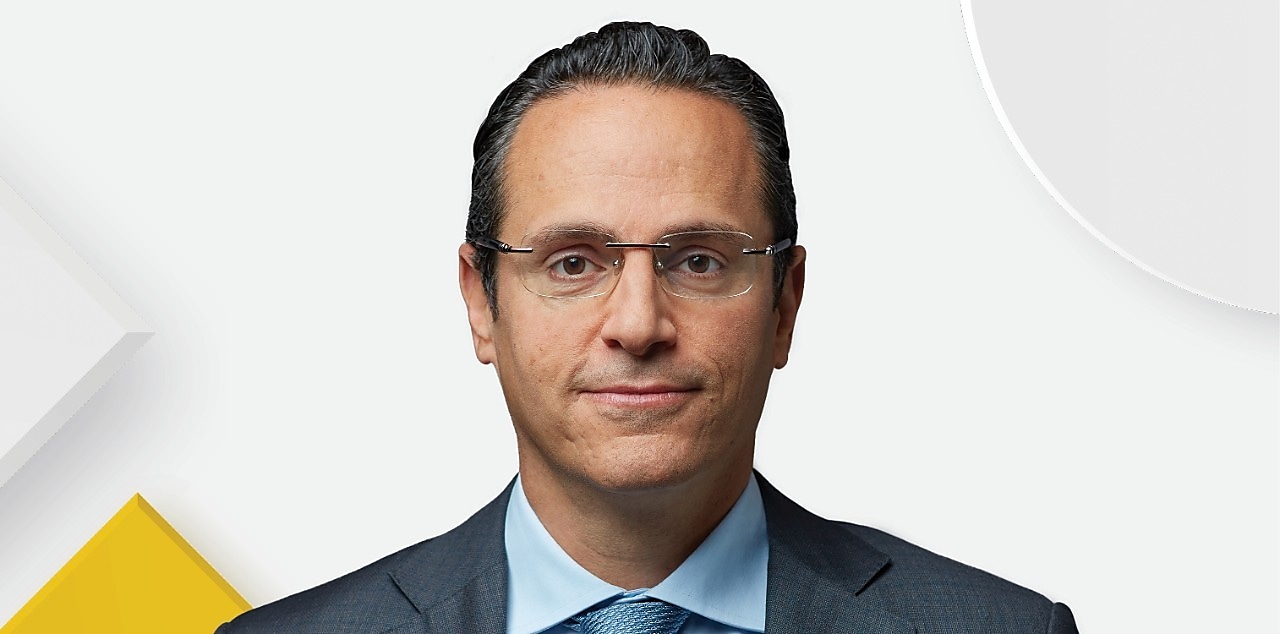
Wael Sawan
CEO of Shell
8
APPEARANCES
6
PODCASTS
Oct 29, 2026

Mike SantoliHOST
While as you look at what the world has had to contend with over the last eight months in terms of supply disruptions and all different countries and industries have had to adapt, do you think it's done anything longer term to the demand curve for petroleum products, whether substitution was accelerated in any way? And of course, working against that, we have all the reserve reductions, which will have to be rebuilt, I guess.

Wael SawanGUEST
So what we see, if I look at our overall marketing business, our retail business, our fuel stations, we're seeing globally a drop of around 5%.
Wael SawanGUEST
It's skewed more, or the drop is more accentuated in Asia where we see almost 10% drop, and that is price sensitive customers responding to that reality.

Sara EisenHOST
And just how much supply is being disrupted by the war in the Middle East, by Iran? I guess I'm just wondering if that ended tomorrow, what would happen to prices and to supply?


Eric VeielHOST
When you got to Shell as CEO after, you know, been at the company for, you know, over 30 years now, what needed to change in your mind when you took the seat at CEO?
Wael SawanGUEST
I started by really looking at the external context first, and then looking at the internal capabilities we have, the portfolio we have, and how are we going to be able to navigate the years ahead.
Wael SawanGUEST
What was becoming clear to me, and this was literally just after the Russian invasion of Ukraine.
Wael SawanGUEST
What I became more and more convinced of is that the energy system was going one way and it was going to be more and more volatile in the years to come.
Wael SawanGUEST
And that was not just because of geopolitically induced volatility, but the very fact that it was going to become a much more varied energy system with more nuclear potentially, we still needed a lot of coal, we still needed oil and gas, we need electricity, everything we can get our hands on.
Wael SawanGUEST
But the intermittency in renewables, for example, the age of the grids, that geopolitical uncertainty all meant that volatility was going to be heightened.
Wael SawanGUEST
And so it convinced me that the core of the company where we truly had a capability in areas like trading, backed by physical infrastructure, we needed to be able to not just hold onto, but we needed to hone and to grow and to strengthen.
13 MINS LATER
Eric VeielHOST
Is that still your current view, and what are the key assumptions that go into that perspective?
Wael SawanGUEST
The real explanation, though, Karl, is that it's been quarter after quarter of focus on relentless performance delivery.
Wael SawanGUEST
We had record performances in every part of our business, whether it was upstream, whether it was, for example, our refining business, which in essence was running at utilization rates of over 100 percent, or our integrated gas business.
Wael SawanGUEST
In addition to that, of course, our world leading trading and supply business could take those molecules and optimize them by selling them into the market at the appropriate prices.

Carl QuintanillaHOST
Finally, is there any reason to think that the Chinese might renew purchases of outright crude?

Ed LudlowHOST
What's your reaction to that? But I think more importantly, what do you think it will do to global oil markets?
Wael SawanGUEST
I mean, very, very early days, and of course, I'll leave it to the UAE leaders and to OPEC to opine on it.
Wael SawanGUEST
What I would say is, you know, OPEC is roughly a third of the overall liquids production of the world.
Wael SawanGUEST
Um, the, the most important influence of OPEC has typically been in who has the spare capacity, and how do they choose to deploy that spare capacity.


Wael SawanGUEST
I think for quite some time, what we had been trying to do is maybe speak to multiple stakeholders.
Wael SawanGUEST
And unfortunately, that can come across as almost being all things to all people.
Wael SawanGUEST
I felt it was really important to one, build our own beliefs around the energy system, really get clear what our role was going to be, and then just say it for what it was.
Wael SawanGUEST
recognizing that not everyone was going to agree with it, that we're always going to have also a small group of avid supporters, and that what was important was for those 80%, 70% in the middle to hear our convictions, and then most importantly, to see us follow through on those convictions.
Wael SawanGUEST
And so what we wanted to do was to position ourselves as a player that is supporting the energy of today while looking forward.
13 MINS LATER


Wael SawanGUEST
Yeah, I'd start, Steve, by saying, actually, coming into the job some three years ago, my mental model was we need to be able to become the best performing, best returning company.
Wael SawanGUEST
So you talked about the first phase, what I'd call phase one of that, the sprint.
Wael SawanGUEST
Today, we've announced that we've taken out over $5 billion of structural costs from the system.
Wael SawanGUEST
We've really shown capital discipline, bringing down the average spend per year from $24 to $21 billion.

Karen TsoHOST
What do you make of the windfall taxes? Is there any sense that this could be negotiated lower? And what do you see in terms of energy policy when it comes to North Sea exploration?

Alix SteelHOST
At what point does BP become so cheap you just cannot avoid looking at them for those synergies?
Wael SawanGUEST
Alex, you'll forgive me if I don't directly answer that question, but what I will say is our focus over the last few years has been to build fitness and strength for Shell.
Wael SawanGUEST
Today, people are asking the question because they see a fitter, stronger, more dynamic company.
Wael SawanGUEST
We've been able to bring our net debt down to essentially the lowest it has been excluding leases for over a decade.
Wael SawanGUEST
We've been able to outperform our peers in the sector on both TSR as well as just pure share performance.
Romaine BostickHOST
Have you actually had a chance to actually meet with anyone from the administration including the president?
Sara EisenHOST
What about Russia-Ukraine? What are your expectations of what's going to happen there? And what's the impact, if any, on your business if they do come up with some sort of deal?
Wael SawanGUEST
From a gas perspective, Europe really needs gas, which is why these LNG flows into Europe matter.
Wael SawanGUEST
And, of course, the sanctions or the potential extension of the sanctions on Russian oil, not to mention Iranian oil, will also create some imbalance in the crude oil markets.
Wael SawanGUEST
We're the largest energy trader in the world, and we're beginning to see some of those disruptions play through.
Wael SawanGUEST
Now, of course, while that creates uncertainty for people depending on oil and gas, for the largest energy trader, it creates opportunities as we look to rebalance those trade flows around the world.
Sara EisenHOST
I just wonder how you are calculating what's going to happen there and what it means for oil and gas production and supply.