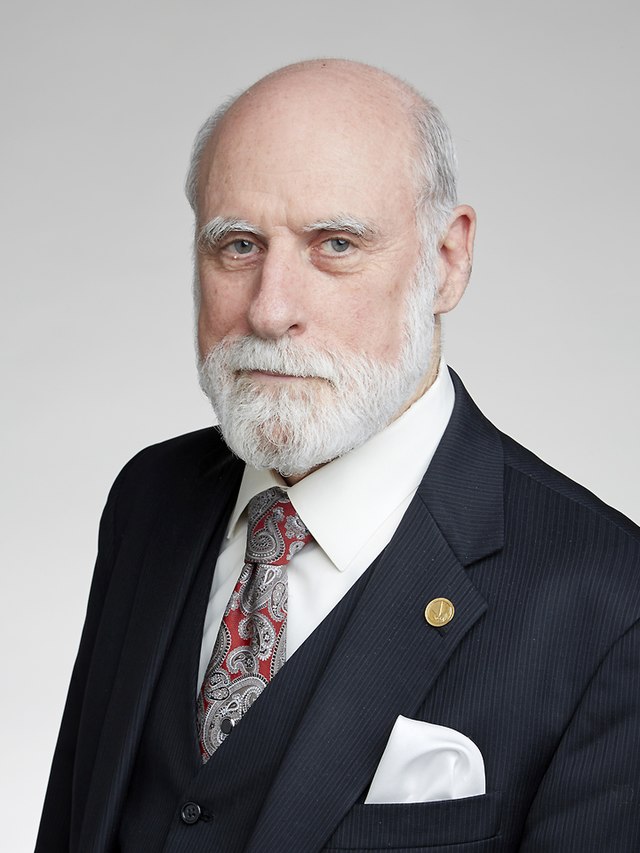
Vint Cerf
American developer
4
APPEARANCES
3
PODCASTS
Sep 25, 2026


Vint CerfGUEST
In fact, Alexander Graham Bell, interestingly enough, was married to a woman who was deaf.
Vint CerfGUEST
But ironically, the telephone was the thing that deaf people couldn't use for a very, very long time until the white-breadth modem came along in the 1960s.
Vint CerfGUEST
It was an off-on-50-baud keyed thing for teletypes that could use modems to talk.
10 MINS LATER
Ray WangHOST
How does our understanding of intent change when we move from deterministic code to probabilistic AI models that sometimes don't always have human in the loop in that chain? I mean, this is more than trying to send the word login and only getting LO, right?
Vint CerfGUEST
It's a little bit like the physics exam at the end of the year that says, describe the universe in 25 words or less.
Vint CerfGUEST
Now, it's true that we had people in the loop, but the networking part was all automated.
17 MINS LATER
Ray WangHOST
So what does that mean? Should we still be worried about this? And how do we build for that verification and veracity of information?


Bill BuchananHOST
AT&T, AT&T were a massive company at the time, and they didn't even want to adopt packet switching because they had invested so much and they just didn't think it was good, but they... small companies was it bbn bbn was one of the first companies to really deploy that packet switch network that's right so we've ended up with a 32-bit uh address field for ip addresses and we obviously have these classifications for the for the subnets a to e why was 32 bits i mean it just seems so small now why was that Wait a
Vint CerfGUEST
And first of all, this is an experiment, right? How many networks were there at the time? Well, let's see.
7 MINS LATER
Bill BuchananHOST
Are there any fields in IP and TCP that you regret adding and ones that you wish you had added?

Ray WangHOST
And when we go back and we look back 56 years after the first four nodes of ARPANET were set up, and you can remind us where the first four nodes were, where do you think the future of the internet is headed, especially in this age of AI and in terms of this world of de-globalization?
Vint CerfGUEST
You know, questions like that, Ray, are kind of like the final exam in the physics class.
Vint CerfGUEST
Give three examples, right? First of all, we are increasing our capacity in the internet world to move data around.
Vint CerfGUEST
A standard data ray speed or transmission speed now on the optical fibers It's 400 gigabits a second per optical channel.
Vint CerfGUEST
And it's so hard to imagine how could we possibly need to send stuff at that speed and with that much capacity.
13 MINS LATER
