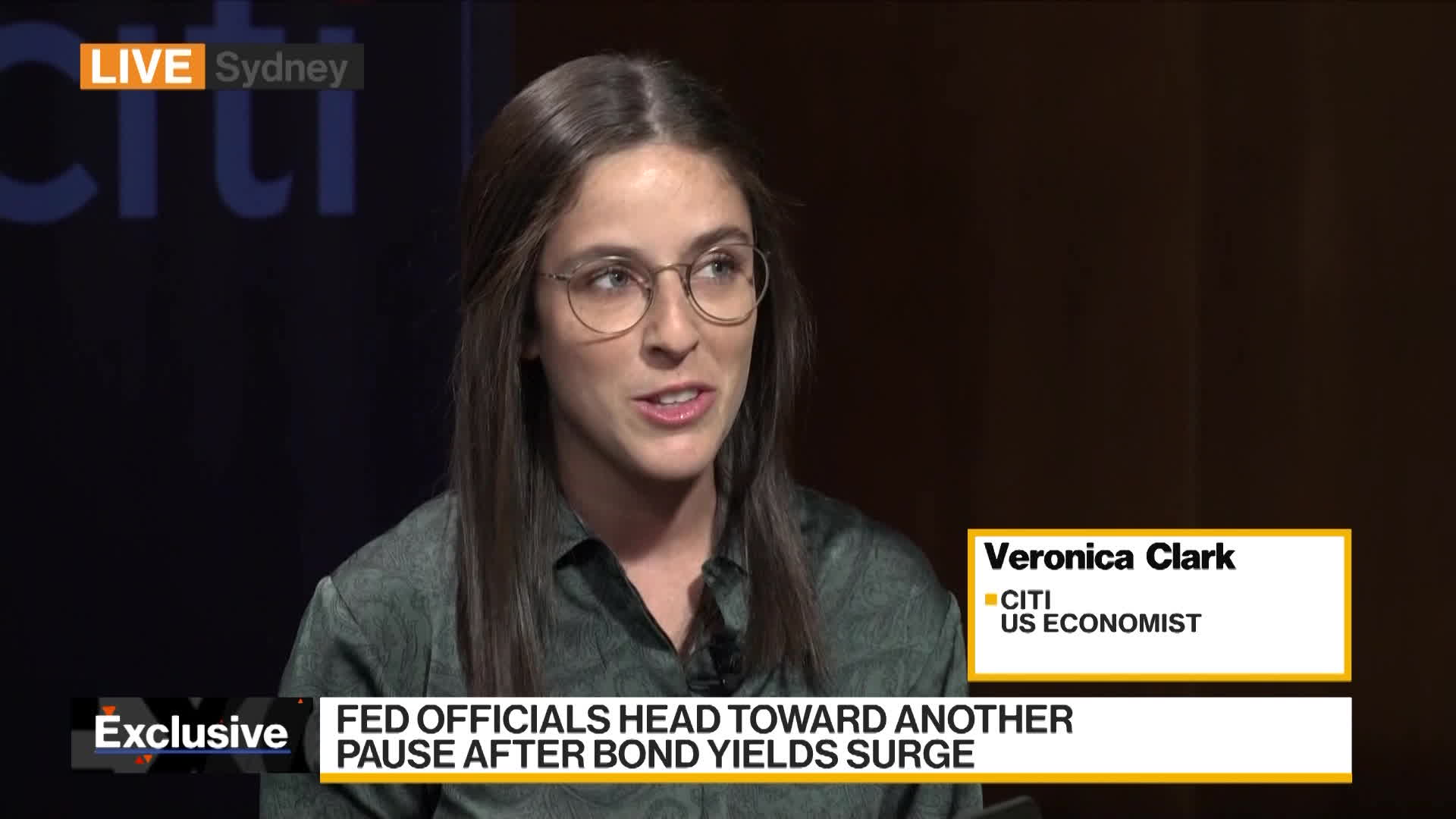
Veronica Clark
21
APPEARANCES
7
PODCASTS
Jul 23, 2026

Rob RoweHOST
And I think the way we'll do this is in six months to a year, After we've been through all the committees and we've done everything, what does the new Warsh Fed look like? What is it going to have? How much forward guidance can we depend on? Will we have a new inflation model? How is this whole thing going to look?
Veronica ClarkGUEST
I mean, we really don't know at this stage, right? I think everyone has kind of gotten comfortable with this lack of knowing for now.
Veronica ClarkGUEST
And the very first thing I think that we learned is that we really should not expect anything in terms of forward guidance from him.
9 MINS LATER


Tom KeeneHOST
What have you changed in your view? What, what's, like, June busting out all over for Citigroup?

Veronica ClarkGUEST
Um, I still think this is a really fragile labor market, not really comfortable with some of the seeming stability that we've seen in some data.
Veronica ClarkGUEST
Um, still think that we'll see a rise in unemployment rate as we get into the summer.
Veronica ClarkGUEST
Obviously, there are new inflation shocks, but the pass-through to core looks pretty limited.
Veronica ClarkGUEST
The types of drivers of inflation that the Fed would care about, a too-tight labor market or housing, is... it's really not there.

Veronica ClarkGUEST
[laughs] No, it definitely, you know, to get 75 basis points, we gotta get any cuts at all, it does have to start with the labor market data, right? Um, and right now, yeah, nothing really looks like it's breaking in the labor market.
Lisa AbramowiczHOST
if prices remain where they are right now f- in the energy complex, we can maintain this level of activity, and frankly, that becomes more inflationary than it does b- suppressive of growth?
Veronica ClarkGUEST
Yeah, the, the earnings and the survey data and these anecdotes, they're, they're interesting, um, but it's always kinda hard to translate those to, to macro forecasts, you know, aggregate data.
Veronica ClarkGUEST
Um, I mean, if anything, in some cases, it seems like earnings are stronger because of job losses and cutting costs that way.
Veronica ClarkGUEST
Um, what we've seen in the actual spending data the last few months or so is, yes, consumption is very resilient.
speaker_3ADVERTISER
Find an independent agent at cinfin.com.
Veronica ClarkGUEST
Yeah, in, in all of this data this week, there's really nothing to change Chair Powell's view.
Veronica ClarkGUEST
Um, but there's nothing really in, in any of this to change their view of rates on hold for now.
Veronica ClarkGUEST
Um, but I do think this is, you know, in terms of their dual mandate, a labor market that's moving in the wrong direction and inflation that's moving in the right direction, and, and I do think they'll be cutting later this year.
Tom KeeneHOST
I guess, how does a util- [chuckles] how does a utility bill that we're getting coming in, how's that going to affect inflation?

Veronica ClarkGUEST
Really? Yeah, so we are penciling in another cut in January, another one in March.
Veronica ClarkGUEST
And it's just this kind of idea that you've clearly gotten more concerned on the labor market side of your mandate if the unemployment rate is something like 4.7 that we think we'll see in December.
Veronica ClarkGUEST
We will have hopefully more inflation data by March that we trust again, early 2026 data.
Veronica ClarkGUEST
If you're seeing inflation slowing and data that you believe again, and you're less concerned on the inflation side of the mandate, you're more concerned on employment, why wouldn't you be at, the midpoint of neutral, which would be cuts in January and March to get
Lisa AbromowiczHOST
The counter argument is if you get rate cuts, potentially two by the end of March, at the same time that you have the one big beautiful bill, the tax refunds and potentially an additional $2,000 stimulus or whatever else might be coming down the pike, don't you risk
Veronica ClarkGUEST
reigniting inflation that never died? Yeah, I'm not so concerned about that right now.
speaker_8HOST
Really?
Veronica ClarkGUEST
Um, and it's just this kind of idea that you have clearly gotten more concerned on the labor market side of your mandate if the unemployment rate is something like 4.7% that we think we'll, we'll see in December.
Veronica ClarkGUEST
Um, we will have, hopefully, more inflation data by March that we trust again, you know, early, you know, 2026 data.
Veronica ClarkGUEST
Um, if you're seeing inflation slowing and, and data that you believe again, and you're less concerned on in- the inflation side of the mandate, you're more concerned on employment, why wouldn't you be at the midpoint of neutral, which would be cuts in January and March to get you there?
speaker_8HOST
... don't you risk reigniting inflation that never died?

Frank HollandHOST
But if goods are going up across the board and people are being laid off, doesn't that set us up for a pretty significant or at least the potential of a significant slowdown?
Veronica ClarkGUEST
And those do tend to be very dependent on wage trends, which, of course, would be dependent on, you know, is the labor market weakening more? Is labor demand loosening? And we did have the employment cost index data out last week for Q3.
Frank HollandHOST
We have to see other companies doing it to maintain the kind of growth that would be seen.
Veronica ClarkGUEST
Yeah, I mean, relative to how we were forecasting the tariff pass through maybe six months ago, though, I think for, for most people, we have been surprised that we haven't seen more pass through it at this point.
Veronica ClarkGUEST
And I think that unfortunately does speak to consumers just can't handle these big one-time kind of price increases.
Veronica ClarkGUEST
It has to be spread out over many months, which could give the appearance that, yeah, inflation is maybe a bit sticky, um, but it's still that softer demand backdrop that means you can't pass on these big price increases all at once, so yeah.
Jonathan FerroHOST
Does that give you and the team pause, that maybe the labor market's not as bad as you and some of the doves on the committee thinks it is?
Veronica ClarkGUEST
We're getting into the time of year which this happened last year also, where there is this residual seasonality pattern in the data where, you know, we had the weakness in summer 2024 and then things seemed to stabilize.

Veronica ClarkGUEST
And there definitely is this divide among Fed officials, kind of like there's the divide in the market where there is the group that.
Veronica ClarkGUEST
But then there's a group of officials that are still more concerned on the stickiness to inflation.


Julie HymanHOST
And at a time where we don't have the government stats, we do have other surveys, right? So what's your assessment of the jobs market in absence of having the official numbers?
Veronica ClarkGUEST
Yeah, I think this is a labor market that has been gradually weakening for a while.
Veronica ClarkGUEST
Obviously, that got a lot more obvious in the official labor market data over the summer.
Veronica ClarkGUEST
That's never a great indicator for the official data in any given month, but it certainly showed more weakness in September.
Veronica ClarkGUEST
We experienced this last summer and there was some stability as we got to the fall, but If this low hiring environment has been the case for a while, I don't really see reason for it to get better.
Julie HymanHOST
When we've seen these kinds of shifts before in reliance on one particular industry, how does that usually play out and how do we think it's going to play out this time?
speaker_4UNKNOWN
If they're saying look through it, then basically the market is only gonna be focused on what, the labor market?
Veronica ClarkGUEST
Um, and th- and there definitely, you know, can be some stronger inflation scenarios.
Veronica ClarkGUEST
Um, but I do think it's probably the case that, you know, demand is soft enough to so you're not really getting these big price increases all at once.
Veronica ClarkGUEST
Um, this could be somewhat drawn out, and that comes down to the demand backdrop, which is the labor market.
Veronica ClarkGUEST
Um, if the labor market is slowing, that's what they're gonna be more, much more focused on.
Jonathan FerroHOST
Which begs the question, if you're not gonna get it through adjusting short term rates, do you have to get it through other means?
Veronica ClarkGUEST
I think the main debate among everyone watching the labor market data right now is, is this, you know, some weakening demand underlying this or is this just an immigration story? We've had a slowing in population growth and that breakeven pace of payroll job growth is lower, I'm sure.
Veronica ClarkGUEST
Um, but I think in the details of the data, there are a lot of worrying things that this is more than just immigration.
Veronica ClarkGUEST
This is a weak demand story and I would look to, you know, a lot of the decline in participation has been discouraged workers.

Veronica ClarkGUEST
Yeah, it's a very tricky situation, of course, and seeing a stronger inflation data can, of course, be uncomfortable.
Veronica ClarkGUEST
But it is interesting that the Fed is going into this tariff inflation period expecting that tariff inflation will be transitory.
Veronica ClarkGUEST
You know, if growth is much softer, then, yeah, you'll see goods prices increase, but you won't see the spillover necessarily to services.
Veronica ClarkGUEST
Obviously, long-run inflation expectations will be an important part of that.
Nathan HagerHOST
What should the bigger focus be for the Fed's dual mandate, maximum employment or the inflation outlook, given these new tariffs? And we've got about a minute left.
Frank HollandHOST
If it comes in in line, what does that mean for the Fed if we get that 2.7 that represents a slight tick up?
Veronica ClarkGUEST
The Fed actually thinks that this February core inflation reading will be at 2.8%.
Veronica ClarkGUEST
So if we do get the consensus 2.7%, that's actually a bit better than what Fed officials have maybe been penciling in.
Veronica ClarkGUEST
Now, none of this inflation reading is usually a surprise we know most of it already from the CPI and the PPI data- and we did see that stickiness to inflation to start the year- that's not necessarily so surprising we saw that in January and February last year- the big question is as we're getting into the spring and summer how much do those tariffs now start to show up.
Frank HollandHOST
though? Is that a market mover at this point? I mean, can't we kind of factor in the idea that tariffs are making prices higher and maybe nobody has a great read on it? Because certainly when we talk or hear from CEOs, they say it's just really hard to figure this all out.
Veronica ClarkGUEST
Yeah, on, on the surface this looked like a jobs report that looks like the last six or seven months.
Veronica ClarkGUEST
We had the unemployment rate staying in that range it's been in, 150,000 jobs, that's, that's fine.
Veronica ClarkGUEST
Um, but it was really the increase in the unemployment rate, so it's still in the range, um, but that occurred alongside a decline in participation, so people may be leaving the labor force.
Veronica ClarkGUEST
Um, unemployment rate would've been even higher, something like 4.4%, if that hadn't happened.
Veronica ClarkGUEST
Um, and then even in the details of, of payrolls, you know, hours worked that are coming down, it doesn't feel like there's a lot of demand for workers right now.
Lisa AbramowiczHOST
How offsides are people in their expectations of the robustness of the US labor market?
Veronica ClarkGUEST
Yeah, we do think we'll see some more slowing in the labor market in February.
Frank HollandHOST
So does that place even more importance on upcoming inflation reports? Or is the Fed still taking a kind of a holistic approach, thinking about the possibility of tariffs and trade policy, maybe even immigration policy and also weighing inflation? Or is it really in your mind just that dual mandate?
Veronica ClarkGUEST
I think for right now, it really is about the labor market and the inflation data.
Veronica ClarkGUEST
We'll see how policy impacts the data of the economy later in the year, I think.
Veronica ClarkGUEST
But for right now, yeah, I think it's really about the next couple inflation readings.
Veronica ClarkGUEST
We'll get a core PC inflation reading tomorrow, which I think should look pretty favorable, something close to 2% on an annualized basis, the monthly reading, that is.
Veronica ClarkGUEST
But as we get into the start of the year, we know that there's some residual seasonality.
Frank HollandHOST
Do you agree? Do you believe that right here is a good place? Or do you think that some of the things we're seeing in the job market, especially hiring, slowing down, the idea that inflation is probably just a bit more stickier than we all thought it was going to be? Do you think there is a need for some type of an adjustment of philosophy for the Fed?
Veronica ClarkGUEST
So we think 120,000 payroll jobs added, which is a bit below consensus expectations, clearly a further slowing.
Veronica ClarkGUEST
But I think the most important part of this Friday's data is that unemployment rate.

Shawna SmithHOST
Is there a risk, Veronica, of that unemployment rate heading even higher? And then I guess what is that signal about some of the weakness that we could see when we start to think about some of the ripple effects across the economy?