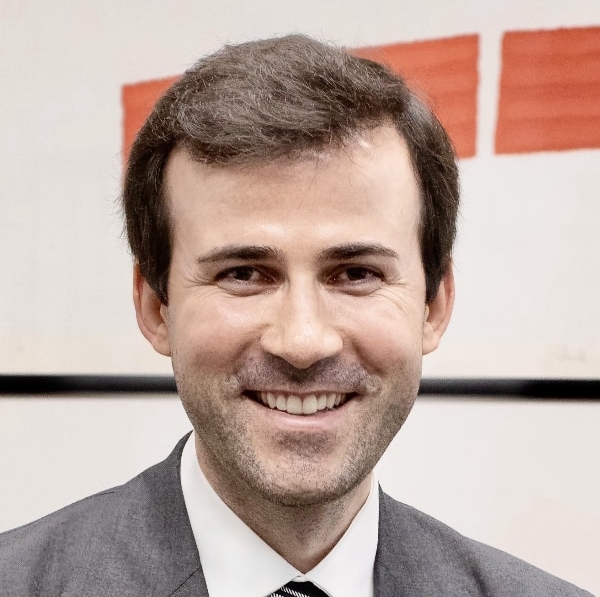
Uljan Sharka
Founder and CEO of Domyn (formerly iGenius), a Milan-based AI unicorn building language models and agents for regulated industries; formerly with Apple.
4
APPEARANCES
4
PODCASTS
Oct 16, 2026


Tom GuinnessHOST
Is this broadly applicable across all verticals? And if so, how big is the market opportunity for a domain?

Uljan SharkaGUEST
I mentioned financial services and advanced manufacturing or industrials more broadly, which are definitely our sweet spots.
Uljan SharkaGUEST
But we're having massive traction also in government, defense, health care, which we haven't started yet, but we can see it being a big one.
Uljan SharkaGUEST
So I think in regulated industries, there is a huge potential for simplification.
Uljan SharkaGUEST
Bureaucracy and compliance is one of the main, I would say, pain points that is withholding these traditional industries to actually innovate and benefit from technology.
Uljan SharkaGUEST
And I don't mean just as a user, because of course they have the best of breed when it comes to tools, but actually putting AI in the product.
Uljan SharkaGUEST
So this is the opportunity that I see more broadly for every industry and every customer out there.
14 MINS LATER
Tom GuinnessHOST
How has customer traction been so far? How many people are using the product? And how is that feeding into a better Domain?


Akash PasrichaHOST
How big a market is this? Uh, d- does it limit you at all? Do you see yourself at all, um, expanding down the line?
Uljan SharkaGUEST
I think sovereign AI need to be demystified to answer that question, I think, in a more precise way because we tend to think of sovereign AI as a borders thing, right? So every country Having their own national champion and then trying to replace, you know, external products with their own version of it.
Uljan SharkaGUEST
We believe in an open market, global market, one where for one economy to win, the others don't have to lose, which means that for us, sovereign AI is more about the ability of organizations, both public and private, to own their future, and that means controlling their data.
Uljan SharkaGUEST
For example, we help these advanced engineering companies or governments in Europe to seal data and AI in a box and use the public cloud as logistics where, you know, the containers are completely encrypted.
Uljan SharkaGUEST
They have the freedom to own them and to move them and to never share, you know, pieces of information with, uh, hyperscalers and, and be sovereign.
Uljan SharkaGUEST
So I think we need to demystify sovereignty at that level, and then the total addressable market becomes huge because of course, if we have to, um, I think count, you know, the number of clients that what need to be sovereign today is every mission-critical use case.
Akash PasrichaHOST
Do you see that to be the same case between the, the relationship between US and, and Europe? Uh, are we seeing more collaboration? What, what's your view on this?

Uljan SharkaGUEST
I think Europe is playing a different game, which we call the third mover advantage.
Uljan SharkaGUEST
So we believe the West does not have an AI strategy, has an AI subscription, and this subscription gets canceled.


Uljan SharkaGUEST
So it was quite obvious to me by interacting with these clients that they were having a problem with this digital divide.
Uljan SharkaGUEST
So the more technology they were introducing in the enterprise, the more people were feeling uncomfortable because they had to learn something additional to their expertise, something new.
Uljan SharkaGUEST
So this clear division between enterprise technology and consumer technology was part of feeding that problem because people were used at home to literally talk with devices.
Uljan SharkaGUEST
Then they were going back to work and they had to learn these very complicated interfaces.
11 MINS LATER