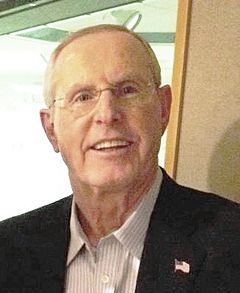
Tom Coughlin
American former football coach
16
APPEARANCES
9
PODCASTS
Nov 10, 2026


Tom CoughlinGUEST
And it's interesting because, according to what I understand, right after the loss last year, to the Bills in the playoffs, Liam walked in the team room and talked about year two, fellas.
20 MINS LATER

Dan HickenHOST
It's incredible what you guys, when you think about what it was just going to be a little golf tournament with you and Fran and, you know, let's, let's have a golf tournament, raise a few bucks and what it's grown to is just phenomenal.

speaker_0HOST
And so can you explain why that is becoming such an important advancement for this next generation of hard disk drives?
Tom CoughlinGUEST
Well, Hammer or heat-assisted magnetic recording is the fundamental means by which we'll be driving additional capacities.
Tom CoughlinGUEST
Seagate is currently shipping hard disk drives over 40 terabyte capacity using this heat-assisted magnetic recording.
Tom CoughlinGUEST
and leads in the technology, I'm guessing, by something like a year, year and a half over, say, Western Digital or Toshiba in terms of the development and actual shipping products.
Tom CoughlinGUEST
Western Digital is using a technology they call ePMR and also more heads and disks to match Seagate's hammer capacities while it qualifies as hammer hard drives.
speaker_0HOST
But what do you think is the most important thing that investors should be watching from the broader storage industry over, say, the next 12 to 18 months?

41:15

From your vantage point, what's going right in Jacksonville? How are we able to see this version of Trevor Lawrence and this version of this team?
10 MINS LATER
Tom CoughlinGUEST
It's like the old story about don't worry about what you did in the last play, let's take care of the next play.
Tom CoughlinGUEST
I don't see it as a, a heavy, you know, oh, it's gonna happen kind of thing that, uh, would disturb the locker room.

Chris CantyHOST
Tell everybody about the event tomorrow night and what the Jay Fund has done here.


Tom CoughlinGUEST
Hey, this is about awareness, okay? And the connection is At the time when Jay was sick, in the spring of 1992, Mike Panos came to me and said, Coach, we have to do something.
Tom CoughlinGUEST
And I said, what are you talking about? He said, we have to help the McGillis family.
Tom CoughlinGUEST
You know, they've They've run to the bedside of Jay, and they don't go to work.
Tom CoughlinGUEST
There's no income coming in, and they're getting in trouble with their bills mounting up, etc., etc.

Austen LaneHOST
In those 31 years of time that you sit back and reflect a little bit, I get there's still a lot of work to do, but in those 31 years, what are some of the moments that stick out the most to you so far in this journey?
Tom CoughlinGUEST
In 1991, I was the head coach of the Boston College Eagles, and I had come from the New York Giants as an assistant, and we had just won Super Bowl XXV in Tampa against the Buffalo Bills.
Tom CoughlinGUEST
And Jay was a tough kid from Brockton, Mass, you know, the home of the champions.
Tom CoughlinGUEST
And so Jay, redheaded Irish kid, you know, I can see him in the offseason program with the cheeks are red as can be, you know, just as he's running around the track and that kind of thing.
6 MINS LATER
Tom CoughlinGUEST
In 1991, I was the head coach, uh, of the Boston College Eagles, and I had come from the New York Giants as an assistant, and we had just won Super Bowl XXV in Tampa against the Buffalo Bills.
Tom CoughlinGUEST
Jay was my starting strong safety, and Jay was a tough kid from Brockton, Mass, you know, the home of the champions.
Tom CoughlinGUEST
Uh, I can see him in the off-season program with the cheeks are red as can be, you know, just as he's running around the track and that kind of thing.
Tom CoughlinGUEST
But we get into the season, and we h- we come back from Syracuse late in the season, and the trainer came to me and said, "I don't think Jay can play this week." I said, "What do you mean he can't play?" He said, "Well, he's got, you know, swollen glands and he's got a running temperature, and we're not sure exactly what it is." And I said, "Well, can we find out so that we, maybe we can get him back in action?" Well, it wasn't the flu, it was leukemia, and it was a shock to our team.

Tom CoughlinGUEST
But Fran Brown, the head coach at Syracuse University, invited me in the spring to spend a few days with him, and I, he invited me this fall.

speaker_5UNKNOWN
We're not at Stevens Point doing two-a-days where the cattle are dying.
Tom CoughlinGUEST
And, of course, the officials are staying in the hotel drinking on our dime.

Jeff ProssrHOST
before the dopper would tell you it's, you know, eight miles away and pull them off the


Andrew MaguireGUEST
Tom, can you give us an idea of how you'd like to start What would you like to start with here?
Thomas CoughlinGUEST
Where's the oxygen mask? So, yeah, as you know, Andy, the whole principle, the vision behind Kinesis was to introduce gold and silver as a form of money in like next generation technologies and to blockchain technologies, efficient medium of exchange married up against, you know, the greatest store of value that the world's ever seen.
Thomas CoughlinGUEST
used as money since human civilizations began and held as value all throughout the ages.
41 MINS LATER
Andrew MaguireGUEST
But I guess the question would be, if someone locks this in, say for a year, for example, because they get the best yield that way, can they lose their gold? Can they lose their real asset? That's the question.

speaker_5UNKNOWN
So, I'm not going to cross
Thomas CoughlinGUEST
And then the income tax changes, you'll recall last year there was a wee bit of a controversy because everyone paying, I think about $115,000 to $120,000, sorry, everyone earning $115,000 to $120,000 a year, they would pay more tax, but everyone under that threshold would pay less.

Francesca RudkinHOST
Could you see them working with Labour on policies like this, with policies like this? I


Tom CoughlinGUEST
Well, when, when I was the head coach at Boston College, my strong safety was a young man by the name of Jay McGillis.
Tom CoughlinGUEST
Uh, he was a great kid, a great teammate, you know, uh, just a humble, solid, solid young man, great in school.
Tom CoughlinGUEST
And, uh, after ten games, we came back, um, and the doctors and trainer came to me and said they didn't think Jay could play the following weekend.
Tom CoughlinGUEST
I said, "Well, what's going on? Why, why can't he play? Can't-- Get the doctors in here.
Tom CoughlinGUEST
Well, when, when I was the head coach at Boston College, my strong safety was a young man by the name of Jay McGillis.
Tom CoughlinGUEST
Uh, he was a great kid, a great teammate, you know, um, just a humble, solid, solid young man, great in school.
Tom CoughlinGUEST
And, uh, after ten games, we came back, um, and the doctors and trainer came to me and said they didn't think Jay could play the following weekend.
Tom CoughlinGUEST
I said, "Well, what's going on? Why, why can't he play? Can't we get the doctors in here? Let's get him treated." He has a temperature.
Chris CantyHOST
I'm curious to know how you've handled... disappointing moments from your players and how you work past that with said player and with your team.
Tom CoughlinGUEST
You can understand the emotion involved, okay? But obviously for a young coach not having gone through the experience of the devastation, you know how important it is, Chris, to win at this level.
Tom CoughlinGUEST
I learned here in New York, and probably the hard way, that our players, If we would lose a game, the media was ferocious in terms of their negativity of the Giants losing.
Tom CoughlinGUEST
You walk a fine line whether you're a parent raising your children or whether you are a coach with your players because you love them, you care for them, but there's a certain standard that they have to meet in order for us to accomplish what we're put forth to do, and in this case, to win.
speaker_11ADVERTISER
have something to do with


Pat McAfeeHOST
Is, is that kind of the idea, the mindset that you have as a coach or GM? Like, "Hey, we got one-day contracts here."
Tom CoughlinGUEST
But you have to understand that, uh, in my belief, and l- and I'm a fan just like you.
Tom CoughlinGUEST
I'm, I'm not in, in any, um, um, office meetings where I listen to how... what their questions are or how they want to go about their business.
Tom CoughlinGUEST
But I do know this, there, there's, there's always a give and take, and something happened in that negotiation that went south.
9 MINS LATER
Boston ConnorHOST
But i- is that a real thing that you have to prepare guys for if they are coming in as rookies or they're coming in as free agents, uh, when you're with the Giants, like, "Hey, this is different here now," or is that kind of more, uh, you know, more of a myth than it is a, uh, real thing that, uh, you guys have to deal with?