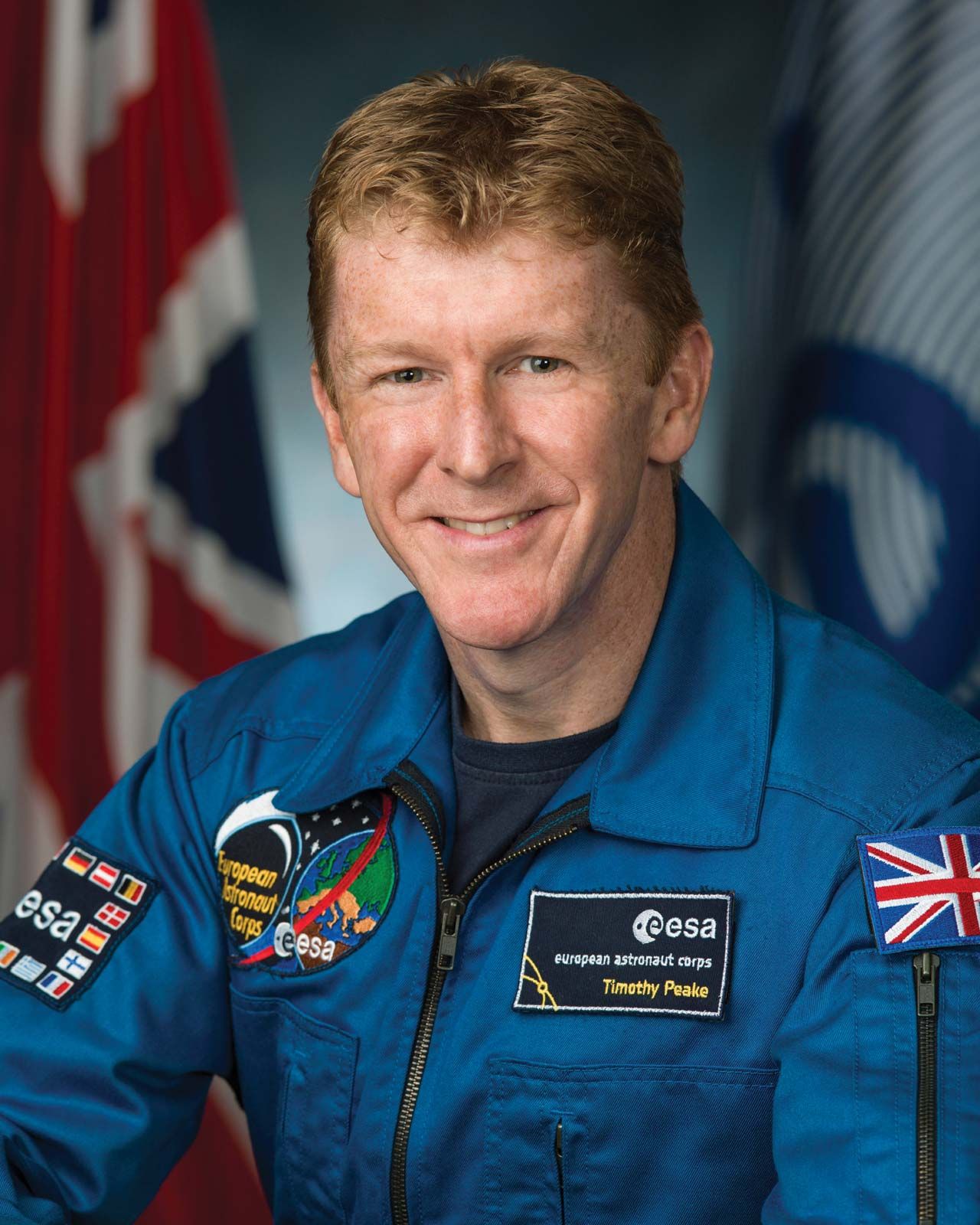
Tim Peake
British astronaut
11
APPEARANCES
10
PODCASTS
Oct 2, 2026

Jonathan DaviesHOST
does there need to be have like a physical big piece of infrastructure where we actually interact across nations to be able to build the right environment to go forward as a humanity rather than just nationally

Tim PeakeGUEST
i think infrastructure does help if you've got a place something somewhere where all nations can contribute to actually building so it's good for industry in those nations whether you're building spacecraft, whether you're building parts of the infrastructure, whether you're providing the science, whether you're providing things like the robotic arm from Canada's point of view, or the logistics supply vehicles.

Jonathan DaviesHOST
But does there need to be have like a physical big piece of infrastructure where we actually interact across nations to be able to build the right environment to go forward as a humanity rather than just nationally?
Tim PeakeGUEST
I think infrastructure does help if you've got a place, something somewhere where all nations can contribute to actually building.
Tim PeakeGUEST
whether you're building spacecraft, whether you're building parts of the infrastructure, whether you're providing the science, whether you're providing things like the robotic arm from Canada's point of view, or the logistics supply vehicles.


Alice BunnHOST
But does there need to be have like a physical big piece of infrastructure where we actually interact across nations to be able to build the right environment to go forward as a humanity rather than just nationally.
Tim PeakeGUEST
I think infrastructure does help if you've got a place, something, somewhere where all nations can contribute to actually building.
Tim PeakeGUEST
So it's good for industry in those nations, whether you're building spacecraft, whether you're building parts of the infrastructure, whether you're providing the science, whether you're providing things like the robotic arm from Canada's point of view, or the logistics supply vehicles.


Tim PeakeGUEST
And, and to put this into context, actually, what we were trying with Artemis I was something new, this, um, skip reentry.
Tim PeakeGUEST
It turns it f- you know, from that sort of 7 G reentry the Apollo astronauts would've experienced to a much more comfortable 4 G reentry.
Tim PeakeGUEST
And you achieve that by dipping into the atmosphere, slowing yourself down a bit.
Tim PeakeGUEST
The spacecraft actually generates a little bit of lift, so you use that lift to come back out of the atmosphere and then go back in a second time, and the whole process is more gentle on the vehicle, it's more gentle on the crew, and it also gives you flexibility to adjust your landing site.
27:26

And back to this Artemis, what, what kind of r-r-results are you looking forward to reading about from the experiments this crew have carried out?

Adam FlemingHOST
Although, Tim, there were a couple of, um, last-minute glitches, weren't there? Glitches that were fixed quite quickly, but nonetheless they were there.
Tim PeakeGUEST
This is the system that would, would be used to actually destroy the rocket in the event that it came off course and caused a danger to the public, and they lost communication, so that was a kinda no-go.
Tim PeakeGUEST
Actually, they ended up using some of the old shuttle hardware [laughs] to repair that.
13 MINS LATER
Adam FlemingHOST
And we will talk about Mars in a second, but Tim, this idea of a permanent moon base, um, just try and sort of paint a picture of what that facility would, would be.

3:47

Tim spent a hundred and eighty-six days on the International Space Station, during which time he conducted a spacewalk, ran a marathon, and performed over two hundred and fifty experiments.
Tim PeakeGUEST
Having lived and worked in space, I know just how extraordinary these missions are, not only for the astronauts, but for everyone on the ground who makes them possible.
Tim PeakeGUEST
Until now, fewer than seven hundred people have had the privilege of going into space.
Tim PeakeGUEST
That number could increase remarkably in the coming years, and Artemis II could well represent the beginning of that new age.

Tim PeakeGUEST
And we thought you might enjoy having a listen to the BBC's Space Podcast that's launching today.
Tim PeakeGUEST
NASA are sending four astronauts on a 10-day trip around the Moon, and our podcast, 13 Minutes presents Artemis 2, is the place to go for all the latest news and updates.
3:04
Tim spent 186 days on the International Space Station, during which time he conducted a spacewalk, ran a marathon, and performed over 250 experiments.
Tim PeakeGUEST
Having lived and worked in space, I know just how extraordinary these missions are, not only for the astronauts, but for everyone on the ground who makes them possible.
Tim PeakeGUEST
That number could increase remarkably in the coming years, and Artemis 2 could well represent the beginning of that new age.

DanHOST
Tim, how do rockets travel to space?
Tim PeakeGUEST
OK, Dan, so some rockets travel just straight up into space and then some rockets travel into orbit where they actually spend long periods of time in space.
Tim PeakeGUEST
If you want to just go straight up and straight back down again, then your rocket has to get to 100 kilometers and it can simply fall back down to Earth.
Tim PeakeGUEST
But if you want to go into orbit, then you have to go up and then you have to get really, really fast.
Tim PeakeGUEST
Now, 25 times the speed of sound is how fast that's 17 and a half thousand miles per hour or 10 times the speed of a bullet.
DanHOST
Is there a joystick? How are you powering yourself around up there?


Nicole StottGUEST
I had the chance to paint while I was there, and it absolutely was one of the personal highlights of my time there.
Tim PeakeGUEST
But there's no better thing to do with your time off than just to go and look at that view of Earth and take photographs.
Nicole StottGUEST
We put together, in an international way, probably the best international cooperation I've seen or heard of ever, defined this higher mission of off the earth for the earth where ultimately everything is about improving life on earth and we came together and we did it we established the rules of engagements and we worked together to make it happen and i'm really really hopeful that people will be able to understand you know this place we've had in space and it'll be carried forward you know in other ways


Tim PeakeGUEST
It was a very hard decision, but I'd, all throughout my military career, certainly in the early days, I'd had to kind of fight against the system a little bit because as an officer, you're expected to do a certain number of jobs that, that pass you up the career chain, and these are more desk-bound jobs than flying jobs, and I was desperate to stay flying.
Tim PeakeGUEST
So that's why I became a helicopter instructor, um, and that's why I became a test pilot.
Tim PeakeGUEST
And I got to the point when I was a, a major, I was finishing my work as a test pilot, and the next job really had to be squadron command.
Tim PeakeGUEST
Um, but that was the point at which I realized, now my career is definitely going to go up the staff route, and I'd be taken away from the cockpit, and I still desperately wanted to fly.
Tim PeakeGUEST
So that's when I made the really difficult decision to continue working as a civilian test pilot with AgustaWestland.
7 MINS LATER