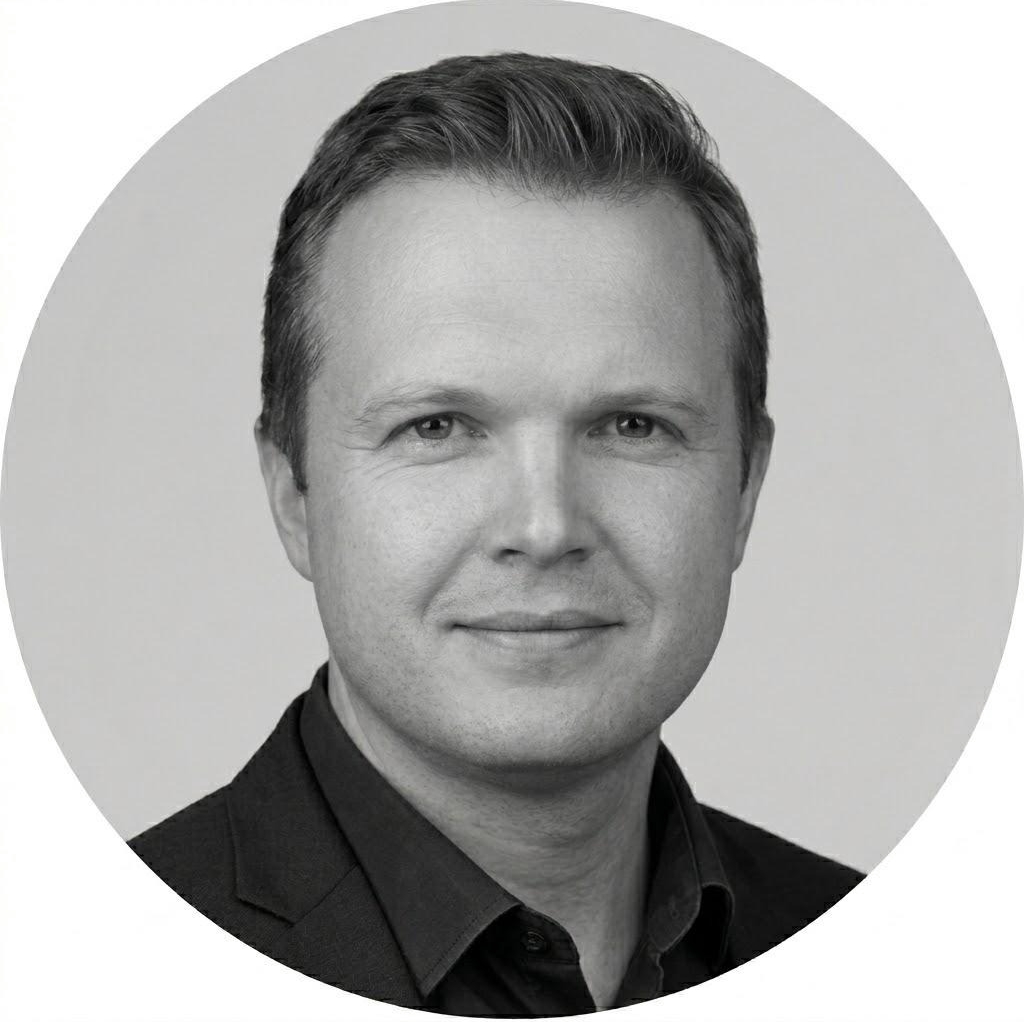
Tim Lidman
Co-founder & CEO of Clyde AI, an AI-native collaboration platform; former Accenture partner and serial tech operator.
15
APPEARANCES
15
PODCASTS
Nov 7, 2026


Chad BurmeisterHOST
So tell me, tell the audience more about what is Clyde AI do and how'd you come up with this idea? Yeah, so it

Tim LidmanGUEST
And what Think Tank was, is it was a collaboration platform that allowed you to, instead of showing up to a client with a myriad of like PowerPoint, Excel, Miro, whiteboards, it allowed you to show up with this one tool that allowed you to go with a client from a problem to an aligned outcome.
Tim LidmanGUEST
And then it had lots of collaborative features based on lots of research into behavioral science around how groups align how they make decisions and so on.
7 MINS LATER
Chad BurmeisterHOST
So thinking about your consultants that you serve and then the end product for the customer, because I like to take a look at does the work that they get served now, is it better, worse, diluted, faster? What's the end deliverable outcome for your customer's customers?

NarbHOST
So just for our audience who might not have a consulting background or work for a consulting firm, What are some of those pains and things that you experienced and kind of led you to starting Clyde?
Tim LidmanGUEST
So it's kind of interesting, you know, that there's a saying in Swedish, it's a bit of a different saying.
Tim LidmanGUEST
I know there's an American equivalent, which is that like the the shoemakers kids has ugly shoes.
Tim LidmanGUEST
I don't know if there's like an equivalent, right? Or where basically the people in the consulting industry that are helping corporates and organizations solve like the hardest problems, right? They they don't get the time to solve their own problems, right? Like they just don't, they don't get the time to internally take care of themselves.
8 MINS LATER
NarbHOST
And it's almost a skill, right? Like to be a good context

8:11
How did you kind of come up with the products for Think Tank, identify the problem, and build it into something? What did it take to get it to the stage where you were confident to try and engage a company like Accenture and ultimately then sell to them?
Tim LidmanGUEST
Yeah, so the Think Tank itself and the idea behind Think Tank was actually rooted in research that went back to right around when I was bored.
Tim LidmanGUEST
So a bunch of researchers had gotten together from a network of universities to really try to understand what is it that when groups of people try to get together and make decisions, what is it that fails, right? So they would research that, you know, politics, hierarchy, egos, extroverts drowning out introverts all kind of get in the way of you know, us humans trying to reach outcomes together.
Tim LidmanGUEST
And so with all that research, one thing that that research had always struggled to do was find its true value, right? And it was always unclear of where could we point that research so that, you know, a group of people are solving a meaningful problem.
Tim LidmanGUEST
And At the same time, this is now going back a few years, consulting was starting to go through their big change journey that they're now on.
Tim LidmanGUEST
It's been massively accelerated with AI, which is that consultings have the same business model for the last 150 years.
Tim LidmanGUEST
And their business model has always been that we're going to take a bunch of smart people and charge them a certain amount per hour for their expertise.
10 MINS LATER
19:49
What do you see, especially in the big consulting firms? What do you see in there? Yeah, so there's

Tim LidmanGUEST
I think the most ethereal answer is I have to, um, but that's, but that's like, that doesn't explain too much.
Tim LidmanGUEST
I think the, the why do it again is, you know, there are moments in time in terms of levels of transformation and disruption that happen in the world.
Tim LidmanGUEST
And if you think about you know, the industrial revolution, right? Let's look at that, right? What happened there? It changed people's work forever, right? Like we automated things to the point where jobs that we didn't know exist became real.
25 MINS LATER
Mark PerkinsHOST
Are those jobs going to be completely eliminated or are the responsibilities required going to be completely reduced, allowing us to really focus on what makes the job, the company, the product for the consumer better?

Lana HoutHOST
Can you tell the listeners a little bit about yourself, your background and Clyde AI?
Tim LidmanGUEST
Originally from Sweden, kind of had an unconventional path to becoming a tech CEO.
6 MINS LATER

4:53
like a background in the development side of things? Or are you just like bringing in developers to build this thing? Because if you're talking 10 or 15 years ago, there was no, let me see if Claude can spin this thing up for me.
Tim LidmanGUEST
No, so I definitely came up through the sales and the go-to-market part of the world.
Tim LidmanGUEST
But then as I sort of became more senior in the sales world, what I realized was that I was extremely product-led and I was really kind of a disguised product guy, right? And I just, I really, really into the product world.
Tim LidmanGUEST
Now, though, I found myself more technical than I've ever been, and I've still never written a line of code.
24 MINS LATER
29:22
So what's your thoughts on that? And how do you kind of think through what AI should do and what humans should do and where to cut those lines off?


Tim LidmanGUEST
Kind of similar, except that a Trello board is – sort of column driven, whereas Miro and these visual canvases are very kind of infinite in that you can put little post-it notes, little comments sort of everywhere and people can start clustering those and sort of collaborate in different ways.
Tim LidmanGUEST
And so back to sort of the point of Clyde being born out of the collaboration space, And I ran a previous startup that was called Think Tank that got acquired by Accenture in 2021.
Tim LidmanGUEST
And what Think Tank was is Think Tank was a, we call it a structured collaboration platform that where like a consulting firm or a client delivery person would, instead of showing up with ideas, Like a myriad of tools like PowerPoint, Excel, you know, whiteboards.
Tim LidmanGUEST
They showed up with this one tool that allowed you to, in a very structured way, collaborate with a client to get from a problem to an outcome, right? Whatever that happened to be.
Tim LidmanGUEST
And so when we got acquired, I operated at Accenture as a partner for about four years.
19 MINS LATER

Tim LidmanGUEST
Kind of similar, except that a Trello board is – sort of column driven, whereas Miro and these visual canvases are very kind of infinite in that you can put little post-it notes, little comments sort of everywhere and people can start clustering those and sort of collaborate in different ways.
Tim LidmanGUEST
And so back to sort of the point of Clyde being born out of the collaboration space, And I ran a previous startup that was called Think Tank that got acquired by Accenture in 2021.
Tim LidmanGUEST
And what Think Tank was is Think Tank was a, we call it a structured collaboration platform that where like a consulting firm or a client delivery person would, instead of showing up with ideas, Like a myriad of tools like PowerPoint, Excel, you know, whiteboards.
Tim LidmanGUEST
They showed up with this one tool that allowed you to, in a very structured way, collaborate with a client to get from a problem to an outcome, right? Whatever that happened to be.
Tim LidmanGUEST
And so when we got acquired, I operated at Accenture as a partner for about four years.
19 MINS LATER


Paul LancasterHOST
So do you, in your own words, do you wanna explain a bit more about what Clyde is and, and, and what, who it's for?
Tim LidmanGUEST
And I think to understand what Clyde is, it, it's helpful to briefly jump back in time to the previous startup that I ran that you mentioned.
Tim LidmanGUEST
Um, and you know, you mentioned something before we [coughs] started recording, which was that, you know, seems to be, you know, a big, big hammer just looking for nails, right? It just seems to be this technology that is constantly searching for use cases as opposed to the other way around.
Tim LidmanGUEST
Um, and, and Clyde very much was born out of the almost the exact opposite of that.

Tim LidmanGUEST
So yeah, now we get to this moment of really bringing sort of me and the whole team from Think Tank into this acquiring firm.
Tim LidmanGUEST
And this was, this was quite the moment because we were a product company, right? A tech led organization moving into a professional services organization.
Tim LidmanGUEST
And Anyone that's in the product or services world knows that it's kind of like oil and vinegar.
Tim LidmanGUEST
And so what I immediately realized was that the team was going to have a very difficult time integrating into this environment.
7 MINS LATER

Bernie BorgesHOST
So why don't you kind of move to the part of your story where like you have some second thoughts and you actually end up leaving?


Steve McGarryHOST
And I think when it comes to the whole timing question, why was it the right time for you guys to exit when you did?
Tim LidmanGUEST
Yeah, I mean, I think there were... a couple of big things that were sort of conflating at the same time.
Tim LidmanGUEST
Um, so I think one, there were some just internal, internal dynamics that, that weren't necessarily market driven.
Tim LidmanGUEST
Um, you know, we had, You know, some lead investors that, you know, had held on to this asset for a number of years that, you know, it was time for their fund to return to their investors.
11 MINS LATER


Tim LidmanGUEST
So Clyde is very much off the back of another startup that I was running that got acquired by Accenture in 2021.
31 MINS LATER

George AHOST
There has to be some kind of flashy, nice tool thing um so you know that it's annoying but it has to be balanced so how do you how do you strike that balance and how do you avoid the product trap


Tim LidmanGUEST
Yeah, I think a helpful way of understanding Clyde is probably also understanding why we created Clyde as a starting point.
Tim LidmanGUEST
And so, you know, Clyde came out of, you know, several years really of working and building, you know, other companies and products sort of led to Clyde.
Tim LidmanGUEST
And so, you know, my first job was, you know, trying to convince people to meet on audio conferences instead of in person, right? And then I sort of grew up through the evolution of how the collaboration industry has been enabling people to work together.


Tim LidmanGUEST
To help you understand what Clyde is, I'll probably start by explaining why we created it, which takes us back to the first startup that I ran.
Tim LidmanGUEST
What Think Tank was is it was a collaboration platform that primarily helped consulting firms drive client engagements and client workshops.
Tim LidmanGUEST
So instead of showing up with a myriad of tools like PowerPoint, Excel, Miro, whiteboards, you would show up with Think Tank, which was a structured collaboration tool that really helped you guide a group of people from ideas to outcomes or challenges to outcomes.
Tim LidmanGUEST
It was based on decades of research in behavioral science and how groups come together to align and make decisions.
Tim LidmanGUEST
And then the product in the UX side of kind of put on top of that research to then create this experience that, you know, if you consider the collaboration industry and its progression, that's an industry I grew up in.
Tim LidmanGUEST
I noticed that there was this shift from just enabling people to connect remotely and to facilitate communication to being much more intentional about collaboration and the outcomes that are intended coming out from that collaboration.
17 MINS LATER

Tim LidmanGUEST
Um, so yeah, I'd love to talk about the, uh, the death of SaaS or, or maybe not the death of SaaS.
Tim LidmanGUEST
But the, to do that, I'll explain just, just a little bit about, um, what I've built in, in Clyde and actually why, why I decided to build it in the first place.
Tim LidmanGUEST
Um, so, so for a little bit of context, um, there was another startup that I ran that was called Think Tank that got acquired by Accenture in, in 2021.
Tim LidmanGUEST
And what's kind of interesting about Think Tank compared to what I've now bu- built in Clyde is Think Tank was, you know, ca- let's call it a classic SaaS platform.
7 MINS LATER

Eric KavanaghHOST
W-what does it actually mean in practice as someone is engaging with the technology?